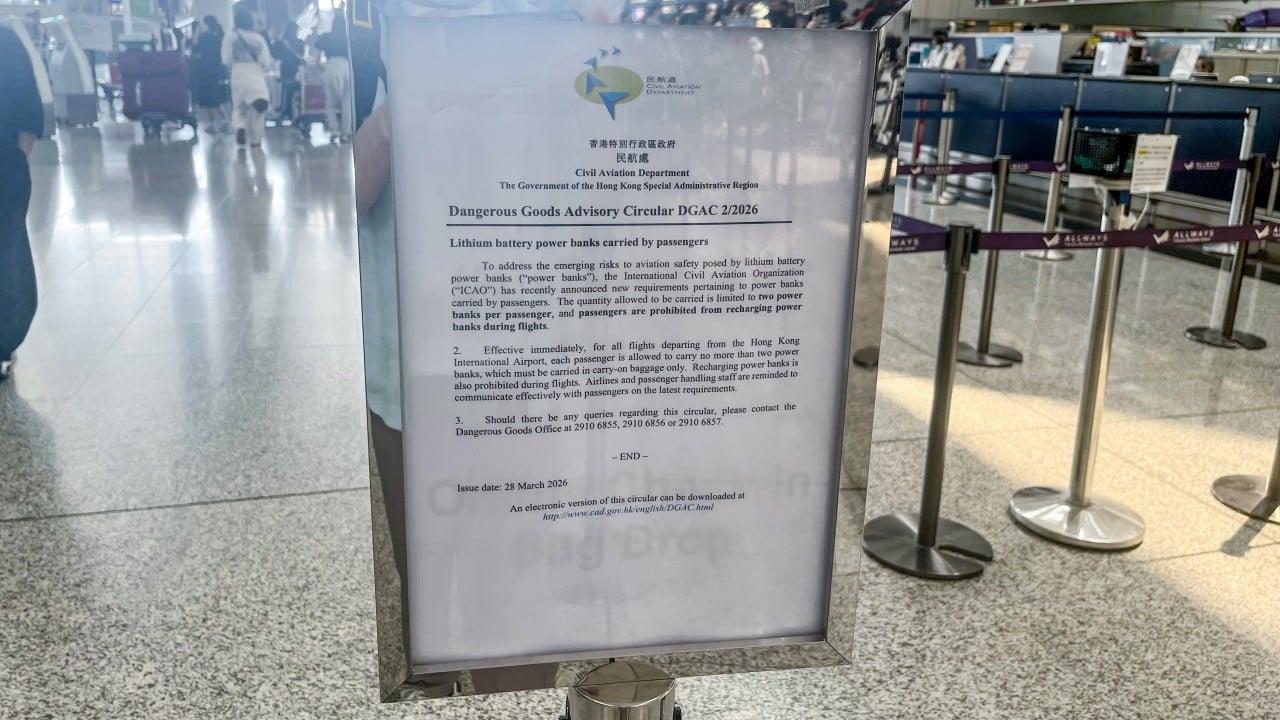
The era of the unlimited portable charger is officially over for travelers passing through Hong Kong International Airport (HKIA). Recent enforcement surges have left passengers scrambling at security checkpoints, forced to abandon expensive hardware or risk missing their flights. While the headlines suggest a sudden shift in policy, the reality is a calculated tightening of existing safety protocols that have been loosely applied for years.
Travelers are now strictly limited to a maximum of two power banks per person. These devices must be carried in cabin baggage and never checked into the hold. More importantly, each device must fall within specific energy capacity limits, typically between 100Wh and 160Wh, with anything over 100Wh requiring prior airline approval. If your power bank lacks a clear, factory-printed label stating its capacity, security will seize it. There is no middle ground.
The Science of the Fire Risk
This isn't bureaucratic theater. Lithium-ion batteries are essentially compact chemical bombs. When a battery undergoes thermal runaway, it generates its own oxygen and heat, creating a fire that is nearly impossible to extinguish with standard cabin equipment.
In the pressurized environment of a cargo hold, a single failing power bank can trigger a chain reaction with other luggage. By forcing these devices into the cabin, regulators ensure that if a fire starts, the flight crew can intervene immediately using specialized fire containment bags. The "limit of two" is a mathematical compromise designed to reduce the total "fuel load" present in the passenger cabin.
The Wh vs mAh Confusion
The most significant hurdle for the average traveler is the measurement unit used by regulators. Most consumers buy power banks based on milliampere-hours (mAh), but aviation law operates on Watt-hours (Wh).
To find your device's rating, you must use a specific formula
$$Wh = \frac{(mAh \times V)}{1000}$$
For a standard 20,000mAh power bank operating at 3.7 volts, the calculation is $$(20000 \times 3.7) / 1000 = 74Wh$$. This fits comfortably under the 100Wh limit. However, the high-capacity "brick" chargers used for laptops often hit the 27,000mAh mark, which pushes the device to roughly 99.9Wh. Any degradation or slight variation in manufacturing can push these devices into the restricted zone, requiring explicit permission from the carrier.
Why Hong Kong is Factoring in Now
Hong Kong serves as a global logistics hub and a primary gateway for electronics manufactured in mainland China. The Civil Aviation Department (CAD) has observed an uptick in "white-label" or counterfeit batteries passing through the terminal. These devices often boast inflated capacities on their packaging while using substandard internal cells that are prone to swelling and short-circuiting.
Security personnel at HKIA have been retrained to spot these discrepancies. They aren't just looking at the number of devices; they are looking for the safety certification marks like CE, UL, or the local HK safety marks. If a device looks weathered, has a bloated casing, or the text has rubbed off the back, it is considered a high-risk item.
The Hidden Logistics of Seizure
What happens to the thousands of watt-hours of energy confiscated every week? At HKIA, once a power bank is surrendered at the security screening point, it is effectively lost. Unlike forgotten belts or umbrellas, lithium batteries are classified as dangerous goods. They cannot be easily stored in a "lost and found" bin due to the fire risk they pose to the airport infrastructure itself.
Most are funneled into specialized hazardous waste streams for recycling. For the traveler, this means a $100 investment in a high-speed charger can vanish in seconds. There is no "mail it home" service available at the security gate.
Navigating the Approval Gray Zone
If you absolutely must carry more than two power banks—perhaps you are a professional photographer or a remote engineer—you cannot simply show up and hope for the best. You must contact your airline at least 48 hours in advance.
Even with airline approval, the final authority rests with the airport security (AVSECO) at the metal detectors. If the security agent deems the total volume of lithium in your bag to be a localized risk, they can override the airline’s permission. This creates a frustrating inconsistency where a traveler might fly out of London or New York with four power banks but find themselves restricted to two during their Hong Kong layover.
The Rise of GaN Technology as a Workaround
Industry analysts suggest that the crackdown will shift consumer behavior toward Gallium Nitride (GaN) wall chargers rather than larger batteries. GaN technology allows for smaller, more efficient plugs that can charge a laptop and phone simultaneously from an airport lounge outlet.
Since these devices do not store energy, they are exempt from the lithium-ion restrictions. The veteran traveler is moving away from carrying a massive battery "reserve" and toward high-speed, multi-port wall adapters that can top up devices quickly during short transits.
Identifying Compliant Hardware
To avoid a confrontation at the gate, inspect your gear today.
- Check the Label: If the Wh or mAh rating is not legible, the device is trash in the eyes of HKIA security.
- The 100Wh Rule: Ensure the total capacity of each individual unit is under 100Wh.
- Cables Matter: Carry high-quality, shielded cables. Poorly made cables can cause a battery to overheat during use, which might draw unwanted attention from cabin crew.
- Tape the Terminals: For spare batteries (not in a power bank casing), tape over the connectors to prevent short circuits.
The friction at Hong Kong International Airport is a precursor to a broader global tightening of passenger electronics. As our devices become more power-hungry and our batteries more dense, the margin for error in the sky disappears. You are no longer just a passenger; you are a courier of volatile materials.
Verify the Watt-hour rating on every piece of hardware in your bag before your next flight to Hong Kong.


