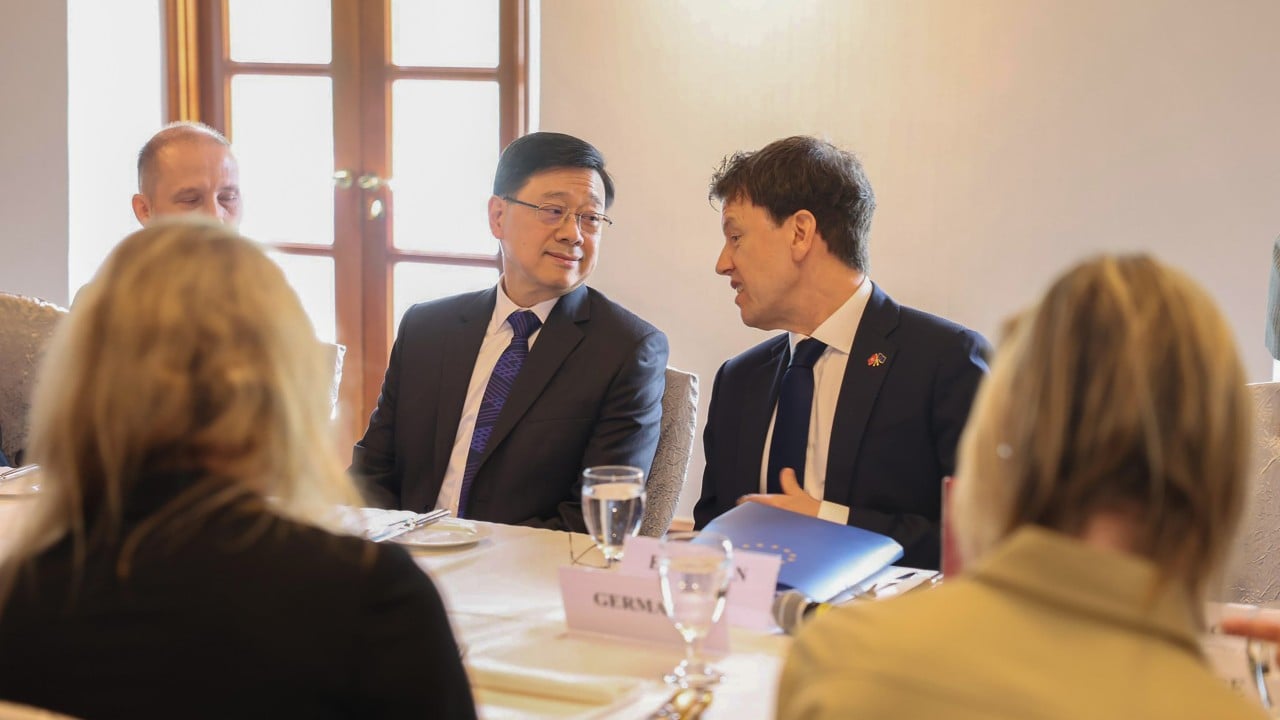
John Lee is currently attempting to sell a version of Hong Kong that many European diplomats no longer recognize. In a series of recent high-level meetings and diplomatic luncheons with European Union officials, the Chief Executive has doubled down on the "super-connector" narrative, promising a city that remains a bastion of free trade despite a rapidly hardening security environment. This charm offensive seeks to stabilize a HK$510 billion trade relationship that is buckling under the weight of political friction and the sweeping implications of Article 23. While the official press releases speak of "deepening collaboration," the reality on the ground is a tense standoff between economic necessity and ideological divergence.
The central tension lies in a fundamental disagreement over what "stability" actually means. For the Hong Kong administration, the Safeguarding National Security Ordinance (SNSO) is the bedrock of a predictable business environment. For the EU, it represents a shift toward an opaque legal system that threatens the very transparency European firms rely on. This isn't just a war of words. It is a structural shift that is forcing European headquarters to reassess whether the city’s unique status is still a competitive advantage or a growing liability. If you found value in this post, you should check out: this related article.
The High Price of the Super Connector Tag
For decades, the deal was simple. European companies used Hong Kong as a low-tax, legally familiar porch from which to step into mainland China. The city provided a buffer. Today, that buffer is thinning. When John Lee met with Harvey Rouse, the head of the EU Office to Hong Kong and Macau, alongside 15 consuls general, the primary objective was to project a return to "business as usual." However, "usual" has been redefined.
The EU remains Hong Kong’s third-largest trading partner, but the composition of that trade is changing. We are seeing a move away from high-level service integration toward a more transactional relationship focused on luxury goods, semiconductors, and machinery. Germany, the Netherlands, and France still lead the pack, but their presence is becoming more defensive. The "super-value-adder" pitch Lee promotes is facing a skeptic audience that is increasingly concerned about data security and the extraterritorial reach of local laws. For another look on this event, see the latest update from The Motley Fool.
Article 23 and the Compliance Crisis
The implementation of Article 23 has introduced a new layer of "gray zone" risk for European firms. While the Hong Kong government insists that the law only targets a "tiny minority," the broad definitions of state secrets and external interference are a nightmare for compliance departments in Brussels and Frankfurt.
Consider the hypothetical example of a European financial analyst conducting a routine deep dive into a state-linked Chinese firm. Under the old rules, this was standard due diligence. Under the new ordinance, if that report is deemed to contain sensitive economic data that "endangers national security," the analyst and the firm could find themselves in a legal vacuum. This ambiguity is the silent killer of investment. It doesn't cause a sudden exodus, but it triggers a slow, quiet "de-risking" where new projects are moved to Singapore or Dubai.
The European Parliament has already signaled its displeasure, passing resolutions that condemn the erosion of the rule of law. The HKSAR government’s response has been characteristically "vehement," dismissing these concerns as "smears" and "hypocritical." This rhetorical tit-for-tat creates a volatile environment for the 1,500 EU companies still operating in the city. They are caught between a local government demanding loyalty and a home parliament demanding adherence to democratic values.
The Divergence of Digital Trade
While John Lee courts European trade, he is simultaneously signing memorandums of understanding with the Cyberspace Administration of China. These agreements, focusing on artificial intelligence and cross-border data flows, aim to integrate Hong Kong more tightly into the mainland’s digital ecosystem. For European tech firms, this is a double-edged sword.
On one hand, easier data flow into the Greater Bay Area is a commercial win. On the other, it aligns Hong Kong’s digital governance with China’s "Great Firewall" philosophy. The EU is currently rolling out its own stringent AI Act and data sovereignty rules. As Hong Kong moves closer to Beijing's digital standards, the friction with EU regulatory frameworks will only increase. We are heading toward a world where a European company may have to choose between two incompatible sets of digital protocols.
The Numbers Behind the Narrative
The trade data for 2024 and 2025 reveals a curious trend. While the total volume of merchandise trade remains high, the "sentiment" indices are dropping.
- EU Exports to HK: Dominated by machinery and high-end manufactured goods (roughly €24 billion).
- EU Imports from HK: Highly concentrated in electronics and re-exports from the mainland.
- Business Outlook: Recent surveys show that more European firms expect the business situation to worsen or stay stagnant than those who expect improvement.
This stagnation suggests that Hong Kong is no longer the growth engine it once was for Europe. It is becoming a "maintenance market"—a place where you keep your existing operations running but hesitate to double down.
Strategic Neutrality or Slow Alignment
The European Union's strategy toward Hong Kong is currently a messy compromise. Member states like Hungary or Greece often favor a softer, commerce-first approach, while the central bureaucracy in Brussels is increasingly hawkish on human rights and security. John Lee is savvy enough to play into these internal divisions, focusing his outreach on bilateral trade benefits that appeal to individual nations.
However, the "free port" status that Lee frequently cites is under threat from more than just local politics. Global protectionism is rising, and the EU is increasingly using "import surveillance" to monitor trade surges. If Hong Kong is seen as merely a "backdoor" for Chinese goods to circumvent EU tariffs—particularly in sectors like electric vehicles or green tech—the city could lose the very trade privileges that make it useful to Beijing.
The Reality of the Exit
There is no "mass flight," but there is a "regional downgrade." European firms are increasingly reclassifying their Hong Kong offices. What was once a "Regional Headquarters" is often being rebranded as a "Local Sales Office." The decision-making power is moving. This shift is subtle, documented in lease renewals and hiring freezes rather than dramatic departures.
The government's focus on attracting "new" markets—such as those in the Middle East and Southeast Asia—is a clear admission that the traditional Western pillars are wobbling. While Lee talks about RCEP membership and pacts with Peru or Bangladesh, these are not replacements for the deep, high-value institutional capital that the EU provides. You cannot swap a German engineering firm's regional hub for a trade pact with Qatar and call it an even trade.
The standoff continues. The EU officials will continue to attend the luncheons, and John Lee will continue to promise a "super-connector" that functions like a Western city but thinks like a mainland one. The fundamental question is whether the European business community can live in the gap between those two realities. For many, the answer is becoming a quiet, calculated "no."
Trade continues, but the trust is gone. Without that, Hong Kong is just another port. It’s a sophisticated one, a wealthy one, but it’s no longer the bridge it claims to be. The bridge is still there, but the toll has become too high for many to pay.
The city must decide if it wants to be the world's window into China or China's mirror to the world. You cannot be both in this climate.