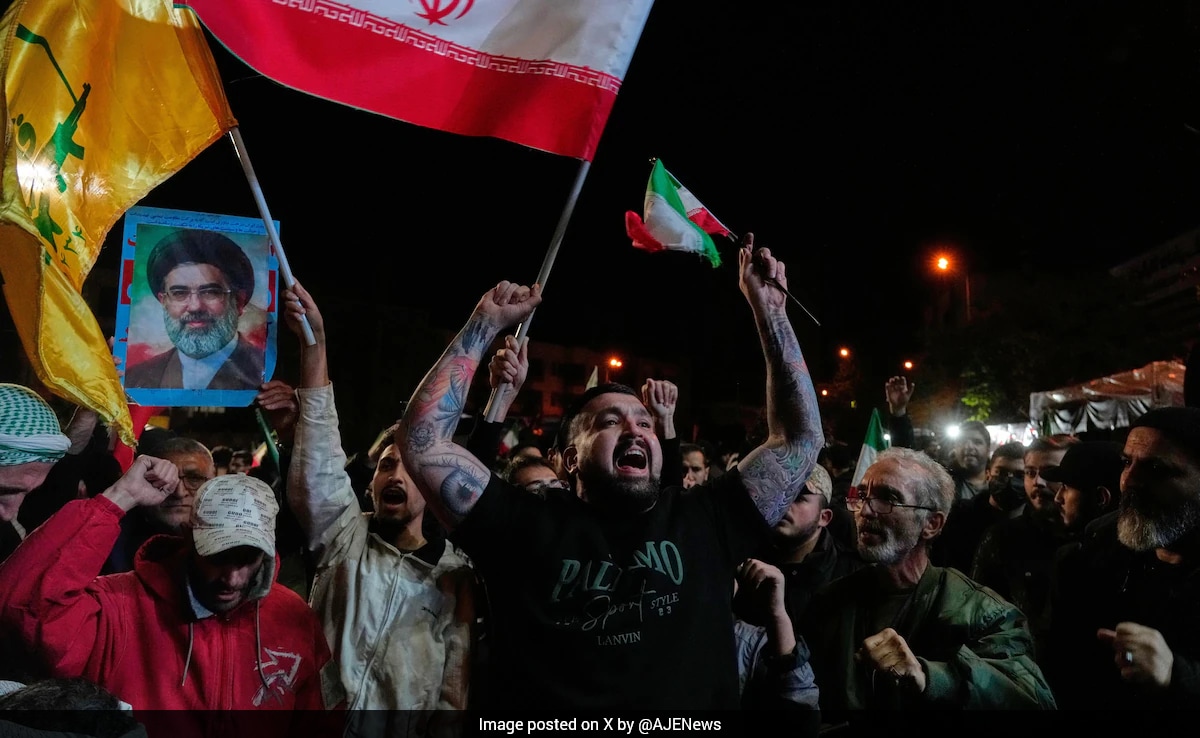
In the narrow, winding alleys of south Tehran, the air usually carries the scent of exhaust and toasted sangak bread. On this particular night, it smelled like gunpowder and relief. The news had broken across the Telegram channels and the state-run television screens like a sudden rain in a drought: a ceasefire. For the families who had spent the last several months glancing nervously at the sky, the announcement was a physical weight lifted from their chests.
Think about a father named Reza. He isn't a politician. He doesn't hold a seat in the Majlis or a rank in the Revolutionary Guard. He is a man who worries about the price of eggs and the structural integrity of his basement. When the ceasefire was announced, he didn't cheer for a strategic victory. He simply looked at his sleeping daughter and realized, for the first time in weeks, that he didn't need to plan an escape route before he closed his own eyes.
But as the street celebrations began—honking horns, scattered sweets, the rhythmic chanting of slogans—the joy remained curiously thin. It was a celebration with a glass ceiling. In Iran, the people have learned that a "ceasefire" is rarely a period at the end of a sentence. It is usually a comma, or perhaps a ellipsis.
The festivities are a mask for a deep, calcified cynicism. To understand why Iranians are cheering while simultaneously gripping their sword hilts, you have to look past the headlines of diplomatic "success." You have to look at the anatomy of a broken trust that spans generations.
The Ghost of 1953 and the Weight of Memory
Trust isn't a switch you flip. It’s a building you construct brick by brick, and in the relationship between Iran, the United States, and Israel, that building was demolished decades ago. When the Iranian government releases statements expressing "extreme caution" despite the cessation of hostilities, they aren't just being difficult. They are reciting a history book that every schoolchild in Mashhad and Isfahan knows by heart.
The skepticism isn't just about the current administration in Washington or the latest cabinet shift in Jerusalem. It is rooted in the collective memory of the 1953 coup, the broken promises of the 2015 nuclear deal, and the targeted assassinations that have turned scientists into martyrs. In the coffee houses of North Tehran, the conversation isn't about if the ceasefire will hold, but who will be the first to find the loophole.
History isn't a series of dates here. It’s a recurring nightmare.
The Iranian leadership views the West not as a partner in peace, but as a predator that has momentarily lost its appetite. This isn't just rhetoric used to stir up the base; it is a fundamental pillar of their geopolitical survival. When they see American carrier strike groups lingering in the Mediterranean or Israeli drones humming near the borders of Lebanon, the words on a ceasefire document begin to look like invisible ink.
The Math of a Precarious Silence
Let’s look at the numbers, because even a story about emotions needs the gravity of math. The regional architecture is currently held together by a web of "proxies"—a word that sounds clinical but translates to thousands of young men with rifles and rockets. Iran spends billions of dollars annually to maintain its "Axis of Resistance." This isn't a hobby. It is a forward-defense strategy designed to keep the theater of war as far from the Iranian border as possible.
A ceasefire, in the eyes of the hardliners in Tehran, is often viewed as a tactical pause for the "Zionist entity" to reload.
Consider the logistical reality. Israel’s military doctrine is built on the concept of "Mabam"—the war between wars. It is the belief that total peace is an illusion and that security is only maintained through constant, low-level kinetic activity. From the Iranian perspective, if Israel isn't dropping bombs today, it's because they are calibrating the guidance systems for the ones they’ll drop tomorrow.
The ceasefire doesn't address the primary irritants: the presence of U.S. troops in Iraq and Syria, the maritime tensions in the Red Sea, or the shadow war being fought in the digital trenches of cyber warfare. It’s like putting a bandage on a compound fracture and telling the patient to go run a marathon. The bleeding stops for a moment, but the bone is still shattered.
The Invisible Stakes of the Bazaar
The real battle isn't happening in a bunker. It’s happening in the bazaar.
The Iranian economy has been gasping for air under the pressure of sanctions for years. For the average citizen, the geopolitical chess match is secondary to the exchange rate of the Rial. There was a brief hope that a ceasefire would lead to a softening of economic pressure, a "de-escalation dividend" that might lower the price of imported medicine or car parts.
But the markets are smarter than the politicians. The Rial didn't rally with the news of the truce. The traders know that as long as the "threat of Iranian aggression" remains the primary talking point in the U.S. Congress, the sanctions aren't going anywhere.
The invisible stake here is the soul of the Iranian middle class. Every time a peace deal is signed and subsequently ignored, a little more of the public’s faith in global diplomacy withers away. They feel like pawns in a game where the rules are written in a language they aren't allowed to speak.
When you hear a spokesperson in Tehran talk about "American duplicity," they are tapping into a very real, very raw feeling of being cheated. They remember the JCPOA. They remember the years of compliance followed by a unilateral exit that sent their economy into a tailspin. To them, the U.S. signature on a document is as stable as a sandcastle in a rising tide.
The Theater of Deterrence
Peace, in the Middle East, is often just another word for "deterrence."
Imagine two archers standing ten feet apart, each with an arrow notched and pulled back to the ear. Their arms are shaking. Their eyes are watering. A "ceasefire" is simply the agreement to keep holding that tension without letting the string go. It isn't the same as putting the bows down.
Iran’s celebration is, in many ways, a performance of strength. By claiming the ceasefire as a victory for the "resistance," the state reinforces the idea that their military posture is the only thing keeping the wolves at bay. It is a narrative of survival. If they admit that the peace is fragile or that they are desperate for it, they lose their leverage.
On the other side, the constant surveillance and the "preemptive" strikes by Israel are a performance of invulnerability. They must prove that their "Iron Dome" isn't just a physical shield, but a psychological one.
This is the tragedy of the current moment. Both sides are so deeply invested in the appearance of strength that any genuine move toward peace is viewed as a sign of weakness. The ceasefire is a vacuum. And in geopolitics, a vacuum is always filled by something—usually suspicion.
The Morning After the Fireworks
The fireworks have stopped now. The streets of Tehran have returned to their usual, grinding traffic. The father, Reza, has gone back to work, but he still checks the news every twenty minutes. He looks at the "Breaking News" banners with a skeptical squint, wondering which headline will be the one to break the silence.
The ceasefire is a fragile thing. It is a thin sheet of ice over a very deep, very cold lake.
The distrust persists not because the people of Iran want war, but because they have been conditioned by decades of broken promises to expect it. They celebrate because they have to. They celebrate because any day without a funeral is a day worth marking.
But as the sun rises over the Alborz mountains, the light reveals a landscape that hasn't changed. The missiles are still in their silos. The sanctions are still in the ledgers. The rhetoric is still sharpened to a razor's edge.
We are living in the interval. It is the quiet space between heartbeats, where the world holds its breath and waits to see if the next pulse will bring life or the final, cold stop. The peace is real, for now. But in this part of the world, "for now" is the most terrifying phrase in the language.
The ink is dry, but the pens are still uncapped.