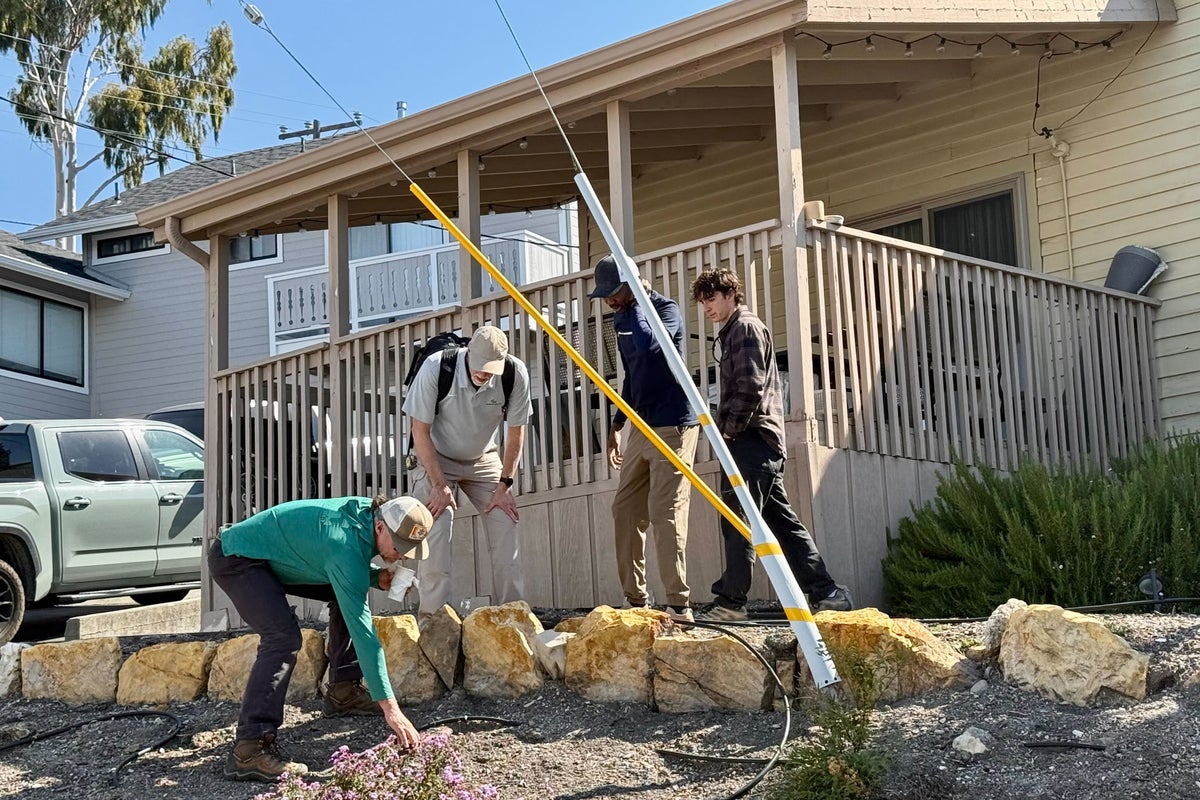
The dirt at 510 Gilliam Way yielded nothing but silence. Despite fresh warrant executions and the high-tech hum of ground-penetrating radar, California investigators confirmed that the latest search of the Flores property failed to produce the remains of Kristin Smart. For the Smart family and a public that has tracked this disappearance for nearly three decades, the news is a familiar, gut-wrenching stalemate. Paul Flores is behind bars, convicted of the 1996 murder, but the fundamental closure of a recovery remains out of reach. This isn't just a failure of a single search; it is a case study in the brutal reality of forensic degradation and the tactical brilliance of a decades-long cover-up.
The San Luis Obispo County Sheriff’s Office moved on the property with the weight of expectation. They weren't looking for a needle in a haystack—they were looking for a grave in a backyard that had already been under a microscope for years. The absence of biological evidence in this latest dig highlights the terrifying effectiveness of time and the potential relocation of evidence. In the world of cold case recovery, the earth is either a time capsule or a giant eraser. At the Flores home, it appears to be the latter. Meanwhile, you can explore related stories here: The Empty Chairs of Khyber Pakhtunkhwa.
The Chemistry of Disappearance
When a body is buried in shallow soil, a complex biological countdown begins. Forensic anthropologists look for "gravesoil"—a specific chemical signature left behind by decomposition. This includes spikes in nitrogen, phosphorus, and calcium. However, these markers don't last forever. In the sandy, acidic soil profiles often found in coastal California, organic material can break down with startling speed.
If remains were moved—a theory that has long haunted this investigation—the window for detecting the "primary" burial site narrows every year. Microbes, moisture levels, and even the type of vegetation growing over a site can scrub the chemical record clean. When authorities say they found nothing, it doesn't necessarily mean nothing was ever there. It means the evidence has potentially crossed the threshold of detection. To see the full picture, we recommend the excellent report by Associated Press.
The Problem with Ground Penetrating Radar
Ground-penetrating radar (GPR) is often portrayed as a magical X-ray that reveals skeletons through several feet of concrete. The reality is far more tedious and prone to error. GPR sends electromagnetic pulses into the ground and measures the reflections. It doesn't find bodies; it finds "anomalies."
An anomaly can be anything: a buried pipe, a large rock, a pocket of air, or a patch of soil that was disturbed twenty years ago. The recent search likely focused on these anomalies, but the challenge with the Flores property is its history of human activity. Years of construction, gardening, and previous excavations create "noise" in the data. To find a clandestine grave, investigators have to filter out thirty years of domestic life. When they dig and find a "dry hole," it’s often because the anomaly was a ghost of previous land use rather than a forensic breakthrough.
A Conviction Without a Body
The conviction of Paul Flores in 2022 was a landmark moment for California law. Historically, "no-body" homicides are notoriously difficult to prosecute. They require a mountain of circumstantial evidence so high that it blocks out any reasonable doubt. Prosecutors successfully argued that Flores was the last person seen with Smart and that his actions following her disappearance—coupled with the cadaver dog alerts at his dormitory room years prior—pointed to a singular conclusion.
But a conviction is not a recovery. For the legal system, the case is closed. For the investigators still carrying shovels, the case remains an open wound. There is a distinct tension between "legal truth" (Flores did it) and "physical truth" (where she is).
The Psychology of the Hidden Grave
Why would a killer refuse to reveal a location even after a life sentence is handed down? In many cases, the location of the remains is the final piece of leverage. It is the only thing the perpetrator owns that the state cannot take by force. For some, it is a final act of control over the victim and their family.
In the Smart case, the theory that the remains were moved from under the deck of the Arroyo Grande home remains the most compelling explanation for the current lack of physical evidence. If the "cargo" was relocated in the dark of night years ago, the search at Gilliam Way was always going to be an exercise in forensic history rather than a recovery.
The Logistics of a Relocation
Moving a body is a high-risk, logistically demanding task that creates new opportunities for detection. However, it also resets the forensic clock. If remains were moved from a primary site to a secondary or tertiary location, the secondary site is often chosen for its "permanence" or its ability to mask decomposition.
We must consider the geography of San Luis Obispo County. It is a vast landscape of rugged coastline, dense brush, and remote canyons. If the remains were taken out of a residential backyard and moved into the wilderness, the chances of a "lucky" find drop toward zero. The search then shifts from a targeted dig to a needle-in-a-thousand-haystacks scenario.
The Limits of Modern Technology
We are living in an era where we believe technology can solve any mystery. We have satellite imagery, DNA phenotyping, and AI-driven soil analysis. But none of these tools can find what isn't there. If the physical matter has been destroyed or moved beyond a certain radius, we are left with the limits of human memory and the hope of a confession.
The San Luis Obispo Sheriff’s Office has been criticized for decades over the early handling of this case. The initial failure to secure the Flores home in 1996 is the original sin of the investigation. Those lost days gave the suspects a head start that investigators are still trying to overcome thirty years later.
The Cost of the Long Game
The resources poured into the latest search at the Flores home are significant. It involves forensic archeologists, heavy equipment, and hundreds of man-hours. This isn't just about one case; it’s about the precedent it sets for cold cases across the country.
When a department refuses to give up, they send a message to other offenders that the clock never stops. But there is a dark side to this persistence. Every "unsuccessful" search provides a minor sense of vindication for the defense and a crushing blow to public morale. It reinforces the idea that some secrets are buried too deep to be unearthed.
The Forensic Value of "Nothing"
In investigative work, a negative result is still a result. By thoroughly clearing the Gilliam Way property, authorities can finally cross it off the list. They are narrowing the map. The "no" they received this week is a data point that forces the investigation to look elsewhere.
If she isn't at the house, and she wasn't under the deck, the focus must shift to the movements of the Flores family and their associates in the weeks and months following the disappearance. It moves the investigation away from the soil and back to the timeline.
The Smart Family and the Burden of Hope
Susan and Stan Smart have conducted themselves with a level of dignity that is frankly hard to comprehend. They have lived through decades of rumors, false leads, and legal hurdles. For them, a search that turns up nothing isn't just a technical update; it’s another day without a grave to visit.
The investigative community owes them more than just effort; it owes them a cold-eyed assessment of the facts. The hard truth is that the physical evidence of Kristin Smart may no longer exist in a form that current science can identify. This doesn't mean the search should stop, but it does mean our expectations of what "discovery" looks like need to evolve.
The dirt on Gilliam Way is just dirt. The answer to Kristin Smart’s location isn't hidden in an anomaly on a radar screen; it is likely hidden in the silence of those who helped move her. Until that silence is broken, the earth will keep its secrets.
Investigative momentum must now pivot away from the physical property and back toward the human elements—the associates, the late-night sightings, and the unexplained gaps in the 1996 timeline. The forensics have reached a stalemate; the resolution will have to come from somewhere else.

