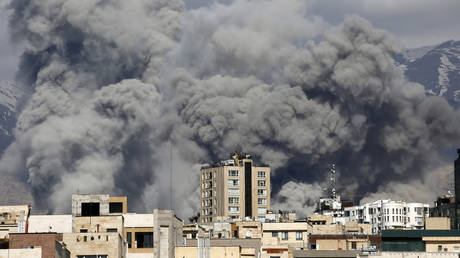
The red lines didn't just move. They vanished. When news broke that a combined US and Israel operation targeted Iranian soil, the global collective intake of breath was audible. We're not talking about a shadow war anymore. This is a front-door confrontation that changes the math for every economy, every energy market, and every diplomatic mission on the planet.
Most people think these strikes are just about "sending a message." They aren't. They're a fundamental shift in how the West intends to manage Middle Eastern power dynamics for the next decade. If you've been following the back-and-forth between Tehran and Tel Aviv, you know the cycle of "strategic patience" is dead. In its place is a high-stakes gamble that many world leaders are calling a dangerous venture with no clear exit ramp.
Global Anxiety Is Not Just Political Rhetoric
While Washington and Jerusalem might see this as a necessary deterrent, the rest of the world sees a supply chain nightmare. From Beijing to Brussels, the reaction hasn't been supportive. It’s been frantic. The European Union, usually a staunch ally in regional security, issued warnings that feel less like diplomatic notes and more like SOS signals. They know that when Iran gets squeezed, the pressure doesn't stay in the Gulf. It travels through every gas pipe and shipping lane connected to the continent.
Oil prices didn't just tick up. They jumped. This is the "fear premium" in action. Traders aren't just worried about the immediate damage to Iranian infrastructure. They’re terrified of what happens if the Strait of Hormuz becomes a parking lot for naval mines. About 20% of the world's total oil consumption passes through that narrow chokepoint. You don't need to be an economist to understand that blocking that route would turn a regional skirmish into a global depression.
Why This Specific Attack Triggered Such a Backlash
It's the scale. We’ve seen cyberattacks. We’ve seen targeted assassinations of scientists. But a direct kinetic strike involving US logistical support and Israeli execution? That's a different beast.
Critics across the Global South are calling it a violation of sovereignty that sets a "might makes right" precedent. Russia and China, predictably, used the moment to paint the US as an arsonist in a room full of gunpowder. But the real surprise was the tone from Gulf states. Countries like the UAE and Saudi Arabia, who aren't exactly fans of Iran, remained remarkably quiet or issued calls for "utmost restraint."
Why? Because they're the ones in the splash zone. If Iran decides to retaliate, it won't just look at Tel Aviv or Washington. It'll look at the American bases sitting on the soil of its neighbors. For the neighbors, this isn't a chess game. It’s an existential threat to their multi-billion dollar tourism and trade hubs.
The Nuclear Elephant in the Room
You can't talk about an attack on Iran without talking about their nuclear program. For years, the International Atomic Energy Agency (IAEA) has warned that the window for a diplomatic solution is closing. This strike might have set back some hardware, but it likely accelerated the software of the problem: the will to build a bomb.
History shows us that when a regime feels its survival is at stake, it doesn't back down. It digs deeper. There’s a very real concern among intelligence circles that this "dangerous venture" will be the final push Iran needs to move its enrichment facilities so deep underground that no conventional bunker-buster can reach them. If the goal was to stop a nuclear Iran, these strikes might have actually guaranteed its arrival.
Domestic Politics Are Driving the Jets
Let's be honest about what's happening at home. In Israel, a government under immense domestic pressure often finds unity in a common enemy. In the US, the need to look "tough on terror" ahead of election cycles is a tale as old as time.
But looking tough has a cost. The US military is already stretched thin. Between supporting Ukraine and keeping an eye on the South China Sea, the last thing the Pentagon wants is a "forever war" with a country three times the size of Iraq. Yet, here we are. Every missile launched is a commitment of resources that can't be used elsewhere. It’s a distraction that America’s rivals are happy to exploit.
Human Cost and the Looming Refugee Crisis
We often talk about "targets" and "assets," but we rarely talk about people. A full-scale conflict with Iran would dwarf the Syrian refugee crisis. We’re talking about a population of 88 million people. If the infrastructure collapses, where do they go? Turkey is already at a breaking point. Europe is swinging toward hard-right populism largely due to previous migration waves. Another massive influx of displaced people would likely shatter the political cohesion of the EU for good.
What Happens When the Smoke Clears
There is no "mission accomplished" banner coming. Iran's network of proxies—from Hezbollah in Lebanon to the Houthis in Yemen—has spent decades preparing for this exact scenario. We call it "asymmetric warfare." Basically, it means they don't have to win a dogfight against an F-35. They just have to make life miserable for everyone else.
Expect more drone strikes on tankers. Expect more "mysterious" explosions in regional ports. Expect a massive uptick in state-sponsored hacking targeting Western financial institutions. This isn't a war that ends with a treaty on a battleship. It’s a slow-burn disaster that will bleed into every aspect of our lives.
What You Should Watch Right Now
If you want to know where this is going, stop looking at the news cycles and start looking at the data.
- Watch the Brent Crude index. If it stays above $95, the markets believe a wider war is inevitable.
- Monitor the "Gray Zone" activity. Watch for cyber disruptions in your own country. Iran's first response is often digital, not physical.
- Listen to the rhetoric from Ankara. Turkey is the bridge. If they close their borders or shift their stance on NATO operations, the logistics of this conflict become nearly impossible for the West.
This isn't just another headline in a busy news week. It's a fundamental break in the world order. Whether you think the strike was justified or a catastrophe, the reality is the same: the world just became a much more expensive and dangerous place to live. Stop waiting for a "return to normal." This is the new normal. Plan your investments, your travel, and your expectations accordingly. Move your assets toward stability and keep a very close eye on the shipping lanes. The next few weeks will decide the economic temperature of the next decade.


