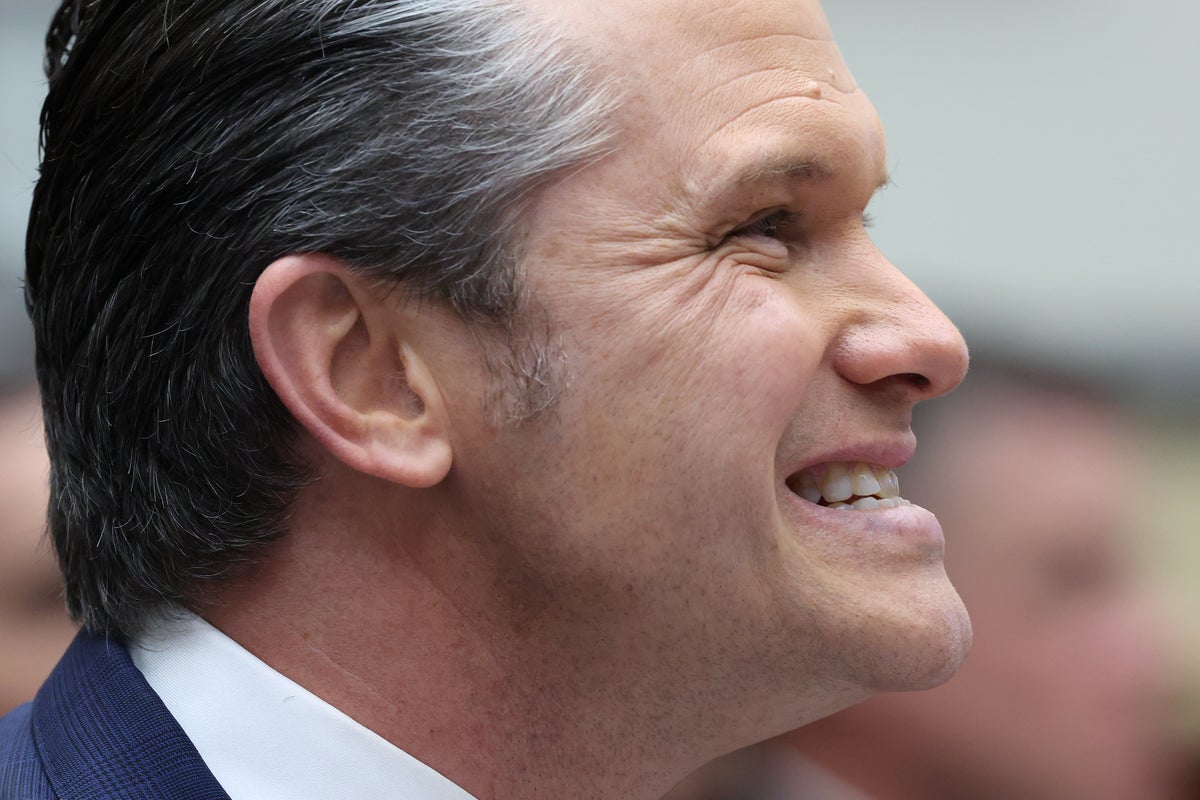
The media is currently hyperventilating over a series of "gotcha" clips from Pete Hegseth’s recent Congressional testimony. They want you to believe he lost his nerve. They want you to think his stutter on a specific tactical nuance regarding Iranian naval capabilities was a white flag.
They are wrong.
What we witnessed wasn't a breakdown; it was a total rejection of the beltway’s favorite hobby: theoretical escalation. The "lazy consensus" among the pundit class suggests that a Secretary of Defense must be a walking encyclopedia of technical specifications and a master of diplomatic double-speak. They think a "strong" performance involves validating every hypothetical scenario a Senator throws at the wall.
Hegseth’s refusal to play that game didn't signal weakness. It signaled a shift in the fundamental philosophy of American intervention. If you think he looked "unprepared," you’re likely still operating under the 2003-era delusion that "preparation" means having a ready-made plan for a thirty-year occupation of the Middle East.
The Myth of the Tactical Expert
Let’s burn one straw man right now. The Secretary of Defense is not a Chief of Naval Operations. They are not a general. They are a civilian leader tasked with managing the most bloated bureaucracy on the planet and ensuring that the military’s goals align with the President's policy.
When a Senator asks a highly specific question about how a particular missile system would perform against an Iranian swarm boat in the Strait of Hormuz, they aren't looking for information. They are looking for a soundbite. They want to trap a nominee into making a commitment that the State Department will have to walk back three hours later.
Hegseth’s "hesitation" was a refusal to bite the hook. In my time watching these confirmation hearings devolve into theater, I’ve seen nominees provide "seamless" (to use a word I hate) answers that were factually hollow but stylistically perfect. The establishment loves style. They despise the reality that a conflict with Iran wouldn't follow a pre-written script found in a Congressional briefing binder.
The Cost of Professionalism
The mainstream critique focuses on "optics." They argue that a Secretary of Defense should project an aura of calm, unshakable authority. But let's look at the "authoritative" figures of the last two decades. We’ve had a string of highly polished, incredibly articulate leaders who presided over the most expensive and least successful military campaigns in modern history.
If "losing your nerve" means pausing before committing to the logic of a potential world-shattering conflict, then we need more of it.
The industry insiders—the ones who profit from the "tapestry" of endless procurement cycles—are terrified of a Secretary who doesn't speak their language. Hegseth speaks the language of the ground floor. He speaks like someone who knows that every theoretical "strategic pivot" discussed in a marble room translates to a twenty-year-old kid losing a limb in the sand.
Why the Iran Questions are Rigged
The questions regarding Iran were designed to force a binary choice: Are you a pacifist or a warmonger?
If Hegseth answers with too much aggression, he’s a liability. If he answers with too much caution, he’s "unprepared." This is a classic trap. The reality of the Iranian threat—and our response to it—is governed by the Theory of Proportionality.
$$Total\ Force = (Capability \times Intent) - Deterrence$$
In the beltway, they ignore the "Deterrence" variable because it’s hard to measure and even harder to sell to defense contractors. Hegseth’s approach disrupts this. He isn't interested in the "holistic" (another terrible word) view of Middle Eastern stability if it means staying in the status quo of "managed decline."
Breaking the Procurement Fever
The real reason the establishment is panicking isn't because Hegseth might start a war; it’s because he might stop the flow of money.
The Department of Defense is an entity that has failed every single audit it has ever undergone. Every. Single. One. We are talking about trillions of dollars that simply vanished into the ether.
Hegseth’s performance showed a man who is not beholden to the military-industrial complex's vocabulary. He doesn't care about the "synergy" of multi-domain operations if those operations don't actually result in a win. He is a disruptor in the purest sense.
When he "stumbled" over questions about Iran, he was effectively saying: "Why are we even talking about this specific tactical failure when the entire strategic framework is broken?"
The "Expert" Trap
We’ve been told for decades that we need "experts" at the helm. But what has expertise given us?
- A $2 trillion failure in Afghanistan.
- A destabilized Iraq that paved the way for regional rivals.
- A navy that struggles with basic maintenance schedules despite a record-breaking budget.
If this is what the "experts" produce, then being an outsider isn't a bug—it’s the primary feature. Hegseth's perceived lack of polish is his greatest asset. It means he hasn't spent the last twenty years being marinated in the groupthink of the Pentagon.
The Reality of Nuclear Ambiguity
One of the moments cited as a "loss of nerve" involved Iran’s nuclear timeline. The Senator in question wanted a definitive date. Hegseth gave a nuanced, uncertain answer.
The media called it a "lack of clarity." I call it the only honest answer given in that room.
Anyone who tells you they know the exact "breakout time" for an Iranian nuclear weapon is lying to you or trying to sell you a war. The intelligence is always a moving target. By refusing to give a hard number, Hegseth avoided the trap of "intelligence-led policy" that led us into the WMD disaster in 2003.
Stop Looking for a General in a Suit
The fundamental mistake the critics are making is expecting Hegseth to be a General. He isn't. He’s a civilian overseer. His job is to be the "No" man.
- "No," we aren't buying another overpriced carrier that can't defend against $20,000 drones.
- "No," we aren't staying in a conflict for twenty years without a definition of victory.
- "No," we aren't going to let the "consensus" dictate the lives of American soldiers.
The moments where he supposedly "lost his nerve" were actually moments where he refused to validate the insane logic of the current system. He didn't blink because he was scared; he blinked because he was looking at a room full of people who have been wrong about every major foreign policy decision of the 21st century and who still have the audacity to ask him if he is ready.
The establishment wants a Secretary of Defense who will play their game, use their buzzwords, and keep the gears of the machine greased with taxpayer money and blood. Hegseth’s performance showed he’s not interested in the game.
If you’re looking for a smooth, rehearsed, "authoritative" figure who will tell you exactly what you want to hear while leading the country into another avoidable quagmire, look elsewhere.
If you want someone who makes the "experts" nervous because he won't adopt their failures as his own, you just found him.
The hearing wasn't a failure of competence. It was a failure of the committee to realize that the old rules no longer apply. The era of the "polished" failure is over. If the beltway is terrified, good. They should be.
Stop checking the transcript for stutters and start looking at the scoreboard. The "experts" are down by fifty points, and they’re complaining that the new coach doesn't like their play-book.
Get used to the silence when the trap questions come. It’s not hesitation. It’s the sound of the status quo being dismantled.
Fix the strategy, or stop asking the questions.



