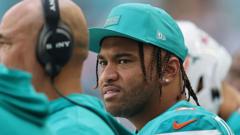
The silence in a general manager’s office during the off-season is heavier than any stadium roar. It is the sound of calculators clicking and the soft thud of a folder closing on a career. In Miami, that silence currently costs seventy-four million pounds.
Tua Tagovailoa was never just a quarterback to the Dolphins. He was a symbol of a radical shift, a left-handed hope carved out of Hawaiian grit and Alabama championships. But the NFL is a cold machine. It grinds bone and talent into spreadsheets. When the news broke that the Dolphins would release Tagovailoa, the headlines screamed about the record-breaking dead cap hit. They focused on the numbers. Yet, the real story isn’t written in ink on a contract; it is written in the scar tissue of a young man’s brain and the desperate gamble of a franchise that ran out of time.
Imagine the locker room on a Tuesday morning. It smells of wintergreen rub and old sweat. For four years, Tua’s jersey hung there as the focal point of a billion-dollar ambition. Now, that space is a vacuum. The decision to cut ties didn't happen because of a lack of talent. It happened because the human body has limits that the modern sports market refuses to acknowledge until it is forced to.
The Anatomy of a Collapse
Professional football is a game of physics played by people who pretend they are invincible. Tagovailoa’s tenure in Miami was defined by a series of collisions that looked like minor glitches on a television screen but felt like car crashes in reality. Every time his helmet hit the turf, the air in the Hard Rock Stadium vanished. Fans held their breath, not for a touchdown, but for a finger twitch.
The medical reality eventually collided with the financial one. To understand why a team would willingly set fire to £74 million—the largest "dead money" hit in the history of the sport—you have to understand the terror of the alternative. If the Dolphins kept him, they were betting on a miracle. They were betting that the next hit wouldn't be the one that changed his life forever.
The math was brutal. By releasing him now, the front office accepted a massive, immediate loss to avoid a total systemic failure later. It is the equivalent of a captain throwing the most expensive cargo overboard because the ship is taking on water. It hurts. It looks like a failure. But if they didn't do it, the whole ship would sink.
The Ghost in the Salary Cap
In the high-stakes world of NFL front offices, "dead cap" is the ghost of players past. It is money paid to someone to go away. It is the ultimate admission of a mistake. Usually, these hits are manageable—a few million here, a veteran’s exit there. But £74 million is a haunting.
This figure represents more than just a lost season. It represents the scouts who spent years tracking him, the coaches who built a lightning-fast offense around his quick release, and the marketing executives who sold his "Tuamania" jerseys to children across Florida. When a team pays that much for a player to not play for them, they are paying for a clean slate that feels like a tombstone.
Critics argue that the Dolphins should have seen this coming. They point to the collegiate injuries, the slight frame, and the specific way he fell. But that is the benefit of hindsight. In the moment of the draft, Tua was the savior. He was the "Tank for Tua" prize. The tragedy of the situation is that both things are true: he was the right choice at the time, and he became the most expensive casualty of the game’s inherent violence.
The Invisible Stakes of the Huddle
Consider the perspective of a teammate. A left tackle whose entire job is to protect the blind side of a man he knows is one play away from a permanent exit. That pressure is invisible. It changes how a line blocks. It changes how a wide receiver runs a route, knowing that if he doesn't get open fast enough, his friend might not get up.
The release of Tagovailoa isn't just a transaction; it's a mercy. It releases the organization from the constant, crushing anxiety of watching a tragedy unfold in slow motion. It allows the fans to stop being amateur neurologists and go back to being football fans. But for Tua, the silence is different.
He is a competitor. To a man who has won at every level, being told you are too expensive to keep and too fragile to play is a psychic wound that £74 million cannot heal. He is the protagonist of a story that ended three chapters too early. We often talk about these players as assets, but when the asset breaks, the human remains.
The Ripple Effect
The NFL landscape is littered with "what ifs," but this one leaves a crater. Miami now enters a desert. Without a franchise quarterback and with their cap space choked by the ghost of Tua’s contract, they have to rebuild from the ashes.
This isn't a "retooling" or a "strategic pivot." This is a survival move. They will have to find bargains in free agency. They will have to hit on every single draft pick. They will have to ask their fan base for a level of patience that doesn't exist in South Beach. The cost of moving on isn't just the money; it’s the years of irrelevance that often follow such a massive financial hit.
The league will watch this closely. Owners in other cities are looking at that £74 million figure and shivering. It changes the way contracts will be structured for "injury-prone" stars. It changes the risk assessment of the draft. Tua Tagovailoa’s exit has set a new, terrifying ceiling for the price of failure.
The Final Walk
There is a specific path a player takes when they are released. They walk past the trophies they helped win, past the photos of them celebrating in the sun, and out through a security gate that no longer recognizes their badge.
Tua leaves Miami as a wealthy man, but a diminished one. He leaves a city that loved him but eventually became afraid for him. The Dolphins move forward with a bank account that is empty and a roster that is thin, but they no longer have to live in the shadow of the next concussion.
The money is gone. The dream is over. All that’s left is the cold, hard reality of a game that loves no one back.
The lights at the stadium stay on long after the players leave, casting long, distorted shadows across the turf where a young man once thought he would be a king. Now, those lights just illuminate an empty field and a very expensive lesson in the fragility of greatness.