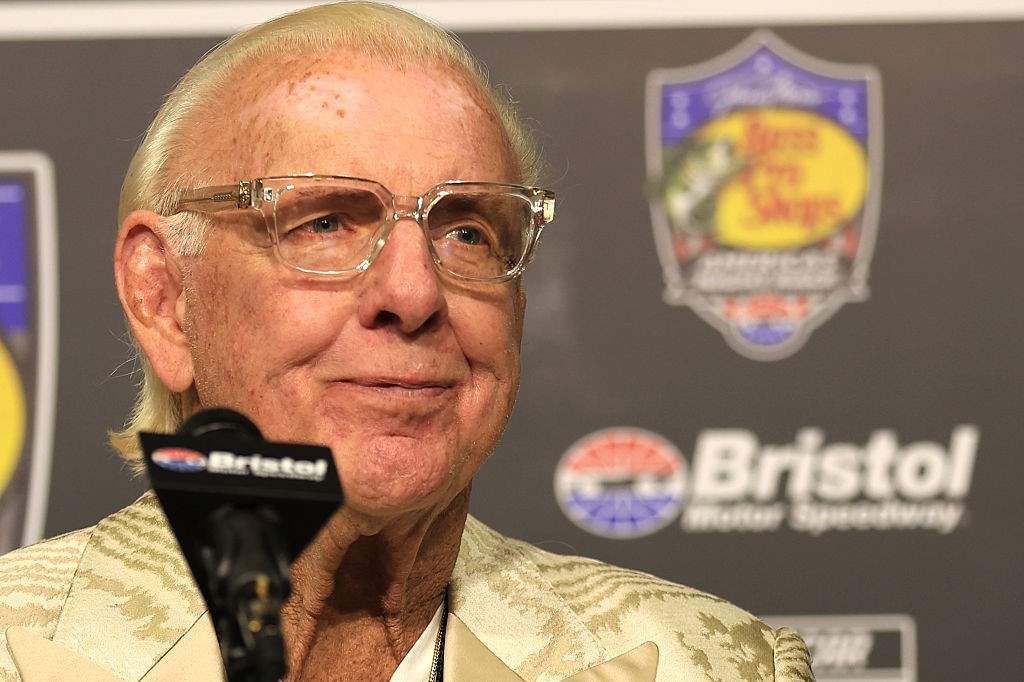
The fluorescent lights of a hospital recovery room do not flatter anyone. They wash out the bronze of a Florida tan, flatten the silver of bleached-white hair, and strip away the blinding, sequined illusion that makes a giant out of a mortal man.
For decades, Richard Morgan Fliehr existed in a state of perpetual motion, fueled by jet fuel, cold beer, adrenaline, and the deafening roar of twenty thousand strangers screaming in unison. To the world, he was Ric Flair, the limousine-riding, jet-flying, kiss-stealing, wheelin’-dealin’ son of a gun who never aged, never backed down, and never stayed on the mat for the count of three. He was a walking diamond, seemingly indestructible, carved out of sheer bravado and rhinestones.
Then came the silence of the ICU. Again.
When news broke recently that the WWE legend had been hospitalized, the reaction across the wrestling world followed a familiar, anxious rhythm. First came the rumors, spreading faster than a brushfire across social media. Then came the collective holding of breath from millions of fans who grew up watching him bleed for their entertainment. Finally, the update arrived directly from the man himself—reassuring, defiant, and laced with that unmistakable, gravelly bravado. He was okay. He was recovering. He was still standing.
We breathed a sigh of relief, clicked away from the headlines, and moved on with our day.
That is a mistake.
When we treat a Ric Flair health update as just another piece of celebrity news—a quick pulse check before scrolling to the next score or scandal—we miss the real story unfolding beneath the surface. We miss the quiet, brutal collision between an aging human body and a persona that demands immortality.
The Anatomy of a Persona That Cannot Die
To understand why a hospital bed cannot seem to keep Ric Flair down, you first have to understand what he built over fifty years in the squared circle.
Consider, as a hypothetical scenario, an actor who plays a superhero on a movie set. When the director yells cut, the actor takes off the cape, washes off the stage blood, goes home to a quiet dinner, and sleeps for eight hours. The character stays on the screen. The human being gets to rest.
Professional wrestling in the twentieth century offered no such sanctuary.
In the territory days of the 1970s and 1980s, living the gimmick was not a marketing strategy; it was a survival mechanism. If you walked into a steakhouse in Charlotte or St. Louis wearing a cheap suit, you were a fraud, and the fans would eat you alive. So Ric Flair became the Nature Boy twenty-four hours a day, seven days a week. He wore custom-tailored suits worth thousands of dollars on Tuesday mornings. He picked up the bar tab for entire rooms of strangers. He wrestled sixty-minute broadways—grueling, bone-jarring marathons in rings that felt like plywood laid over steel beams—five, six, sometimes seven nights a week.
I remember sitting in the third row of a smoky arena in the late eighties, close enough to smell the sweat, the cheap hairspray, and the metallic tang of blood. Watching him work in person was an education in controlled self-destruction. When he took a backdrop, he didn't land flat to distribute the weight like modern trainers teach; he landed high on his left hip, absorbing thousands of pounds of kinetic shock into the exact same joint night after night. When he took a chop to the chest, he stood still and let his skin split open until it looked like raw hamburger.
He wasn't faking the pain. He was turning pain into currency.
And the body keeps a meticulous ledger. Every bump on concrete, every sleepless red-eye flight, every night spent medicating soreness with alcohol at a hotel bar is written down in ink that never fades. For most people, the bill comes due in their fifties. For Flair, who survived a catastrophic 1975 plane crash that broke his back in three places and left doctors swearing he would never walk again, the bill has been contested in court for half a century.
Inside the Rope-a-Dope With Mortality
If you have ever sat beside a hospital bed watching someone you love fight their way back from a medical crisis, you know the terrifying vulnerability of that space. The beeping monitors reduce a towering personality to jagged green lines and fluctuating numbers. The air smells of antiseptic and anxiety. You watch their chest rise and fall, acutely aware of how fragile the machinery of the human body truly is.
Flair has been in that exact bed too many times to count.
In 2017, a ruptured intestine led to kidney failure, congestive heart failure, and a medically induced coma. Doctors gave him a twenty percent chance of survival. He was placed on dialysis, connected to a ventilator, and stripped of everything that made him the Nature Boy. His family was told to prepare for the worst.
Yet, weeks later, he walked out.
He went back on television. He launched podcasts, endorsed cannabis lines, appeared at conventions, and even stepped back into the ring in 2022 for a "Last Match" in Nashville that terrified nearly everyone watching, as a seventy-three-year-old man with a pacemaker fought through visible exhaustion and dehydration to finish a bout.
When his latest hospitalization occurred, the medical specifics—whether tied to complications from past surgeries, heart issues, or the general wear and tear of a seventy-seven-year-old body that has lived three lifetimes—almost mattered less than the pattern they revealed. Fans immediately searched for what happened to Ric Flair, wondering if this was finally the moment the clock struck midnight.
His response was pure Flair. Speaking out after the scare, he thanked his doctors, acknowledged the concern of his fans, and immediately pivoted back to strength, resilience, and his refusal to fade quietly into the background. He reassured the public that he was out of danger and already looking forward to his next appearance.
It is easy to cheer that kind of grit. America loves a fighter who refuses to stay down.
But step closer to the glass, and the picture gets far more complicated.
The Addiction Worse Than Any Substance
We often talk about the physical toll of professional sports, the torn ligaments and concussions that leave legends limping through airports in their golden years. We talk far less about the psychological withdrawal that happens when the applause stops.
Think of the roar of an arena as a literal chemical rush. Psychologists and neuroscientists have long noted that intense public adoration triggers massive surges of dopamine, endorphins, and adrenaline. For fifty years, Ric Flair’s nervous system was wired to expect that surge. When the opening notes of Also sprach Zarathustra hit the arena speakers, a frail seventy-something man with a pacemaker transforms. His posture straightens. His eyes narrow. The limp disappears. The applause acts like an IV drip of pure life force.
Now imagine taking that away. Imagine telling a man who has only ever felt truly alive under forty-foot spotlights that his job now is to sit on a porch, drink decaf tea, and watch the grass grow.
To most of us, a quiet retirement sounds like heaven. To a man like Flair, silence feels like a slow death.
This is the invisible stake behind every health update he shares. When he tells the world he is fine, he isn't just reassuring his fans; he is fighting for his right to remain relevant, visible, and plugged into the only power source he has ever trusted. He has been brutally honest in past interviews about his personal tragedies—the devastating loss of his son Reid to an overdose in 2013, the multiple divorces, the financial struggles, the years of heavy drinking that nearly destroyed his liver and heart. Work, travel, and the spotlight were never just a career for him. They were his shelter from grief.
Why We Refuse to Let Our Heroes Grow Old
There is another side to this equation, and it sits squarely on our shoulders.
We say we want our heroes to be safe, healthy, and retired. We flood social media with prayers and well-wishes every time a legend ends up in an emergency room. Yet the moment they walk out of the hospital doors, what do we ask of them?
We ask them to Woooo!
We ask them to pose for photos at airport gates at six in the morning. We buy tickets to see them sign autographs for six hours straight in convention centers. We watch viral clips of them partying in college bars and share them with captions celebrating their eternal youth. We have cast Ric Flair in the role of Peter Pan in a sequined robe, and we feel a strange, selfish panic whenever reality reminds us that he is mortal.
Because if the Nature Boy can be brought to his knees by time, what does that mean for the rest of us?
Watching our childhood icons age is a mirror we rarely want to look into. Ric Flair was the soundtrack to Friday nights with our fathers, the larger-than-life villain we loved to hate in our living rooms, the embodiment of swagger when we were awkward teenagers trying to figure out who we were. As long as he is out there strutting, styling, and profiling, a piece of our own youth remains untouched by time.
When a hospital bracelet replaces the Rolex on his wrist, the illusion shatters. We are forced to confront the uncomfortable truth that toughness does not make a human body immune to biology. A pacemaker does not care how many world championships you won. Scar tissue does not yield to charisma.
The Courage of the Unvarnished Truth
What makes Flair’s recent health updates so compelling—and so deeply human—is the tension between the bravado he projects and the vulnerability he can no longer completely hide.
In his younger days, Flair would have denied ever feeling a twinge of pain. Weakness was poison to his brand. Today, while the trademark humor and defiance remain intact, there is a raw honesty in how he communicates with the people who love him. He acknowledges the doctors. He admits the scares are real. He expresses gratitude simply for waking up and having another day to tell his story.
That shift is profound.
True courage at seventy-seven looks very different than courage at thirty-five. At thirty-five, courage is stepping into a steel cage knowing you are going to bleed. At seventy-seven, courage is surviving a medical crisis, looking in the mirror without the makeup, the tan, or the sequined robe, and accepting the fragile, scarred human being staring back—while still choosing to step out the front door with your head held high.
He does not need to take another back-body drop to prove his toughness. He does not need to prove he can still go sixty minutes. Every breath he takes after a plane crash, a coma, heart failure, and decades of self-inflicted war is already a victory lap that defies medical logic.
The Robe Still Hangs in the Closet
The next time a headline flashes across your screen about Ric Flair’s health, pause for a second before you scroll past. Look beyond the generic update and see the man standing behind it.
See the kid from Minnesota who was adopted and spent his whole life trying to prove he belonged. See the athlete who survived a broken spine and willed himself into becoming the greatest performer of his generation. See the grieving father who lost his son and kept walking through airports just to keep moving forward. And see an old man sitting on the edge of a hospital bed, waiting for the nurse to unhook the IV lines so he can put his watch back on, smooth down his silver hair, and walk out into the sunlight one more time.
Somewhere in a closet in Florida, the heavy, custom-stitched robes still hang in protective garment bags—feathers ruffled, rhinestones catching the stray light, waiting for an entrance that may never come again.
He doesn't need to wear them anymore. The man who survived the crash, the cage, the coma, and the quiet terror of the ICU has already outlasted every opponent who ever stepped across the ring from him.
And if you listen closely to the steady, rhythmic beep of a heart monitor refusing to flatline, it sounds an awful lot like a man kicking out at two.