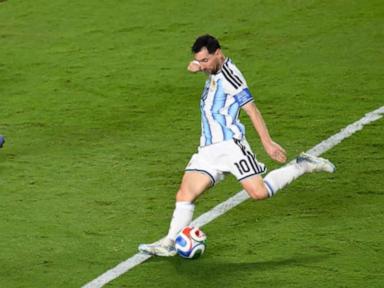
Lionel Messi dismantled Algeria with a clinical hat trick at Arrowhead Stadium, securing a 3-0 victory for Argentina to open their World Cup defense and tying the all-time tournament scoring record with 16 goals. Yet, the real story of the night unfolded miles away from the pitch, where an unprecedented cultural collision saw the small college town of Lawrence, Kansas, completely adopt the Algerian national team. This bizarre convergence of elite global sporting excellence and grassroots Midwestern hospitality exposes how the expanded 48-team tournament structure is fundamentally altering the traditional dynamics of hosting international soccer.
The sheer scale of what occurred in Kansas City requires looking past the standard match statistics. While Argentina walked away with three points, the structural machinery behind the tournament revealed both the massive commercial allure of the sport and the severe infrastructural strains facing smaller host markets.
The Logistics of Genius
For ninety minutes, Arrowhead Stadium traded its customary sea of NFL red for the stark blue and white stripes of Buenos Aires. Messi, appearing in an unprecedented sixth World Cup, operated with the calculated economy of motion that defines his late-career brilliance. He did not chase the ball; he waited for the game to find him.
The tactical reality of the match contradicted the final score. Algeria actually won the possession battle, suffocating passing lanes and utilizing their physical presence to disrupt the Argentine midfield. However, elite soccer is dictated by moments of ruthless efficiency rather than prolonged territorial dominance.
Match Statistics and Group J Standings
| Team | Match Statistics (ARG vs. ALG) |
|---|---|
| Goals | Argentina: 3 / Algeria: 0 |
| Shots (On Target) | Argentina: 10 (6) / Algeria: 7 (2) |
| Possession | Argentina: 46% / Algeria: 54% |
| Fouls Committed | Argentina: 11 / Algeria: 14 |
The victory instantly reshapes the outlook for Group J, putting the reigning champions in a commanding position while forcing the remaining squads to battle for survival.
Group J Standings
| Position | Team | Played | Won | Drawn | Lost | GD | Points |
|---|---|---|---|---|---|---|---|
| 1 | Argentina | 1 | 1 | 0 | 0 | +3 | 3 |
| 2 | France | 1 | 1 | 0 | 0 | +1 | 3 |
| 3 | Senegal | 1 | 0 | 0 | 1 | -1 | 0 |
| 4 | Algeria | 1 | 0 | 0 | 1 | -3 | 0 |
Messi's strikes in the 17th, 60th, and 76th minutes were masterclasses in spacing. His final goal, a curling effort into the lower corner that equaled Miroslav Klose's record, sent a crowd of over 69,000 into hysterics. But as the stadium shook, a parallel phenomenon was peaking just across the state line.
The Lawrence Experiment
When FIFA expanded the tournament format, it forced smaller media markets to absorb international squads for prolonged training camps. Algeria drew Lawrence, Kansas, a quintessential university town fundamentally unaccustomed to the hyper-surveillance and fervor of international soccer. What was expected to be a quiet, heavily guarded base camp turned into a full-scale civic takeover.
Local businesses began flying the Algerian green, white, and red flag. The University of Kansas campus featured a massive Algerian crest mowed into its turf. The phrase "Rock Chalk Algeria" echoed through local bars. This was not manufactured corporate marketing; it was a organic community response to an influx of international outsiders.
The Desert Foxes found an unexpected home crowd thousands of miles away from North Africa. Local residents did not just watch the training sessions; they actively learned the chants. While global audiences focused on Messi's historic evening, the Algerian squad walked onto the pitch knowing that a small pocket of the American Midwest was grieving their defensive lapses as deeply as their fans in Algiers.
The Small Market Strain
The idyllic narrative of cultural unity hides a harsher administrative reality. Kansas City is the smallest of the North American host cities, and the infrastructure struggled under the sudden weight of global tourism.
Massive traffic gridlock outside Arrowhead Stadium caused hundreds of ticket holders to miss the opening kickoff. The transit system, designed around vehicular commuting rather than centralized public rail, choked under the pressure of moving tens of thousands of international fans simultaneously. This is the hidden tax of the expanded World Cup format. When the global spotlight shifts to non-traditional sporting hubs, the romance of the game quickly collides with the limitations of regional infrastructure.
The tournament is no longer confined to major metropolitan capitals with robust transit networks. By decentralizing the event into the American Heartland, soccer officials have unlocked a fierce, localized passion, but they have also exposed the deep logistical vulnerabilities of cities trying to play host to the world on a budget.
The contrast defines the modern sporting era. On the pitch, an aging icon uses his remaining brilliance to rewrite the record books. In the surrounding community, a town completely detached from the history of Algerian soccer discovers a newfound identity through civic adoption. The game ends, the stadium empties, and the reality remains that soccer's global expansion is changing the host communities far more permanently than it changes the record books.