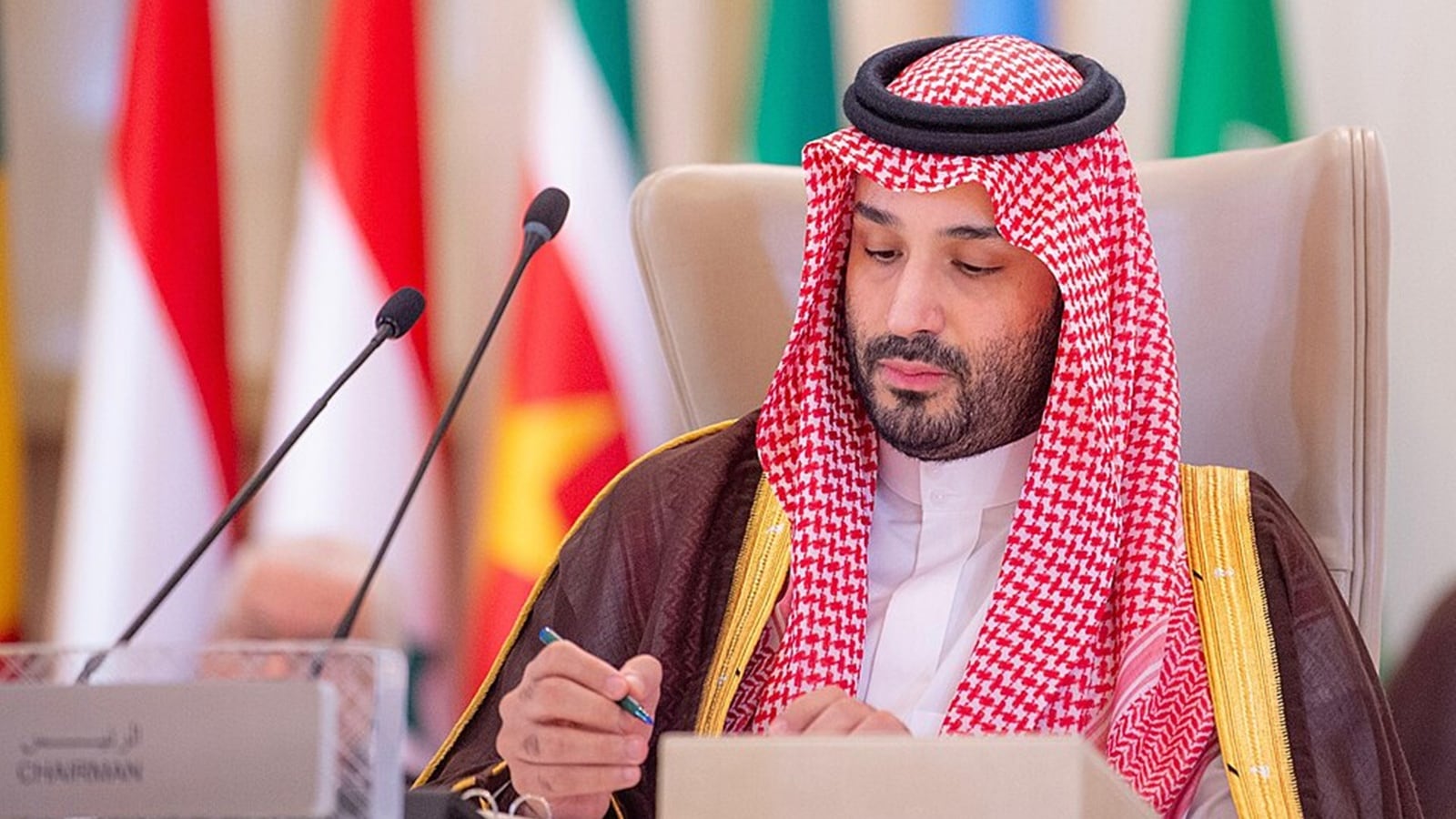
Saudi Arabia is done waiting. For decades, the Kingdom played a cautious game of containment, balancing public calls for "regional stability" with the reality of a Cold War across the Persian Gulf. But the diplomatic mask is slipping. While the official line from Riyadh still pays lip service to the 2023 China-brokered détente, the private reality is far more aggressive.
Crown Prince Mohammed bin Salman (MBS) is now actively steering Donald Trump toward a finish line that previous American administrations feared to cross: the total dismantling of the clerical regime in Tehran.
The logic is simple and brutal. Riyadh has calculated that as long as the Islamic Republic exists, the ambitious "Vision 2030" project—the Crown Prince’s multi-trillion-dollar plan to modernize the Saudi economy—is a hostage to fortune. A single drone strike on an Aramco facility can wipe out years of investor confidence. For MBS, regime change isn't just a neoconservative fantasy; it is a business necessity.
The Private Push and the Public Pivot
In Washington, the whispers have turned into a coordinated campaign. Saudi Defense Minister Prince Khalid bin Salman recently warned U.S. officials that hesitation is the greatest gift they could give Tehran. The Saudi message to the White House is clear: if the U.S. does not capitalize on the current internal chaos and military degradation within Iran, the regime will only emerge more radicalized and dangerous.
This is a stark departure from the "brotherly" rhetoric seen as recently as 2025. Following the June 2025 joint U.S.-Israeli strikes on Iranian nuclear sites, Riyadh publicly condemned the "aggression." Behind the scenes, however, the tone was celebratory. The public condemnation served two purposes: it protected Saudi infrastructure from immediate Iranian retaliation and it maintained the Kingdom’s standing in the wider Islamic world.
But the "strategic patience" of the Al Saud family has expired. The current wave of protests inside Iran, which has seen the regime kill tens of thousands of its own citizens, has convinced Riyadh that the "head of the snake"—a phrase famously coined by the late King Abdullah—is finally vulnerable.
The Vision 2030 Factor
To understand why Saudi Arabia is pushing for a definitive end to the current Iranian government, one must look at the balance sheets. The Kingdom is attempting to transition from an oil-dependent monarchy to a global hub for tourism, technology, and logistics.
- Foreign Direct Investment (FDI): Investors do not put money into "giga-projects" like NEOM if they believe those projects are within the crosshairs of Iranian-backed Houthi missiles.
- The Tourism Gamble: You cannot build a global luxury tourism industry if the regional narrative is one of constant, low-level warfare.
- Maritime Security: The constant threat to the Strait of Hormuz acts as a permanent tax on Saudi exports.
MBS views the Iranian regime not as a religious rival, but as a "disruptor" in the most negative sense of the word. He sees a future where a post-clerical Iran is integrated into a regional economy, potentially becoming a market for Saudi services rather than a source of regional instability.
Trump and the "Regime Change" Vacuum
The Trump administration’s current posture—a relentless series of strikes that have reportedly decimated the IRGC’s top leadership—is exactly what Riyadh has been lobbying for. Donald Trump has recently claimed that "regime change" is already happening, citing the collapse of the Iranian command structure after the death of Ali Khamenei.
However, the Saudi strategy carries immense risk. The Kingdom has refused to let its own airspace be used for direct strikes, a move that seems contradictory but is actually a masterclass in plausible deniability. By forcing the U.S. and Israel to do the "heavy lifting" while technically remaining a neutral party, Riyadh hopes to avoid the inevitable "scorched earth" retaliation Iran has promised its neighbors.
The Counter-Argument: The Chaos Theory
Not everyone in the Saudi intelligence community is convinced this is a winning hand. A school of thought remains—echoed by some European allies—that the collapse of the central authority in Tehran would lead to a "failed state" scenario on Saudi Arabia's doorstep.
A fractured Iran, divided among ethnic lines (Kurds, Azeris, Baluchis), could export more instability than a weakened theocracy. There is also the "wounded animal" theory: if the regime feels its end is truly imminent, it may launch every remaining asset in its arsenal at Saudi oil fields as a final act of spite.
Despite these fears, the Crown Prince appears to have decided that the status quo is more dangerous than the unknown. The 2023 détente was a truce, not a peace treaty. It gave Riyadh two years to bolster its defenses and align its strategy with a more hawkish Washington.
The Endgame
As the U.S. military campaign enters its second month, the Saudi role has shifted from quiet observer to active advisor. Riyadh is reportedly providing the U.S. with granular intelligence on the internal fissures within the Iranian military, identifying which factions might be willing to flip if the clerical leadership is removed.
The goal is no longer "containment" or a "new nuclear deal." The goal is a regional reset. If MBS succeeds in steering Trump toward a final confrontation that topples the Islamic Republic, he will have removed the single greatest obstacle to his 2030 ambitions. If he fails, he may have triggered a regional conflagration that no amount of oil wealth can extinguish.
The "snake" is being cornered, and Saudi Arabia is the one holding the bag.
Would you like me to analyze the specific economic impact a transition in Tehran would have on the global oil market and Saudi Vision 2030?