Cold. That is the first thing you notice when the grid flickers and dies in November. Not the dramatic snap of a lightning bolt, but the slow, creeping chill that settles into wool socks, into unheated hallways, into the marrow of people who have spent months pretending normalcy is a choice.
Now imagine a hypothetical scenario. Picture a mid-level logistics coordinator in eastern Europe—let’s call her Olena—standing in a dimly lit basement with a thermos of lukewarm tea and a spreadsheet that governs whether three thousand people get transformer parts before the first hard freeze. No one in that room feels like a geopolitical chess piece. They feel tired. Their eyes burn from staring at serial numbers and customs forms while air-raid sirens echo faintly above ground.
When a headline reduces a leader’s trip to Brussels to a "begging bowl" under a "Trump cloud," it reaches for a sneer. It turns a desperate struggle for air defense missiles, electrical gear, and budget survival into a cartoon of a panhandler rattling a tin cup outside a glass palace. That framing is lazy. Worse, it hides the actual mechanics of power in Europe right now.
The Architecture of a Summit
A European Union summit in Brussels looks, from the outside, like a parade of dark suits, flags, and polite handshakes on a red carpet. Inside, it is a pressure cooker built out of unanimity rules, domestic politics, and budgets stretched thinner than a winter coat on its fourth season.
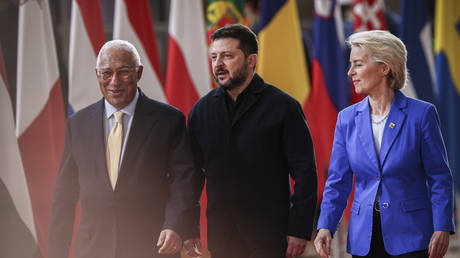
Consider what happens next when a wartime leader walks into that room. Volodymyr Zelenskyy does not arrive as a spectator or a guest at a gala. He arrives as a petitioner carrying a ledger of urgent needs—air defenses, artillery shells, energy grid repairs, financial lifelines—knowing that every euro and every interceptor has to survive a labyrinth of national interests before it ever reaches a frontline trench or a repair crew in Kharkiv.
To understand why the stakes feel so sharp, think of European security as a shared dam holding back floodwaters. For years, different countries built different sections of that dam. Some poured thick concrete early; others watched from high ground, convinced the water would never reach their valley. When the pressure rises, everyone suddenly notices every crack in the wall—and everyone argues over who should pay for the next load of cement.
Metaphorically speaking, that dam is under strain from two directions at once. On one side sits a relentless war of attrition that consumes ammunition and infrastructure at a pace peacetime factories struggle to match. On the other side hangs the looming shadow of American political shifts—the "Trump cloud" that makes diplomats in Brussels flinch every time someone mentions burden-sharing, tariffs, or Washington’s appetite for open-ended commitments.
I have stood in rooms where diplomats speak in velvet tones about "unwavering solidarity" while checking their phones for signals from home. The air smells faintly of espresso, damp wool, and quiet panic. Nobody says the quiet part out loud at the podium, yet everyone feels it in the weight of the silence between prepared remarks.
Why "Begging Bowl" Misses the Point
Words shape what people believe is possible. Call a man a beggar, and the listener starts looking for his flaws—his tone, his suit, his insistence—instead of examining the transaction on the table.
Ukraine’s requests in Brussels are rarely charity in the casual sense people imagine. They are demands for instruments of survival and containment tied directly to Europe’s own stability. When air defenses hold over a Ukrainian city, fewer drones and missiles cross into neighboring airspace, fewer refugees are forced westward by freezing winters, and fewer shockwaves hit European energy and food markets.
Still, it is fair to ask: why does this feel like a recurring ritual rather than a settled plan?
Because democracies do not move like autocracies. In an autocracy, one voice decrees a budget or a factory shift overnight. In the European Union, twenty-seven member states each answer to voters dealing with inflation, housing costs, farmer protests, and local elections. A prime minister in a capital a thousand miles from the front has to explain to skeptical constituents why tax money is going abroad while a local hospital or school waits for funding.
That tension is real. Pretending it does not exist makes an essay sound naive; turning it into mockery makes it sound cruel. The truth sits in the friction between those two realities: a country fighting for its existence on one side, and a union of nations trying to stay cohesive and solvent on the other.
Let’s be honest about how confusing this whole dynamic can look from the outside. Billions of euros are announced, pledged, debated, delayed, and re-packaged until even seasoned observers lose track of what has actually been delivered versus what is still stuck in bureaucratic approval. When numbers get big enough, human brains tend to shut down. A billion euros sounds like monopoly money until you translate it into what it buys: how many weeks a municipal heating system can run, how many air-defense interceptors stand between an apartment block and a glide bomb, how many months civil servants and teachers can be paid so a state does not hollow out from within.
The Shadow Stretching From Washington
No summit in Brussels happens in a vacuum anymore. Every hallway conversation eventually bends toward Washington.
For decades, European capitals grew accustomed to a comforting assumption: even when transatlantic disagreements flared, the United States would anchor the security architecture and carry the heaviest military load. Donald Trump’s return to the center of American power—and the sharper, more transactional edge he brings to alliances and foreign aid—has rattled that assumption to its core.
European leaders know what a shift in U.S. policy could mean. If Washington pulls back, slows aid, or demands steep concessions, Europe cannot simply wave a wand and replace decades of American logistics, intelligence, and munitions production overnight. Factories take years to scale. Political consensus takes months of arm-twisting.
So when Zelenskyy meets with EU leaders under that cloud, the mood is heavier than usual. There is an unspoken math happening in every bilateral huddle. If the United States becomes less predictable, Europe faces a stark choice: step up faster and spend more of its own political capital, or watch the ground shift beneath its feet while arguing over details.
Picture a hypothetical scenario to make that math concrete. Imagine two neighbors sharing a leaky roof during a storm. One neighbor has been bailing water with a heavy bucket for years and now says, "I’m tired of doing most of the work—and maybe I’m going inside." The other neighbor suddenly realizes the bucket is half-empty and the rain isn’t letting up. Panic doesn’t solve the leak, nor does blame. Only deciding who grabs the next bucket changes what happens to the ceiling.
Inside the Hallways of Compromise
What actually happens behind closed doors at an EU summit is rarely a dramatic movie scene. More often, it is hours of grinding negotiation over wording in a communique, footnotes on legal mechanisms, and quiet horse-trading over unrelated issues.
One country might drag its feet on a joint package because of a dispute over agricultural imports or budget rebates. Another might worry about domestic backlash if a commitment sounds too open-ended. Meanwhile, leaders sympathetic to Kyiv push hard to lock in predictable support before fatigue sets in or political winds shift again.
It is exhausting work, and it often looks underwhelming on television. A press conference ends with carefully parsed sentences about "continuing support" and "working through remaining details." Critics roll their eyes. Supporters feel frustrated.
Yet history shows that European integration has almost always moved forward in clumsy, incremental bursts rather than clean masterstrokes. After crises—economic shocks, energy blackmail, security scares—leaders repeatedly argue to the brink of deadlock and then inch toward a compromise because the cost of total fracture looks even worse.
Whether that pattern holds under this level of pressure is not guaranteed. Fatigue is a real force in politics. Public attention wanders. Leaders change. Coalitions wobble. Admitting that uncertainty is not a sign of weakness; it is the only honest starting point if you want to understand why every summit feels like a high-wire act without a net.
What Is Really Being Tested
Strip away the headlines, the snark, and the diplomatic jargon, and a summit in Brussels is a test of nerve and clarity.
It tests whether European leaders see Ukraine’s survival as peripheral to their lives or central to their future. It tests whether they can build industrial and financial muscle fast enough to matter in a world where allies cannot be taken for granted. And it tests Zelenskyy’s ability to keep a weary coalition focused, urgent, and aligned without burning out the very goodwill he depends on.
None of that fits neatly inside a cheap punchline. A "begging bowl" implies someone asking for scraps out of pity. What is actually being negotiated across those tables is far harder and far more consequential: who bears the cost of deterrence, how much risk a continent is willing to absorb, and what kind of security order will survive the winter.
Down in that basement with the lukewarm tea, Olena doesn’t need a grand speech about history. She needs the next shipment cleared through customs before the pipes freeze. Up in Brussels, twenty-seven leaders sit around a table trying to decide if their collective will is strong enough to keep the lights on.
The lights are still flickering, and nobody in the room gets to walk away from the switch.


