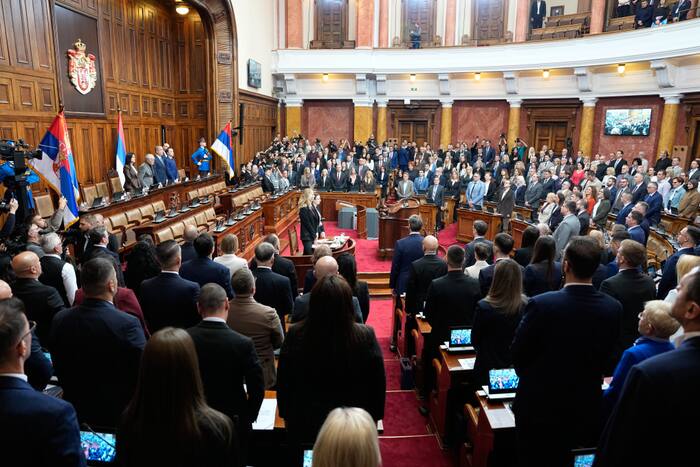
Most political analysts swore it couldn't happen. You don't topple a 14-year populist machine with leaderless university plenums, doctors, and chemistry professors. Yet on November 17, 2026, Serbia's new parliament met for the first time with 140 Student List lawmakers holding an outright majority in the 250-seat National Assembly.
Aleksandar Vučić and his Serbian Progressive Party (SNS) are officially in the opposition. The street protests that erupted after the deadly Novi Sad railway station canopy collapse in November 2024 didn't just fizzle out like past Balkan demonstrations. They morphed into an electoral juggernaut that pulled 53.69% of the vote on October 25, 2026, with voter turnout surging to 68.89%. Recently making news in this space: The Anatomy of Federal Aviation Oversight Why Ground Stops Expose a Fifty Billion Dollar Governance Deficit.
Still, winning an election is one thing. Running a country when almost none of your lawmakers have ever held public office is another beast entirely.
Inside the Chaotic First Day in Belgrade
If you watched the live broadcasts from Belgrade on November 17, the contrast outside and inside the National Assembly told the whole story. Outside, hundreds of supporters cheered and danced the traditional kolo circle dance as Student List deputies walked up the steps. When outgoing SNS figures arrived, the mood turned sharp—jeers echoed across the square, and one protester even poured a bottle of drinking yogurt over SNS candidate Lidija Vukićević. Additional information into this topic are covered by The New York Times.
Inside the chamber, parliamentary rules forced an ironic opening scene. Because a new speaker hadn't been chosen yet, the inaugural session had to be chaired by the oldest serving member of parliament. That meant 78-year-old mathematician Stojan Radenović—elected on Vučić's own United Serbia list—gaveled in the very lawmakers who just ended his party's era.
Two days later, on November 19, the new majority elected Student List deputy Aleksandar Čupić as parliamentary speaker. Under Serbia's constitution, that vote carried double weight. Because Vučić had resigned from the presidency back in September to lead his party's parliamentary ticket, Čupić immediately became Serbia's acting president.
Why Traditional Opposition Parties Got Left Behind
A lot of international coverage misses why the Student List succeeded where established opposition coalitions failed for over a decade. For years, Serbian voters watched fragmented opposition parties bicker over ideological purity while Vučić consolidated control over state media and public institutions.
The students bypassed that trap by refusing to build a traditional party around a single charismatic savior. Instead, university plenums vetted and selected non-partisan professionals—lawyers, physicians, engineers, and academics—to run under a unified banner headed by Ilija Srdanović. Several existing opposition groups realized the political reality and withdrew their own lists to back the students. Those that refused, including the "European Serbia" coalition and the nationalist "Authentic Right," took heavy heat from voters who accused them of acting as spoilers to split the anti-SNS vote.
That strategy paid off in raw numbers:
- Student List (SL) captured 140 seats with 53.69% of the vote, clearing the 126-seat majority threshold without needing messy coalition deals.
- Aleksandar Vučić – United Serbia (AV–US) dropped 26 seats, landing at 103 seats with 39.48% of the vote.
- Minority lists, including the Alliance of Vojvodina Hungarians (VMSZ) and Bosniak and Albanian parties, claimed the remaining 7 seats.
The Inexperience Trap and How They're Preparing
Critics from the outgoing establishment keep hammering one talking point. They claim a parliament full of political rookies will paralyze the state.
Sarah El Sarag, a human rights lawyer and newly sworn-in Student List MP, didn't hide from that criticism when speaking to reporters in Belgrade. She acknowledged that none of them are career politicians. To avoid getting tripped up by procedural tricks on day one, the incoming deputies spent weeks running daily parliamentary simulations coached by sympathetic legal and procedural veterans.
There's also an upside to filling a legislature with working professionals rather than party loyalists. When committees debate healthcare reform, agricultural subsidies, or university funding, the people writing the bills actually worked in those clinics, farms, and lecture halls.
Even so, the students who started this movement aren't giving their chosen lawmakers a blank check. Just before the November 17 session, the Student Plenum of the Higher School of Civil Engineering and Geodesy in Belgrade published a blunt open letter reminding the new MPs that state offices aren't "comfortable armchairs". The message was clear. The plenums put them in those seats, and the plenums will hold their feet to the fire if they start acting like the politicians they replaced.
Corruption Probes and Vučić's Counteroffensive
Power in Belgrade isn't shifting quietly. Outgoing Prime Minister Đuro Macut remains in charge of a caretaker cabinet until the new majority approves a permanent government—a step Serbian law requires within 90 days of parliament's first session.
Meanwhile, prosecutors and police have already moved aggressively against figures tied to the former ruling party. Recent arrests have targeted the owner of Alta Bank, which handled bill-processing concessions for the state electricity utility, alongside construction executives involved in the controversial redevelopment of the historic Hotel Jugoslavija site. Senior police officials and local operatives accused of election-day violence and vote rigging are also facing charges.
Vučić isn't sitting back and taking it. Now positioned as opposition leader, he has accused the Student List of unleashing "naked terror" through what he calls submissive prosecutors and threatened mass counter-protests of his own. With 103 seats in parliament and deep networks across municipal governments and media outlets, SNS still has plenty of leverage to slow down legislation and stoke street tension.
The Next Big Test Comes on December 27
Controlling parliament is only half the institutional battle in Serbia. Because Vučić stepped down from the presidency in September, voters head back to the polls on December 27, 2026, for an early presidential election.
On November 27, the student movement named its pick for the race. Rather than tapping a seasoned partisan operator, they nominated 65-year-old Radomir Saičić, a full professor at the University of Belgrade's Faculty of Chemistry and a member of the Serbian Academy of Arts and Sciences. Saičić backed the student blockades from the beginning and won a parliamentary seat on the Student List in October.
If Saičić wins on December 27, the movement will hold both the presidency and an absolute parliamentary majority, clearing the path to overhaul Serbia's judiciary, election laws, and media regulators without constant institutional vetoes. If Vučić's camp manages to claw back the presidency, Serbia faces years of bitter cohabitation and political gridlock.
What to Watch in Belgrade Over the Next 60 Days
If you're following Balkan politics, European Union enlargement, or regional markets, keep your eye on three concrete milestones rather than daily partisan noise:
- Cabinet nominations before the 90-day deadline. Watch who the Student List taps for Prime Minister and the ministries of Justice, Finance, and Interior. Choosing technocrats with clean records will reassure international lenders, while internal squabbles among student plenums would signal trouble early.
- The December 27 presidential ballot. Track turnout among younger voters and diaspora communities, which powered October's 68.89% surge. A drop in enthusiasm gives SNS a realistic shot at reclaiming the presidency.
- Institutional guardrails over street justice. The new majority's real credibility test isn't how many SNS insiders get arrested this winter, but whether parliament passes transparent procurement laws and independent judicial reforms that survive long after the current wave of public anger fades.



