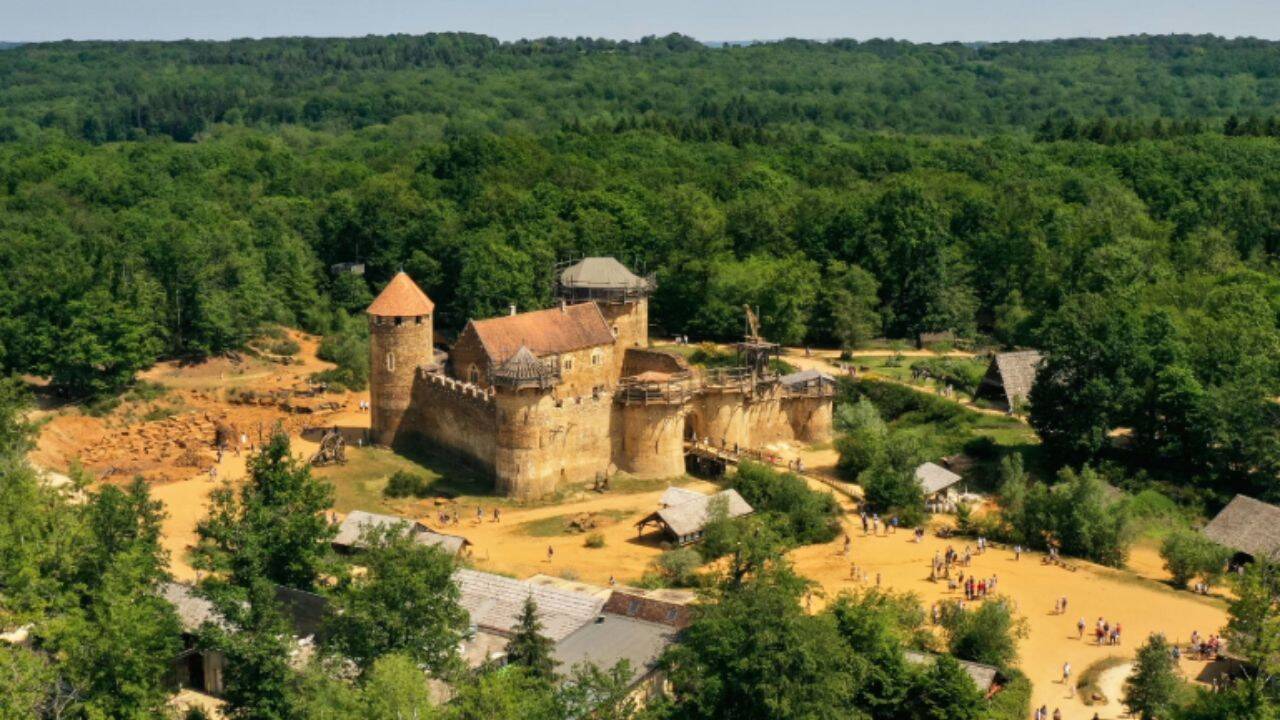
You can’t buy a ticket to the year 1228, but you can drive two hours south of Paris and get pretty close.
In an abandoned sandstone quarry in Burgundy, a team of dozens of artisans is building a medieval fortress from scratch. They aren't using power tools, diesel cranes, or pre-mixed concrete. Instead, they’re hauling stone with horses, mixing mortar by hand, and using human-powered treadwheel cranes to hoist massive blocks into the sky. If you liked this post, you should check out: this related article.
This is Guédelon Castle. The project started in 1997 with a simple, crazy idea: build a castle using only the materials, tools, and knowledge available in the 13th century. Nearly three decades later, the builders are still at work.
If you think this is just an expensive, slow-motion exercise in historical reenactment, you’re missing the point. Guédelon has completely changed how historians understand medieval engineering, and it even played a surprising role in saving one of France’s most famous landmarks. For another look on this story, refer to the recent coverage from National Geographic Travel.
The Genius of Experimental Archaeology
Most of what we know about the Middle Ages comes from looking at ruins or reading dusty manuscripts. But analyzing a crumbling wall only gets you so far. You can't truly understand how medieval builders solved problems until you try to solve those same problems yourself.
That’s called experimental archaeology, and Guédelon is the ultimate laboratory for it.
Take the mortar, for instance. Early in the project, the builders had to figure out how to make lime mortar that would actually hold the stone walls together. There was no instruction manual. They had to experiment with different ratios of local slaked lime and sand, essentially rediscovering a lost recipe through trial and error.
Then there’s the transport. In the 13th century, moving heavy materials over long distances was incredibly expensive and difficult. Because of this, medieval builders had to be master opportunists. The site of Guédelon wasn't chosen at random; it was selected because it sits in a dense oak forest right next to an abandoned sandstone quarry, with a natural clay deposit and a steady water supply nearby. Everything needed to build the castle is harvested within a stone's throw of the site.
How the Castle is Built Without Modern Technology
Watching the artisans work at Guédelon is like watching a highly choreographed, low-tech dance.
The process starts in the quarry, where quarrymen split sandstone blocks using iron wedges and heavy mallets. Stonemasons then take those rough blocks and carve them into precise shapes using hand tools.
To lift these massive stones onto the rising walls, the team uses a wooden treadwheel crane. It’s essentially a giant wooden hamster wheel. A worker climbs inside and walks, using their body weight to wind a rope around a central axle and hoist loads weighing up to a ton.
Every detail is bound by a strict historical timeline. The project organizers established a fictional backstory to guide their decisions. In their historical narrative, construction began in 1228 under the orders of a modest local lord named Jean de Toucy. Every year that passes in real time also passes in the castle’s fictional timeline. This means the builders cannot use any technology or architectural styles that emerged after the mid-13th century.
Saving Notre-Dame
For a long time, critics viewed Guédelon as a quirky tourist attraction. That changed after April 15, 2019, when a devastating fire destroyed the roof and spire of Notre-Dame Cathedral in Paris.
When the French government pledged to rebuild the cathedral exactly as it was, they ran into an immediate problem: nobody in modern France knew how to work with massive oak timbers using 13th-century hand axes.
Except, of course, the carpenters at Guédelon.
Over twenty years of squaring logs and fashioning complex wooden roof trusses with hand tools meant the Guédelon team possessed the exact, highly specialized knowledge needed for the reconstruction. Carpenters trained at Guédelon were recruited to help rebuild the medieval framing of Notre-Dame, proving that the ancient skills kept alive in this Burgundy forest are far from obsolete.
Why the Endless Construction is the Whole Point
If you visit Guédelon hoping to see a completed, polished castle, you’ll probably be disappointed. But completion was never the goal.
Once a castle is finished, the learning stops. The magic of Guédelon is in the process—the messy, difficult, trial-and-error work of building. It's a living museum where you can smell the woodsmoke from the blacksmith's forge, hear the rhythmic clinking of the stonemasons' chisels, and talk directly to the people who are keeping these ancient crafts alive.
If you want to experience this firsthand, you can actually visit the site in Treigny, France. The castle is open to the public from April through October each year, and the entry fees directly fund the ongoing construction and the salaries of the artisans.
Pack your sturdiest walking shoes and leave your expectations of modern speed at the gate. Step into the quarry, watch the treadwheel turn, and appreciate a place where progress is measured in inches, not updates.