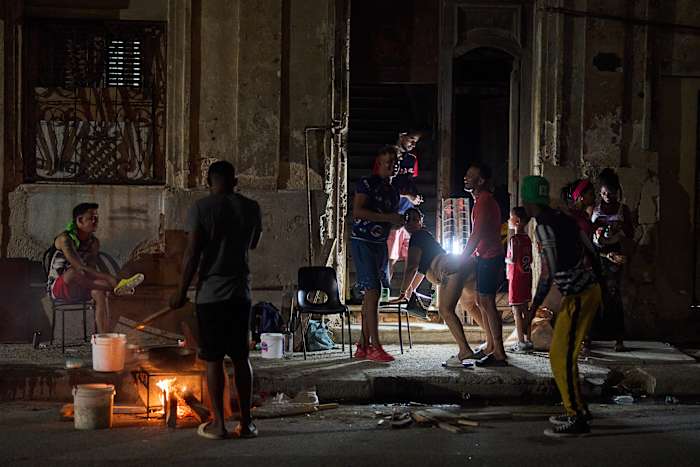
The collapse of Cuba’s national electric system (SEN) is not an isolated mechanical failure but a terminal expression of thermodynamic and capital exhaustion. When the Antonio Guiteras thermoelectric plant—the island’s most significant individual generation asset—desynchronizes from the grid, it triggers a kinetic chain reaction that the existing infrastructure is physically unable to damp. This systemic instability is the result of three converging vectors: the centralization of failure points, a chronic deficit in spinning reserves, and the degradation of thermal efficiency across the aging Soviet-era fleet.
The Architecture of Total Grid Collapse
The Cuban power grid functions as a "weakly interconnected" system. Unlike continental grids that benefit from the massive inertia of thousands of linked generators, a small island grid must balance frequency and voltage within extremely tight tolerances.
The mechanics of the recent massive outage follow a predictable sequence of frequency decay:
- The Trigger Event: A localized failure at the Antonio Guiteras plant (Matanzas) removes approximately 280 MW of base-load capacity instantaneously.
- Frequency Deviation: Because the total system load often exceeds available generation, the loss of a major unit causes the system frequency to drop below the standard 60 Hz.
- The Failure of Under-Frequency Load Shedding (UFLS): In a healthy grid, automatic relays cut power to specific neighborhoods to balance the load. In the Cuban context, the gap between demand and supply is so narrow that the UFLS cannot trip fast enough to prevent the remaining generators from "stalling."
- Cascading Desynchronization: To protect their own internal components from physical damage caused by low frequency, other plants (such as Felton or Mariel) automatically disconnect. The result is a "Black Start" requirement across the entire landmass.
The Three Pillars of Generation Decay
Understanding why a single plant repair does not solve the energy crisis requires disaggregating the three specific types of failure currently plaguing the SEN.
1. The Maintenance Deficit (Capital Exhaustion)
Thermoelectric plants are designed for a lifecycle of approximately 25 to 30 years. The backbone of Cuba’s generation consists of units that have surpassed 40 years of continuous operation. The "repair" mentioned in recent reports often refers to "patching" boiler tubes or cleaning condensers—actions that address symptoms rather than the underlying metallurgical fatigue.
The cost function here is exponential: as the equipment ages, the mean time between failures (MTBF) decreases while the mean time to repair (MTTR) increases due to the scarcity of specialized components. This creates a "death spiral" where units are rushed back online before completing full maintenance cycles, leading to more frequent and more severe subsequent breakdowns.
2. The Fuel Caloric Imbalance
Cuba relies heavily on heavy crude oil (crude d’état) produced domestically. This fuel has a high sulfur content, which is highly corrosive to the boiler internals of the thermoelectric plants.
- Thermal Efficiency: Using low-quality fuel reduces the heat rate of the plants, meaning more fuel must be burned to produce the same megawatt-hour.
- Infrastructure Erosion: The sulfurous byproduct accelerates the fouling of heat exchangers, requiring more frequent shutdowns for cleaning—a direct trade-off between short-term generation and long-term stability.
3. The Distributed Generation Paradox
In response to previous total failures, Cuba invested heavily in "distributed generation"—thousands of small diesel and fuel-oil generators. While this was intended to provide a buffer, it introduced a logistical bottleneck. These units require a constant, truck-based supply chain of refined fuel, which is more expensive and harder to manage than the pipeline or tanker supply used by large thermal plants. When the large plants fail, the distributed units cannot carry the base load; they are designed for peaking, not continuous operation.
Quantifying the Resilience Deficit
The stability of a power grid is roughly proportional to its "Inertia." Inertia is provided by the massive spinning rotors of large turbines. When a system shifts toward smaller, distributed units or intermittent renewables without synchronized condensers, its "Synthetic Inertia" is low.
$$I_{sys} = \sum_{i=1}^{n} \frac{H_i \cdot S_i}{f_{nom}}$$
In this framework, $H$ represents the inertia constant and $S$ the rated power. As the large thermal plants (high $H$) fail and are replaced by smaller, fragmented units or temporary floating power barges (Turkish Karpowerships), the total system inertia ($I_{sys}$) drops. This makes the grid hypersensitive to even minor fluctuations. A single tripped circuit breaker in a sub-station can now cause a national blackout that previously would have been a flickering light.
The Bottleneck of the Black Start
Restarting a national grid from zero—a Black Start—is one of the most complex maneuvers in electrical engineering. It requires "islanding," where a small generator starts and then slowly picks up a small amount of load, then connects to a larger plant to provide it the "startup power" it needs to heat its boilers.
The current strategy relies on the Antonio Guiteras plant as the "anchor." However, if the transmission lines connecting Matanzas to Havana or the eastern provinces are degraded, the "cranking power" cannot reach the other plants. The physical state of the high-voltage transmission lines (220kV and 110kV) is a silent factor; salt-spray corrosion on insulators and aging transformers mean that even if the plants are "repaired," the energy cannot be effectively moved to the centers of consumption.
Strategic Realities of the "Floating" Solution
The integration of Turkish power barges (Karpowerships) provides a temporary injection of capacity, but it introduces a foreign exchange dependency. These barges operate on a "power purchase agreement" model, requiring payment in hard currency.
- Operational Integration: These ships feed power into the grid at specific nodes (like Mariel or Havana).
- Structural Limitation: While they provide immediate megawatts, they do not resolve the underlying weakness of the inland transmission network. They act as a life-support system rather than a cure for the domestic generation fleet.
Risk Assessment of the "Repaired" Status
When official reports state that a plant has been "repaired," it is essential to distinguish between a "General Overhaul" and "Emergency Recovery."
- Emergency Recovery: This usually involves bypassing damaged sections or welding leaks. It restores capacity but does not reset the clock on the unit's failure probability.
- General Overhaul: This involves a total teardown and replacement of turbine blades and boiler walls. Cuba has not had the capital or the "down-time" window to perform a general overhaul on its major units in years.
The "repaired" Antonio Guiteras plant is currently operating in a state of high-stress equilibrium. Any deviation in fuel quality, a spike in ambient temperature (affecting cooling efficiency), or a minor sensor malfunction will likely trigger the next collapse.
The primary strategic move for the energy sector is no longer the restoration of the 20th-century centralized thermal model. The path toward grid stability requires the immediate deployment of massive-scale Battery Energy Storage Systems (BESS) at key nodes. These systems can provide the "Instantaneous Frequency Response" that the aging mechanical turbines can no longer offer. Without electrochemical storage to act as a shock absorber, the Cuban grid will remain a binary system: either fully operational under extreme stress or completely dark. The focus must shift from "fixing the boiler" to "stabilizing the frequency" through non-kinetic means.