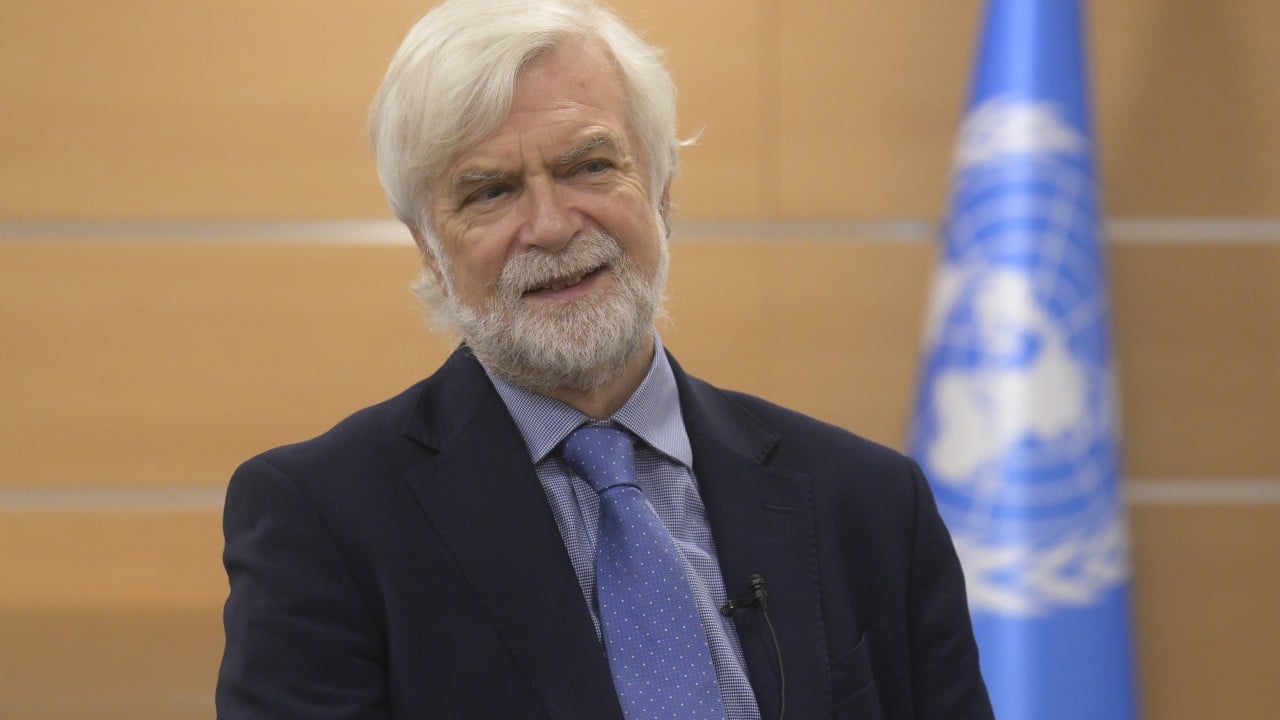
The United Nations climate apparatus is currently navigating its most precarious era since the signing of the Paris Agreement. With the United States officially retreating from its previous commitments, a massive structural void has opened in the international order of carbon diplomacy. This isn't just about a single nation's policy shift; it is a fundamental realignment of who owns the future of energy. While the UN body attempts to maintain a semblance of continuity, the gravitational center of the green transition has shifted decisively to the East. China is no longer just participating in the renewable energy market—it is effectively the market.
The Washington Vacuum
When the United States pulls back from international climate treaties, it does more than just stop hitting emission targets. It removes the financial and diplomatic scaffolding that holds the UN framework together. The immediate result is a crisis of confidence among developing nations that rely on American capital and technology transfers to justify their own transitions.
The UN climate body is currently forced into a defensive posture. Officials are working behind the scenes to convince the remaining signatories that the process remains viable without the world’s largest economy. However, the numbers tell a different story. The absence of U.S. funding for the Green Climate Fund creates a multibillion-dollar shortfall that no other Western power seems willing or able to bridge. This fiscal gap slows down projects in emerging markets, from offshore wind in Southeast Asia to solar grids in Sub-Saharan Africa.
The logic of American withdrawal is often framed as a defense of domestic industry. In reality, it may be the greatest strategic miscalculation of the decade. By stepping away from the negotiating table, the U.S. yields its influence over the standards and regulations that will govern the next fifty years of global trade. If you aren't at the table, you're on the menu.
Beijing's Industrial Hegemony
While Western capitals debate the costs of the transition, China has treated decarbonization as a brutal race for industrial dominance. The scale of their deployment is staggering. China is currently installing more solar capacity than the rest of the world combined. This isn't a gesture of environmental altruism; it is a calculated play for energy independence and global export supremacy.
The Monopoly on Supply Chains
China controls nearly 80% of the global solar supply chain. From the processing of polysilicon to the assembly of finished modules, the world is effectively dependent on Chinese factories. They have achieved an economy of scale that makes it nearly impossible for Western startups to compete on price alone.
- Rare Earth Minerals: China processes about 60% of the world’s lithium and 80% of its cobalt.
- Battery Tech: Six of the top ten electric vehicle battery manufacturers are Chinese.
- Wind Power: Chinese turbines are now consistently cheaper and, in many cases, more efficient than European counterparts.
This dominance creates a massive paradox for the UN. On one hand, China's massive investment is the only reason renewable energy prices have plummeted fast enough to keep climate goals within theoretical reach. On the other hand, the global transition is now tethered to the political whims and industrial policies of a single state.
The UN Identity Crisis
The United Nations Framework Convention on Climate Change (UNFCCC) was built for a world where the U.S. and Europe set the agenda. That world ended. The organization now finds itself in the uncomfortable position of being a referee in a game where the biggest players are ignoring the rules or writing their own.
Bureaucrats in Bonn are scrambling to reinvent their relevance. They are shifting focus toward "non-state actors"—cities, regional governments, and multi-national corporations—to maintain momentum. This strategy assumes that the private sector can bypass national gridlock. It is a risky bet. Corporations, despite their glossy sustainability reports, ultimately follow the path of least resistance and highest profit. Without the "stick" of national legislation, voluntary corporate commitments are often little more than sophisticated PR.
The Carbon Border Conflict
We are moving toward a world of "climate clubs" and trade barriers. The European Union is already moving forward with its Carbon Border Adjustment Mechanism (CBAM). This is a tax on carbon-intensive imports like steel, cement, and electricity. It is designed to protect European industries that have to pay for their emissions from being undercut by countries with lower standards.
China views these mechanisms as a new form of protectionism. The UN is caught in the middle. If the UN body sides with the EU, it risks alienating the very country that is doing the most to deploy renewables. If it ignores the issue, it allows the global trade system to fragment into warring blocks.
This fragmentation is already happening. We are seeing the rise of "green protectionism," where nations subsidize their own clean-tech industries while slapping tariffs on foreign competitors. The dream of a unified, global response to climate change is being replaced by a gritty, competitive industrial war.
Financing the Global South
The most dangerous consequence of the U.S. exit is the growing resentment in the Global South. For decades, the bargain was simple: developing nations would skip the coal-heavy industrialization phase if the West provided the money and tech to go straight to green energy.
That bargain is breaking.
Without the U.S., the financial math simply doesn't work. Private investors are still wary of "high-risk" markets in developing countries, and the remaining public funds are a drop in the bucket. China has stepped into this breach with its Belt and Road Initiative, funding massive infrastructure projects across Africa and South America. However, much of this funding comes in the form of loans, leading to concerns about debt traps and long-term political leverage.
The UN’s inability to secure reliable, large-scale climate finance for poor nations is its greatest failure. It undermines the moral authority of the entire climate movement. If the world’s wealthiest nation walks away from its responsibilities, why should a developing nation sacrifice its own economic growth?
The Myth of the Neutral Transition
The transition to renewable energy is often sold as a peaceful, cooperative venture. It isn't. It is an aggressive restructuring of global wealth. The oil-rich nations of the Middle East are frantically trying to diversify their economies before their primary export becomes a stranded asset. Russia’s influence, heavily tied to gas exports, is at risk of permanent erosion.
China understands this better than anyone. They are not just building solar panels; they are building a new geopolitical architecture. By becoming the world’s primary provider of clean energy hardware, they are creating a new kind of dependency. In the 20th century, power was defined by who controlled the flow of oil. In the 21st century, it will be defined by who controls the technology that captures the sun and the wind.
The Path of Necessary Realism
The UN climate body must stop pretending that the old consensus is coming back. It won't. The era of American leadership in this space is, at best, on a long hiatus and, at worst, finished. The organization needs to pivot from being a facilitator of grand, idealistic treaties to being a hard-nosed coordinator of industrial standards and trade reality.
This means acknowledging that the transition will be messy, competitive, and often unfair. It means finding ways to integrate China’s massive industrial capacity without handing them a total monopoly. It means creating financial instruments that actually work for the Global South, rather than just promising money that never arrives.
The survival of the planet's climate depends on the speed of this transition, but the survival of the current international order depends on how we manage the fallout of the U.S.-China split. We are witnessing the birth of a bipolar energy world.
Stop looking for a return to the status quo. The transition is happening, but it is being driven by industrial competition and national security interests rather than a shared sense of global duty. The UN must adapt to this colder, more pragmatic reality or face total irrelevance.
Invest in the supply chain, not just the sentiment. Focus on the raw materials, the processing plants, and the shipping lanes. That is where the real climate war is being fought. The speeches in the UN plenary halls are just the background noise.
The center of gravity has moved. Follow the silicon. Follow the lithium.
The age of American climate diplomacy is over; the age of the Green Industrial Cold War has begun.