The afternoon heat inside the automotive components factory just outside Stuttgart felt heavy, almost liquid. Marco adjusted his safety glasses, his fingers tracing the edge of a newly stamped aluminum housing. For twenty-two years, his life had possessed a distinct, rhythmic predictability. The machines hummed, the steel arrived from northern suppliers, and the finished parts shipped out to power some of the most celebrated luxury sedans on Earth.
Lately, though, the rhythm had stuttered. For another perspective, see: this related article.
A mile down the road, a brand-new showroom had opened its doors. The vehicles inside didn't bear familiar logos from Munich or Wolfsburg. They were sleek, electric, whisper-quiet, and bore names that most locals still struggled to pronounce. They arrived from across the ocean fully formed, packed with software that made local designs look like historical relics, and priced at a level that Marco knew, down to his very bones, was impossible to match using European wages and European steel.
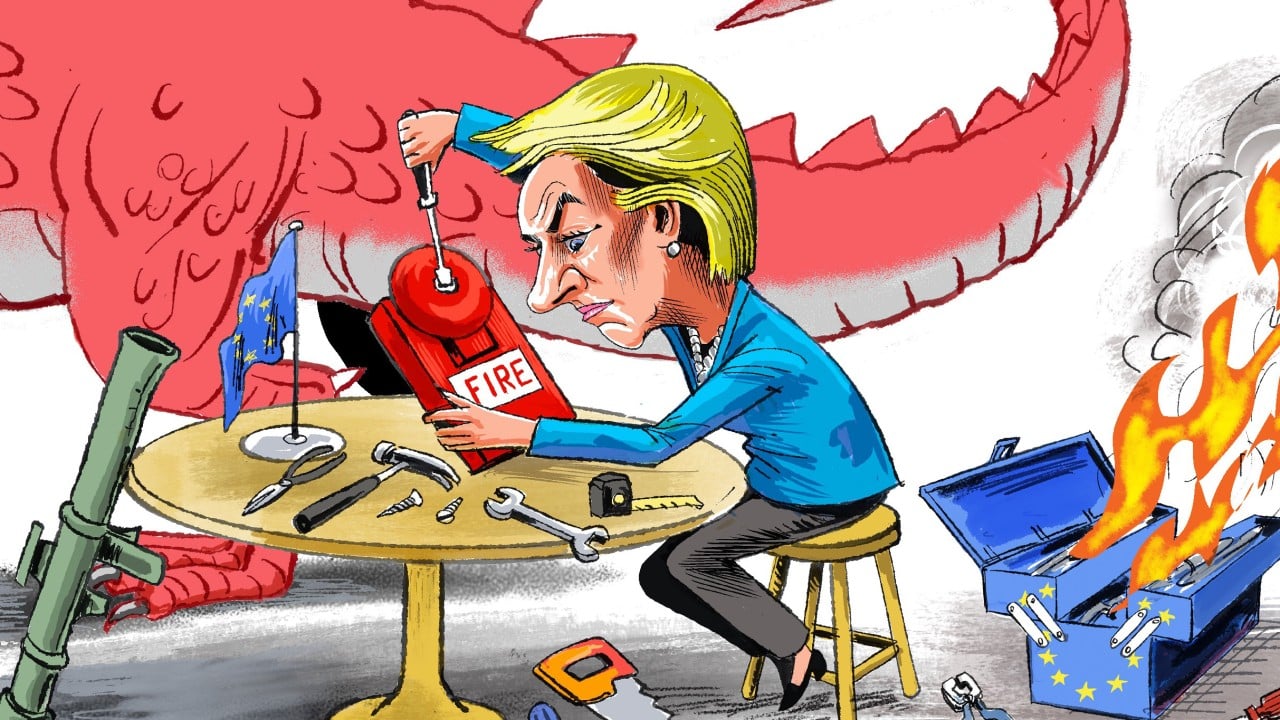
The common diagnosis for Marco’s anxiety is blared across every major news network daily. The story goes like this: Beijing is unleashing a torrent of state-subsidized electric vehicles, solar panels, and wind turbines onto global markets. This second great industrial wave threatens to hollow out Europe’s manufacturing core, turning its proud industrial heartlands into a museum of the twentieth century. The solution, we are told, is simple. Build higher walls. Impose tariffs. Protect the homeland. Further reporting on the subject has been shared by The Motley Fool.
But that story is dangerously incomplete. It mistakes a mirror for a weapon.
When you look closely at the fracturing of the global economic order, a colder truth emerges. The massive influx of foreign goods isn't the sickness tearing through the old continent. It is merely the symptom. The real crisis isn't that a rising Asian superpower is playing too hard; it is that the old world forgot how to play at all.
The Illusion of the Ledger
To understand how we misread the script, consider a bizarre statistical anomaly buried deep within global banking data.
China is currently the world’s second-largest creditor, possessing trillions of dollars in foreign assets. Yet, on paper, its balance of payments shows a strange, massive deficit in investment income. It routinely reports losing over a hundred billion dollars net on interest and dividends. Meanwhile, Germany, with a smaller overall credit footprint, rakes in massive surpluses from its foreign investments.
How can the world’s factory be so bad at making money on its money?
The answer isn't financial incompetence. It is a deliberate choice of architecture. For years, international economic institutions looked at traditional charts and concluded that Europe and China were running similar race tracks because both held massive trade surpluses. But they were looking at a ghost in the machine.
A significant chunk of Europe’s apparent trade dominance was artificially inflated by corporate engineering. Multinational corporations funneled massive profits through small, low-tax European hubs like Ireland, turning intellectual property into phantom exports that never actually touched a factory floor.
China, conversely, spent those decades doing the exact opposite: understating its true trading muscle by shifting how its customs data was recorded, all while suppressing domestic consumption to keep its export engine hyper-competitive.
When you strip away the accounting magic and the corporate tax shelters, a stark reality is laid bare. The true trade imbalance is twice as large as the official reports suggest. The Asian industrial machine isn't just competing; it has spent twenty years building an entirely separate ecosystem.
The Subsidized Myth
Walk back into Marco's factory, and the conversation invariably turns to fairness. "We cannot compete with state money," a foreman tells him over lukewarm coffee.
It is an easy argument to make. The independent data tracking global commerce confirms that overseas manufacturers receive anywhere from three to eight times the direct financial assistance that European firms can legally access. Whole sectors can run at an absolute loss for a decade because state-backed banks will simply refinance the debt forever.
But blaming the entire crisis on unfair checks misses the structural rot within the old world's borders.
Consider Europe's celebrated solar industry. A decade and a half ago, Germany was the undisputed global capital of solar innovation. The technology was refined there. The initial scaling happened there. But when the time came to turn that intellectual spark into an unstoppable mass-manufacturing engine, the system froze.
Local capital was timid. Regulatory approvals dragged on for years. The continent's energy costs skyrocketed because of geopolitical miscalculations.
The industrial transition required massive, unified investments in infrastructure, grid integration, and raw material processing. Instead, European leadership treated the transition like a luxury lifestyle choice—setting aggressive climate targets while starved of the domestic industrial capacity required to meet them.
The rival system didn't just win because of cheap labor or direct grants. It won because it built an integrated supply chain where the mine, the refinery, the battery plant, and the assembly line sat within a short train ride of one another. Europe, meanwhile, outsourced the messy, dirty work of refining and manufacturing, preferring to keep its hands clean while collecting the intellectual property royalties.
Now, the royalties have dried up. The expertise has migrated.
The Price of Stagnation
The true vulnerability of the European project is not a lack of protection; it is a lack of ambition.
For thirty years, the continent functioned under a comfortable assumption: it would design the high-value machines, and the rest of the world would buy them to manufacture everyday goods. It was a beautiful division of labor. It funded generous social safety nets, long vacations, and a high quality of life.
But technology doesn't stand still. The lines between heavy machinery and digital intelligence blurred.
When the automotive world shifted from internal combustion engines—a field where European engineering spent a century perfecting every valve and piston—to electric drivetrains governed by software, the ground vanished beneath the old guard's feet. An electric car is fundamentally a battery pack surrounded by computers.
Look at the corporate boardrooms that dictate Marco's future. For years, executives viewed the electric shift as a compliance exercise rather than an existential race. They delayed battery development, underfunded software divisions, and relied on legacy brand loyalty to keep the margins high.
While they waited, their rivals built the future.
The current panic over foreign competition is an admission of this internal paralysis. Raising tariffs on electric vehicles might provide temporary relief for corporate balance sheets in Paris or Berlin, but it acts as an economic sedative. It shields domestic companies from the urgent necessity of radical reform. It tells Marco that his job is safe because of a legal decree, rather than because his factory is the most efficient or innovative on earth.
It is a promise that cannot be kept.
The True Stake
The human cost of this industrial drift isn't measured in abstract gross domestic product percentages. It is measured in the slow, quiet erosion of communities that defined themselves by what they created.
If Marco’s factory closes, the loss isn't just a line item on a regional government's unemployment registry. It is the destruction of a specific kind of dignity. It is the end of an era where an ordinary worker could look at a masterpiece of engineering driving down the street and say, I helped build that.
To avoid that fate, the continent has to stop looking across the ocean for someone to blame.
The path forward requires a brutal look inward. It requires acknowledging that a regulatory framework designed to prevent domestic monopolies has inadvertently prevented European companies from scaling up to compete globally. It means recognizing that a continent with a fragmented energy policy and a phobia of venture capital cannot outpace an adversary moving with singular, strategic intent.
The competitive shock currently rattling the markets isn't a threat to be managed away with paperwork and border guards. It is an ultimatum.
As dusk fell over Stuttgart, Marco watched the factory lights flicker to life for the evening shift. The heavy presses began their slow, rhythmic thudding once more, stamping out parts for an older world. The machines were still working perfectly, but the air felt entirely different. The future had arrived, uninvited and indifferent to the past, waiting to see if the old world would learn to build again or simply watch the lights go out.