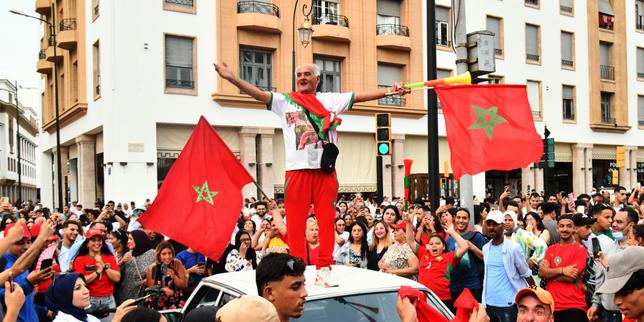
The international press corps fell helplessly in love with a beautiful lie during the Qatar World Cup. You know the narrative because it was pasted across every major news feed for weeks: joyous Moroccan and Egyptian fans, swept up in the euphoria of historic victories, spontaneously transforming stadium concourses and public squares into platforms for pan-Arab unity and Palestinian solidarity. Mainstream commentators wept tears of joy over this supposed organic awakening, declaring it a definitive proof that the political artificiality of the Abraham Accords had been thoroughly crushed by the raw, authentic will of the Arab street.
It makes for a heartwarming script. It is also a lazy, superficial reading of a highly complex geopolitical theater.
What the western media breathlessly framed as a sudden, spontaneous outburst of grassroots activism was actually something far more calculated, deeply institutionalized, and historically managed. Having spent fifteen years analyzing sports diplomacy and state-sponsored fan culture across North Africa and the Levant, I have watched Western observers repeatedly fall into the same trap. They look at a sea of flags and hear a roaring chorus, and they assume they are witnessing a revolutionary spark. They completely miss the structural mechanics underneath. The reality is that the stadium has long ceased to be an alternative space for rebellion in the region; it is a highly regulated pressure valve, deliberately maintained by political actors who know exactly how to use the beautiful game to manage domestic dissent.
The Illusion of the Spontaneous Fan Collective
Let us dismantle the core premise of the mainstream reporting immediately. The idea that hundreds of thousands of fans from across different socio-economic strata suddenly arrived at a unified, vocal political stance purely through the magic of football is a fairy tale.
In North Africa, organized fan groups—specifically the Ultras—do not operate in a vacuum of pure, unadulterated passion. They are sophisticated, highly hierarchical organizations with deep ties to local political dynamics. For over a decade, authorities in Cairo and Rabat have systematically cracked down on stadium political expressions when they target domestic corruption or economic failure. The Egyptian state effectively dismantled the leadership structures of major Ultras groups like the Al Ahly and Zamalek collectives after the geopolitical upheavals of the early 2010s, strictly censoring what can be chanted within domestic borders.
When these fans travel abroad, or when domestic spaces are suddenly opened up for specific types of chanting, it is not an escape from state surveillance. It is a permitted detour.
- The Permitted Detour Mechanism: Authoritarian frameworks survive by understanding where to bend so they do not break. Permitting fierce, vocal solidarity for an external, universally agreed-upon cause like Palestine serves as the ultimate national pressure valve.
- The Diversionary Effect: It allows a population frustrated by soaring inflation, currency devaluations, and restricted civil liberties to channel their collective anger outward into a safe, sanctioned arena.
When an Egyptian fan sings for Palestine in Doha, they are expressing a deeply held, genuine personal belief—let us not deny them their authenticity. But the structural permission to mass-produce that expression without state interference is a calculated political affordance. It is a crucial distinction that Western journalists, looking for a simple David versus Goliath narrative, completely failed to grasp.
The Strategic Irony of Moroccan Football Diplomacy
The hypocrisy of the mainstream commentary becomes glaringly obvious when you analyze the specific geopolitical positioning of Morocco during that tournament.
The Western press celebrated Moroccan players hoisting the Palestinian flag after defeating Spain and Portugal, framing it as a direct, defiant middle finger to the Moroccan state’s official normalization of relations with Israel. This reading is laughably naive. It assumes the Moroccan Royal Federation and the security apparatus were somehow caught off guard by their own national team on the world's biggest stage.
In reality, the Moroccan state utilized the tournament as an absolute masterclass in dual-track diplomacy.
+-----------------------------------+-----------------------------------+
| Track 1: Elite Diplomacy          | Track 2: Populist Legitimacy      |
+-----------------------------------+-----------------------------------+
| Maintained strategic defense and  | Allowed national team and fans to |
| economic pacts with international | project unyielding pan-Arab and   |
| partners behind closed doors.     | Islamic solidarity on the pitch.  |
+-----------------------------------+-----------------------------------+
By allowing—and subtly endorsing—the visibility of Palestinian solidarity on the pitch, the Moroccan establishment effectively insulated itself from domestic accusations of selling out the Arab cause. The football team became a shield. It provided the monarchy with a massive injection of populist legitimacy at home and across the wider region, while changing absolutely nothing about Rabat's hard-nosed, transactional foreign policy objectives. It was brilliant statecraft, executed not in spite of the fans' behavior, but through it.
Dismantling the People Also Ask Nonsense
If you look at the algorithmic questions driving public interest around this topic, the intellectual laziness of the conversation becomes even clearer. The internet is constantly asking variations of these three fundamentally flawed questions:
Do football wins actually advance regional peace?
Absolutely not. To think that a collective chant in a stadium translates into a shift in borders, treaty renegotiations, or concrete diplomatic leverage is pure delusion. Sports solidarity provides psychological comfort and cultural capital, but it lacks any material mechanism to alter structural power realities. The day after the World Cup final, the brutal economic blockades, military occupations, and diplomatic treaties remained exactly where they were before the first whistle blew.
Why does the West view Arab football culture as inherently dangerous?
Because Western media suffers from a chronic inability to view Arab crowds without an orientalist lens. When European fans riot, sing nationalist songs, or set off flares, it is analyzed as a localized subculture or a law-and-order issue. When Arab fans gather in massive numbers and display intense collective emotion, the Western lens immediately shifts to a framework of existential threat or volatile revolutionary potential. They cannot comprehend the stadium as a highly organized, nuanced civic space, so they reduce it to a caricature of either terrifying mob violence or utopian political awakening.
Is pan-Arabism reborn through sports?
No. Pan-Arabism as a functional political ideology died decades ago. What you saw in Qatar was not the resurrection of a unified political project, but the manifestation of shared cultural trauma and linguistic community. Confusing shared emotional reactions to a football match with a unified political will is the ultimate rookie mistake in geopolitical analysis. The domestic interests of Egypt, Morocco, Algeria, and the Gulf states remain fiercely distinct, competitive, and often deeply adversarial. A ninety-minute football match will never erase deep-seated regional rivalries over resources, borders, and hegemony.
The Cost of the Feel-Good Narrative
There is a dark side to this obsession with romanticizing stadium chants. When you tell a population that singing in a stadium is a meaningful form of political resistance, you are selling them a sedative. You are validating an exercise that requires zero systemic risk, changes no laws, and challenges no actual dictators.
I have spent years interviewing former Ultras leaders who now look back on their stadium days with bitter cynicism. They realize they were playing a game where the rules were written by the very regimes they thought they were defying. The regime allows you to scream for two hours, lets you burn an effigy or wave a flag, and then sends you home through a heavily policed exit while they continue to run the economy into the ground.
By cheering on this performance as a profound geopolitical shift, international commentators became complicit in this pacification strategy. They helped market the pressure valve as if it were the engine of change.
Stop looking at the stadium as a laboratory for geopolitical revolution. It is, and always has been, a theater of containment. The flags were real, the emotion was real, but the political impact was precisely zero. The sooner we stop mistaking collective choreography for actual political power, the sooner we can begin to understand the real, brutal, unromantic dynamics of power in the region.