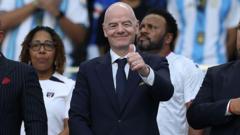
The hum of the air conditioning inside the Zurich boardroom is the only sound that competes with the weight of expectation. Outside, the Swiss air carries a sharp autumn chill, but inside, the atmosphere is heavy, thick with the scent of coffee, expensive wool suits, and unspoken tension.
Gianni Infantino sits at the head of the table. He is surrounded by men and women who hold the financial lifeblood of the global game in their palms. To the casual fan watching from a pub in Manchester or a dusty pitch in Buenos Aires, FIFA is an abstraction—a distant acronym that pops up on television screens during World Cup draws or scandal headlines. Yet, in rooms like this, the abstract becomes intensely concrete. Decisions made here ripple outward, dictating the schedules of exhausted athletes, the revenue streams of historic clubs, and the dreams of children who sleep in shirts bearing the names of modern gods.
Consider the ordinary Tuesday of a professional midfielder. Wake up. Ice the knee. Check the flight schedule. Fly across continents for a mid-week international fixture. Fly back. Play a domestic league match. Repeat.
Now, look back at the boardroom.
The agenda on the mahogany table is not just a list of agenda items; it is a pressure test on the physical limits of human endurance. Executives lean forward. Papers rustle. Questions hang in the air like smoke. How much more can the human body take before the system breaks?
The Arithmetic of Exhaustion
To understand the friction between FIFA leadership and executive stakeholders, you have to look at the numbers. But forget spreadsheets for a moment. Picture a single player, lungs burning in the ninety-fourth minute of extra time, legs heavy as lead.
That fatigue is monetized. Expanded tournaments, newly minted club competitions, and global tours generate billions of dollars. They also compress recovery windows into vanishingly small slivers of time.
When Infantino faces the executive committee, the central conflict is rarely about the love of the sport. It is about a fundamental clash of horizons. Broadcasters and commercial partners want eyes on screens twelve months a year. Managers and medical staff warn that players are running on borrowed time.
Let us walk through a hypothetical scenario to ground this reality. Imagine Marcus, a twenty-four-year-old starter for a top European club and his national team. Last year, Marcus played seventy-two matches. That is not a typo. Seventy-two high-intensity matches, excluding travel days, promotional obligations, and tactical training sessions. By April, his hamstring began to whisper warnings. By May, those whispers turned into a tear.
Who pays the price when the calendar overloads? Marcus does, with months of lonely rehabilitation in a quiet gym, watching his team chase glory from a television screen.
The executives in Zurich know this. They stare at the data points scrolling across their tablets. They see the injury rates spiking year-on-year. Yet, the gravitational pull of expansion remains immensely powerful. More matches mean more revenue. More revenue means more funding distributed to smaller federations across the globe—a point Infantino frequently champions as democratization of the sport.
The Great Redistribution
Here lies the paradox that defines modern football administration.
On one hand, elite players are pushed toward the brink of physical collapse. On the other hand, the financial engine driving this expansion pumps resources into regions of the world that have historically been starved of football infrastructure.
When critics argue against the relentless growth of the international match calendar, they are entirely correct about the toll on elite athletes. But when FIFA defends its expansionist strategy by pointing to grassroots programs in developing football nations, they are also speaking a verifiable truth. Two opposing realities coexist in the same breath.
Step inside a newly constructed training facility in a rural province far away from the glamour of European capitals. Synthetic turf laid down with development grants. Goalposts that do not wobble. Kits that do not smell of damp storage rooms. For a generation of kids playing on those pitches, the decisions made in sleek Swiss boardrooms translate directly into opportunity.
This is the tightrope Infantino walks. He is simultaneously the CEO of a multi-billion-dollar entertainment conglomerate and the steward of a global cultural heritage.
The Invisible Stakes
Meetings adjourn late into the evening. The coffee turns cold. The digital clocks on the wall tick toward midnight.
Outside, the lights of Zurich reflect off the dark waters of the lake. Inside, the debate shifts to broadcast rights, governance reforms, and revenue-sharing models that will shape the next decade. No dramatic shouting matches disrupt the quiet decorum. Power in the modern era rarely screams; it negotiates in low murmurs over polished wood.
Yet, every policy shift hatched under these fluorescent lights will eventually manifest on a muddy pitch on a rainy Wednesday night. It will decide whether a teenager makes it to the professional ranks or burns out before their twentieth birthday. It will determine whether a historic rivalry retains its soul or becomes just another content delivery mechanism for a streaming service.
The executive committee packs their leather folios. They step out into the crisp night air, heading toward waiting cars and private terminals. The room empties. The hum of the air conditioning continues, indifferent to the massive weight of the game it quietly oversees.