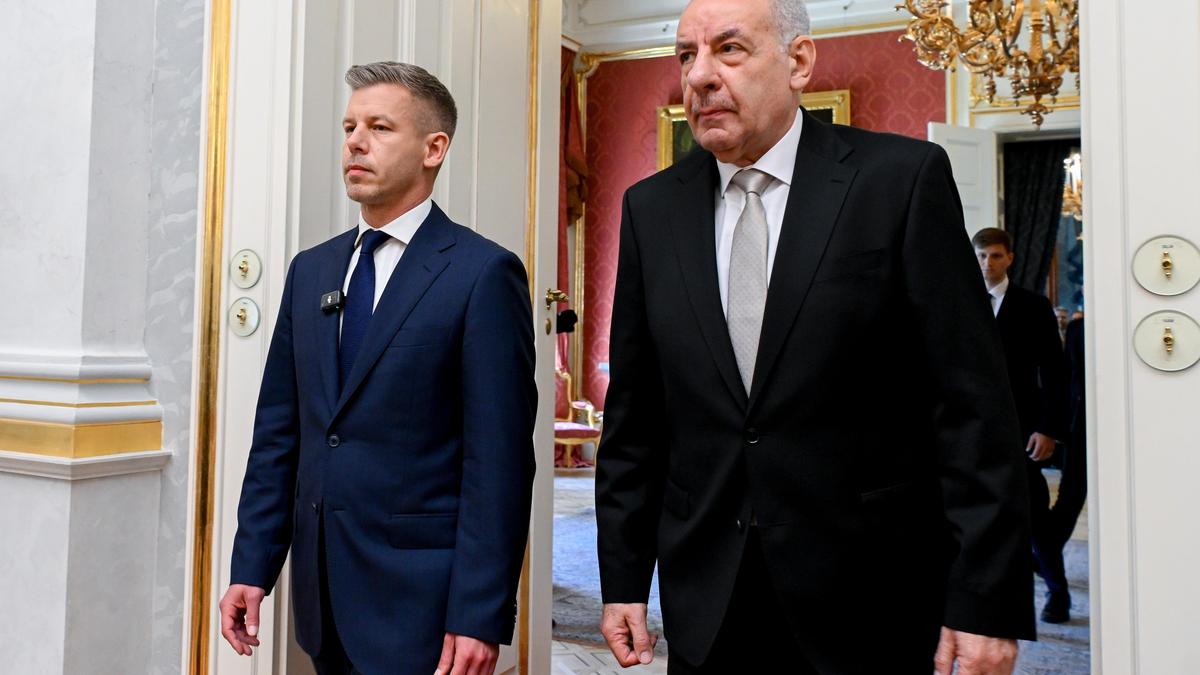
The air inside the Sándor Palace usually smells of old parchment and the faint, metallic tang of prestige. It is a building designed to project stability. But lately, that stability feels like a thin sheet of ice stretched over a very deep, very cold lake.
Tamás Sulyok sits in the middle of this silence. As the President of Hungary, his role is largely ceremonial—a guardian of the constitution, a signature on a page, a symbol of the nation. He is not supposed to be the protagonist of a political thriller. Yet, he currently finds himself at the center of a high-stakes staring match with the most powerful man in the country: Prime Minister Péter Magyar.
Magyar wants him gone. Sulyok refuses to move.
To understand why this matters beyond the borders of Central Europe, you have to look past the official press releases. This isn't just a squabble between two men in expensive suits. It is a friction point where the old guard of Hungarian legalism meets a new, aggressive wave of political restructuring. When a Prime Minister publicly demands a President’s resignation, and that President says "no," the gears of a democracy don't just grind; they scream.
The Weight of the Signature
Power in a parliamentary republic is a strange, liquid thing. It flows mostly toward the Prime Minister, leaving the President as a sort of ornamental dam meant to regulate the flood. For Sulyok, a former head of the Constitutional Court, the law is a secular religion. He views his position not as a gift from a political party, but as a constitutional mandate.
When Péter Magyar—the charismatic former insider turned revolutionary leader—ascended to the premiership, he did so on a platform of "total renewal." To Magyar, Sulyok represents the remnants of a system he was elected to dismantle. He sees a roadblock. Sulyok sees a foundation.
Consider a hypothetical watchmaker. If the Prime Minister is the one who winds the spring to make the hands move, the President is the casing that protects the delicate internal balance. Magyar is arguing that the casing is cracked and needs replacing to keep the watch running on time. Sulyok argues that if you remove the casing while the gears are spinning, the whole mechanism will fly apart.
The pressure began as a whisper. Then it became a headline. Now, it is a siege. Magyar’s supporters have taken to the streets and the airwaves, painting Sulyok as an obstacle to the "will of the people." In modern politics, "the will of the people" is often used as a sledgehammer against the "rule of law."
The Loneliness of the Holdout
There is a specific kind of courage—or perhaps stubbornness—required to stay in a room when everyone outside is shouting for you to leave. Sulyok is operating from a position of profound isolation. He has no private army. He has no legislative bloc to protect him. All he has is a piece of paper that says he belongs there until his term ends.
Magyar’s strategy is one of exhaustion. By keeping the President under constant fire, he ensures that every delay in government, every legislative hiccup, and every economic tremor can be blamed on the "recalcitrant" palace. It is a masterclass in political framing. If the country isn't changing fast enough, it's because the man in the Sándor Palace won't pick up his pen.
But why won't he?
Sulyok’s resistance isn't necessarily about personal vanity. It’s about the precedent. If a President resigns simply because a Prime Minister finds him inconvenient, the office ceases to be an independent check. It becomes a temp agency. By staying, Sulyok is forcing a conversation about the nature of Hungarian democracy: Is the law a set of permanent tracks, or is it a GPS route that the driver can recalculate whenever they see a shortcut?
The stakes are invisible but heavy. They involve the trust of international markets, the eyes of Brussels, and the internal psyche of a nation that has spent decades oscillating between authoritarian shadows and democratic light.
The Echoes in the Hallway
History is a heavy ghost in Budapest. The city’s architecture is a constant reminder of empires that thought they would last forever and vanished in a weekend. Sulyok knows this history. He knows that once the boundaries of an office are breached, they are rarely rebuilt.
Magyar is betting on the future. He represents a generation that is tired of the slow, grinding process of institutional checks and balances. They want results. They want the "new Hungary" they were promised. To them, Sulyok’s legalism feels like a pedantic distraction from a national emergency.
This creates a dangerous disconnect. On one side, you have the logic of the court: precise, slow, and anchored in text. On the other, you have the logic of the movement: emotional, rapid, and anchored in momentum. These two worlds are currently colliding in the person of Tamás Sulyok.
He remains at his desk. The PM remains at the podium.
The standoff has paralyzed the usual rhythm of the capital. Decisions are being weighed not by their merit, but by how they might influence the "Presidential problem." It is a war of nerves where the primary weapon is silence. Sulyok’s refusal to engage in a public mudslinging match with Magyar has, ironically, made him a more formidable opponent. You can't argue with a man who simply points at the constitution and stops talking.
The Fragility of the Status Quo
We often think of political crises as explosions—coups, riots, dramatic collapses. But most crises are actually slow leaks. They are the gradual erosion of norms that everyone took for granted. The "pressure" Magyar is applying is an attempt to see if the Presidential office is made of stone or glass.
If Sulyok breaks, the Prime Minister gains total control over the narrative of the state. If Sulyok holds, Magyar faces his first real limit. For a leader who has built his reputation on being an unstoppable force, hitting an immovable object is a branding disaster.
The streets outside the palace are beautiful this time of year. Tourists take photos of the changing of the guard, unaware that the real shift is happening behind the windows. The guards move with a choreographed, rhythmic precision, oblivious to the fact that the man they are protecting is currently the most debated figure in the country.
There is no easy exit for either man. For Magyar to back down would be a sign of weakness to his base. For Sulyok to resign would be an admission that the law is secondary to political popularity.
So, the staring match continues.
The Sándor Palace stands on a hill, overlooking the Danube. It looks solid. It looks permanent. But as the sun sets over the Parliament building across the water, the shadows it casts are long and jagged. The President is still there. The Prime Minister is still waiting. And the country is held in the breath between a "yes" and a "no."
The ink on the next decree is dry, but the hand that holds the pen isn't moving.