The stadium lights in Paris do not just illuminate; they interrogate. They bounce off the polished track, the chrome of high-performance wheelchairs, and the sweat-beaded brows of humans who have already defeated biology before even reaching the starting blocks. But as the opening ceremony for the Paralympic Games unfurled, a specific kind of silence began to compete with the roar of the crowd.
It was the silence of a missing flag.
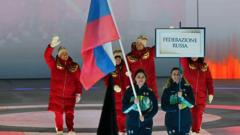
When the delegation of Russian athletes began their procession, the visual shorthand we use to understand global sport—the tricolor stripes, the national anthem, the crest of the federation—was gone. In its place was a vacuum. They marched under a pale, neutral banner, stripped of their geography and their state identity. They were there, but they were not "there."
To understand the weight of that walk, you have to look past the political headlines and into the marrow of what it means to be an elite athlete in a body that has already survived a different kind of war.
The Weight of the Invisible
Imagine spending four years—or in the case of the shifting Olympic cycles, even longer—refining a single muscle twitch. You wake up at 4:00 AM. You push through the searing pain of phantom limbs or the neurological fog of cerebral palsy. You do this because you believe that, for one minute on a global stage, you will represent something larger than your own struggle. You will be the pride of a neighborhood, a city, a nation.
Then, the world changes.
Decisions made in wood-paneled rooms thousands of miles away suddenly strip you of your colors. Because of the ongoing invasion of Ukraine, the International Paralympic Committee (IPC) decreed that these athletes could only participate as neutrals. No "Russia." No "Rossiya" on the jacket. Just a blank space where a home used to be.
This isn't just about branding. It is about the psychology of the arena. When an athlete looks into the stands and cannot find their flag, the equilibrium of the competition shifts. They are no longer ambassadors; they are survivors of a geopolitical wreckage, allowed to compete only if they remain politically invisible.
The Paradox of the Neutral
The crowd’s reaction is a complex chemical soup. There is the instinct to cheer for the triumph of the human spirit—the very core of the Paralympic movement—clashing violently with the moral outrage of a continent at war.
Consider the "Neutral" athlete. To qualify for this status, they had to prove they had no active link to the military and had offered no public support for the war. It is a vetting process that turns a sportsperson into a legal case file. They arrived in Paris via backdoors and quiet bookings, avoided by some, pitied by others, and scrutinized by everyone.
The tension is a physical thing. It sits in the throat.
Critics argue that their presence at all is a betrayal of the Ukrainian athletes who have had to train in bomb shelters, their tracks cratered by missiles, their coaches traded for rifles. To those critics, the neutral flag is a thin veil that fails to hide the bloodstain of state aggression. They see the athletes not as individuals, but as soft-power assets of a regime that has forfeited its right to play.
But then, look at the athlete.
Is a swimmer with a spinal injury responsible for the movement of tanks? Does the disqualification of a blind sprinter bring peace to a besieged city? This is the agonizing friction of the modern Games. We want sport to be a sanctuary, a place where the "Faster, Higher, Stronger" mantra transcends the dirt of diplomacy. Yet, Paris 2024 proves that the sanctuary has no roof. The rain of the real world gets in.
A Walk on Shifting Sand
The ceremony continued. The Seine flowed, indifferent to the heat of the debate. As the neutral delegation passed, the cheers were filtered. Not the full-throated roar reserved for the home team or the sentimental favorites, but a polite, hesitant patter.
It was the sound of a world that doesn't know what to do with its contradictions.
For the athletes from Ukraine, the sight of these "neutrals" is not a triumph of inclusion; it is a source of profound, quiet fury. For them, the stakes are not a medal count. The stakes are the survival of their families back in Kyiv, Kharkiv, and Odesa. When they see a neutral athlete in the dining hall, they don't see a fellow competitor. They see a shadow of the force that is trying to erase their own flag from the map.
This is the invisible competition happening alongside the shot put and the handcycling. It is a contest of narratives.
The Cost of Cold Facts
The numbers tell one story: dozens of athletes, hundreds of hours of vetting, a specific count of medals that will not be added to a national tally. But the numbers are cold. They don't capture the moment an athlete realizes their career peak will be forever marked with an asterisk.
They don't capture the loneliness of standing on a podium while a generic melody plays instead of the song they grew up singing.
Sporting history usually remembers the winners. But Paris will remember the ghosts. It will remember the athletes who were invited to the party but told they couldn't bring their names. It will remember the way the Paralympic movement—built on the idea of radical inclusion—struggled to define the boundaries of its own mercy.
As the flame was lit, the shadows grew longer. The Games began, and the clock started ticking. In the pools and on the courts, the "neutrals" will break records. They will heave weights and sprint through the dark. They will perform miracles of physics.
But as they cross the finish line, they will reach for a flag that isn't there. They will look for a recognition that the world is not yet ready to give. They are the human faces of a global fracture, reminders that even in the city of light, there are corners where the sun doesn't reach, and where the only thing heavier than a silver medal is the weight of a country you are no longer allowed to claim.
The stadium eventually went dark, leaving only the memory of those pale banners fluttering in the wind, symbols of a peace we haven't found and a grace we are still learning how to afford.