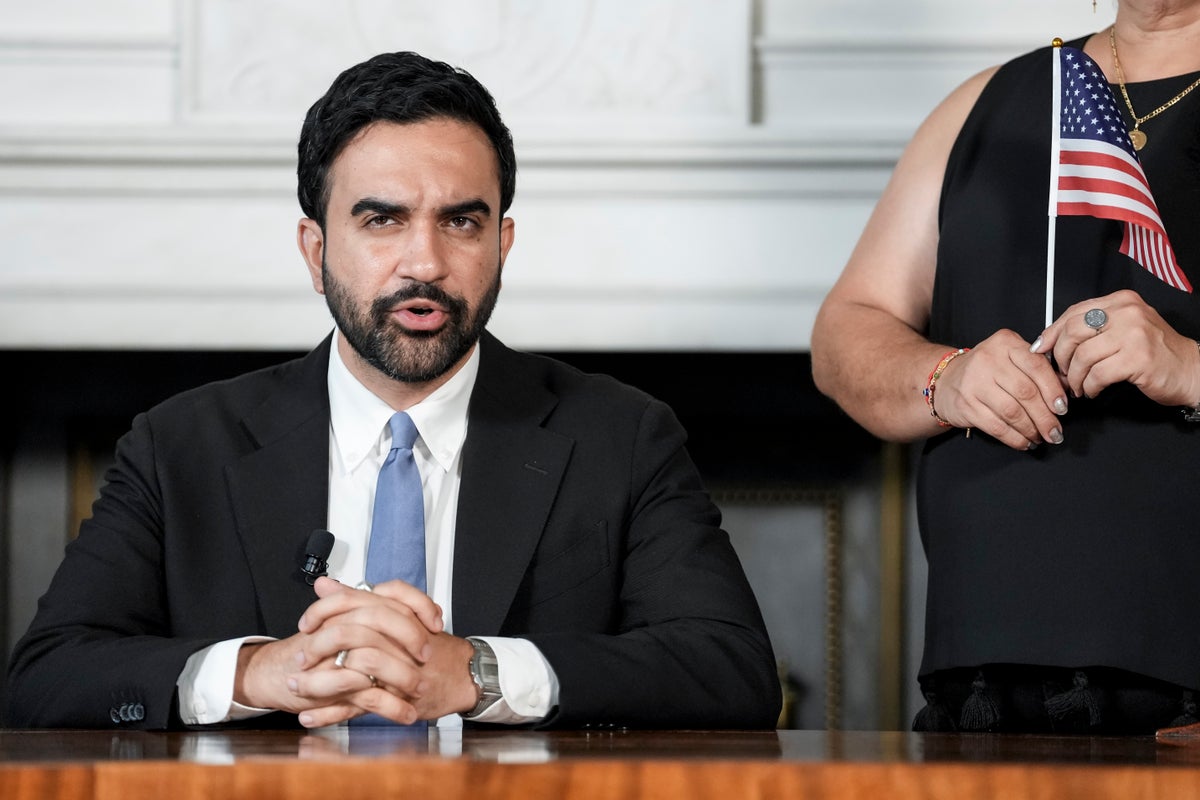
The wood is heavy, dark, and scarred by centuries of history. It is the New York City Hall desk once used by George Washington, a relic from an era when a fragile new republic was trying to define what it meant to belong. On the Fourth of July, while fireworks burst over the East River and the scent of charred asphalt and backyard barbecues filled the heavy summer air, Zohran Mamdani sat behind that very mahogany.
He did not look like the ghosts who usually inhabit such spaces. He is young, Muslim, the son of immigrants, representing a Queens neighborhood where dozens of languages collide on a single subway platform. Recently making news in this space: Donald Trump and the Calculated Evolution of the MAGA Media Strategy.
He looked at the polished surface. He thought about who built this country, who is being locked out of it, and the growing shadow of a political agenda designed to systematically dismantle the American immigrant story.
Politics often feels like an abstract game played by billionaires and talking heads in distant television studios. We talk about borders as lines on a map. We talk about policy in numbers, percentages, and fiscal quarters. But policy is never just data. Policy is flesh and bone. Further information into this topic are detailed by The Washington Post.
To understand why Mamdani chose this specific backdrop to launch a fierce, unrelenting critique of Donald Trump’s anti-immigration platform, you have to look past the grand speeches. You have to look at the quiet, invisible stakes playing out in living rooms across the nation.
Consider a hypothetical family in Astoria, just a few miles from where Mamdani spoke. Let’s call the father Javier. He has spent fifteen years washing dishes, paying taxes with an ITIN number, and waking up at four in the morning to ensure his daughter, born in a local hospital, never misses a day of school. Under the sweeping deportation plans currently being championed on the national stage, Javier’s entire existence is reduced to a bureaucratic violation.
The proposed agenda calls for the largest domestic deportation operation in American history. It promises the utilization of the Alien Enemies Act of 1798, a wartime relic, to bypass due process. It envisions massive detention camps and the termination of birthright citizenship for the children of undocumented parents.
When these policies are announced at rallies, they are met with thunderous applause. But the reality on the ground looks entirely different. It looks like a teenage girl coming home from high school to find an empty apartment. A cold stove. A cell phone ringing out to voicemail.
Mamdani’s address was a deliberate attempt to reclaim the patriotism of the holiday from those who wish to turn it into an exclusive club. Sitting at Washington’s desk, he drew a straight line from the founding ideals of the country to the modern immigrant struggle. The message was clear: the people driving delivery bikes through torrential rain and staffing the midnight shifts in local hospitals are doing more to honor the spirit of America than the politicians trying to expel them.
The current political rhetoric relies heavily on a specific, powerful myth. It suggests that immigrants are taking something away from native-born citizens, that the economy is a pie of a fixed size, and every new arrival means a smaller slice for everyone else.
But economic reality refuses to cooperate with this narrative.
Economists across the ideological spectrum have noted that the post-pandemic recovery of the United States—which outpaced almost every other major global economy—was fueled significantly by an influx of immigrant labor. They filled critical shortages in agriculture, construction, healthcare, and technology. They paid billions into social security funds they may never be allowed to access.
The real danger of the anti-immigration agenda is not just the human suffering it inflicts on families like Javier’s. It is the profound self-sabotage of the country’s own future.
When you remove millions of workers from the supply chain, fields go unharvested. Groceries become more expensive. Small businesses, the literal lifeblood of American neighborhoods, shutter their doors because they cannot find staff. The fabric of daily life begins to fray in ways that cannot easily be repaired.
It is easy to get lost in the noise of the news cycle. One day it is a supreme court ruling, the next a campaign rally gaffe. We become numb to the escalating cruelty of the language used to describe human beings. They are called "invaders." They are said to be "poisoning the blood" of the country.
Mamdani’s speech was an act of friction against that numbness. By choosing the Fourth of July—a day usually reserved for superficial unity and historical amnesia—he forced a confrontation with the core contradiction of the American experiment.
The very desk he sat at was a symbol of a government created by people fleeing tyranny, yet that same government immediately began wrestling with who deserved protection under its laws. History is not a static monument; it is an ongoing argument.
The debate over immigration is ultimately a debate about fear versus memory.
The fear is manufactured daily, piped into millions of homes through screens, warning of a changing culture and a lost past. It tells people that their hardships are the fault of someone who speaks a different language or prays a different way. It is an old, effective tactic. It works because it gives pain an enemy with a face.
Memory, however, requires more effort. It requires remembering that almost everyone in this country came from somewhere else, often under desperate circumstances. It requires admitting that the strength of the nation never came from its homogeneity, but from its radical, chaotic ability to absorb the tired, the poor, and the huddled masses, turning their striving into collective progress.
As the fireworks faded into smoke over New York harbor, leaving the smell of sulfur in the humid night air, the mahogany desk remained in the quiet hall. The politicians will continue their campaigns. The television networks will continue to broadcast the anger and the division.
But the real story of the country isn't happening in the capital. It is happening in the dark before dawn, in the quiet determination of parents riding the subway to work, clutching faded documents, hoping that the promise of the place will outlast the cruelty of its politics.