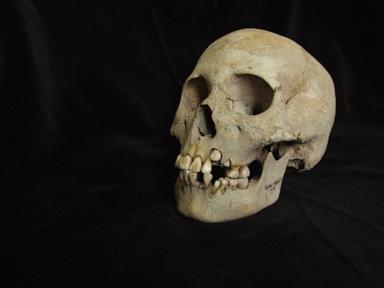
Five thousand five hundred years ago, a woman closed her eyes for the last time in a settlement near the Baltic Sea. We do not know her name. We do not know the color of her hair, or whether she laughed easily, or what she feared when the sun went down. But we know how she died.
She died with her blood swimming with Yersinia pestis. The plague.
For decades, the history books gave us a comfortable timeline. They told us the Black Death was a medieval horror, a sudden explosion of biological malice that swept through fourteenth-century Europe, wiping out a third of the population. It was a tragedy bound by a specific era, born of filth and wooden ships and a lack of penicillin.
We were wrong.
History is not a neat line of dates carved into stone. It is a messy, deeply personal sprawl of human survival, and our understanding of our oldest microscopic enemy just shifted on its axis. The blueprint of our past was not found in dusty parchment, but hidden inside the dark, protected hollows of ancient human teeth.
The Secrets Traced in Enamel
To understand how a disease travels across millennia, you have to look at the only part of the human body built to outlast time itself. Enamel is a fortress. Long after skin, muscle, and even standard bone have dissolved into the earth, teeth remain. They act as tiny, biological time capsules, sealing in microscopic drops of the blood that once kept us alive.
Imagine an archaeologist sitting in a sterile, brightly lit laboratory, miles away from the damp soil where that ancient woman was buried. They are not looking at a skeletal grimace; they are looking for a ghost. Using precise drills, researchers can extract the petrified pulp from inside a prehistoric tooth, sequence the DNA fragments, and reconstruct the genetic code of organisms that died before the pyramids were even a thought.
When scientists ran the numbers on these ancient samples, the results sent a chill through the scientific community. The plague did not start with medieval rats. It was already hunting us during the Stone Age.
This discovery changes the entire weight of the story. It means that as humanity was just beginning to gather, to build the very first permanent villages, to plow the earth and trade across borders, an invisible killer was walking right alongside us.
A Different Kind of Killer
The word "plague" immediately brings to mind images of pustules, panic, and carts rolling through muddy streets. But the strain of Yersinia pestis pulled from those 5,500-year-old teeth tells a far more nuanced story.
It was a genetic ancestor, a precursor to the monster that would later devastate Europe. Crucially, this ancient version lacked a specific gene called ymt. Without that tiny piece of genetic code, the bacteria could not survive inside the gut of a flea.
Think about what that means. The textbook version of the plague relies entirely on the flea-and-rat connection. Fleas bite infected rats, the rats die, the fleas jump to humans, and the disease spreads like wildfire. But in the Stone Age, that mechanism did not exist yet. The bacteria had to rely on a different method of transportation: human-to-human contact.
It was a respiratory disease. A cough in a crowded shelter. A shared breath by a winter fire.
Consider a hypothetical family living in that Baltic settlement. They were likely among the world’s first farmers. They lived in close quarters, surrounded by newly domesticated animals, clearing forests to plant grain. One day, a traveler arrives, coughing, pale, seeking shelter from the damp cold. Within a week, the entire household is burning with fever.
They had no concept of bacteria. They had no idea that the air around them was heavy with an invisible predator. They only knew that a sudden, inexplicable weakness was taking their loved ones one by one.
This was not a massive, sudden pandemic that collapsed an empire overnight. Instead, it was a slow, persistent burn. It was a shadow that followed human progress, whispering through the timbers of our earliest homes.
The Price of Gathering Together
There is a profound irony hidden in this rewritten timeline. The rise of the plague aligns almost perfectly with the dawn of human civilization.
For hundreds of thousands of years, humans lived in small, nomadic bands. If a deadly disease emerged in one group, it usually died out with that group. There simply were not enough people, living close enough together, to keep the chain of infection going.
But then, we changed the rules.
We stopped moving. We built towns. We accumulated waste, we kept livestock in close quarters, and we created trade networks that connected distant communities. We built the modern world. And in doing so, we accidentally built the perfect incubator for infectious disease.
The ancient teeth reveal that the plague did not wait for the medieval world to find its footing. It took advantage of our very first attempts at community. Every time we drew closer to one another for safety, warmth, and cooperation, the microbes found a new path forward.
It makes the subject intensely human. It forces us to realize that our ancestors were fighting a war on two fronts: they were trying to build a future out of the wilderness, while simultaneously battling an enemy they could neither see nor understand.
The Long War
Looking at the data can feel overwhelming, even terrifying. It reminds us that our hold on this planet has always been fragile. We like to think of medical history as a series of victories where we conquered the darkness, step by step, until we reached the safety of modern healthcare.
But science requires us to be vulnerable enough to admit that we are part of an ongoing cycle. The plague is not a relic of the past; it is an active organism that evolved alongside us, adapting as our habits changed. It learned to use fleas when we started living near rats, but it started by simply using our own breath against us.
When we look at those ancient Baltic teeth, we are looking into a mirror. The genetic code etched inside that enamel is a record of human resilience. The woman who died 5,500 years ago lost her battle, but the lineage of humanity survived her. We carried on, adapting, learning, and leaving behind the clues that would eventually allow her descendants to understand exactly what took her life.
The dirt has settled over her resting place, and the settlement she knew is gone, buried beneath millennia of fallen leaves and new cities. Yet, the story remains, written in the hardest part of her body, waiting for us to finally read it correctly.
A single tooth holds a revolution in history, reminding us that every breath we take today is a victory in a war that began before the world even knew it was fighting.