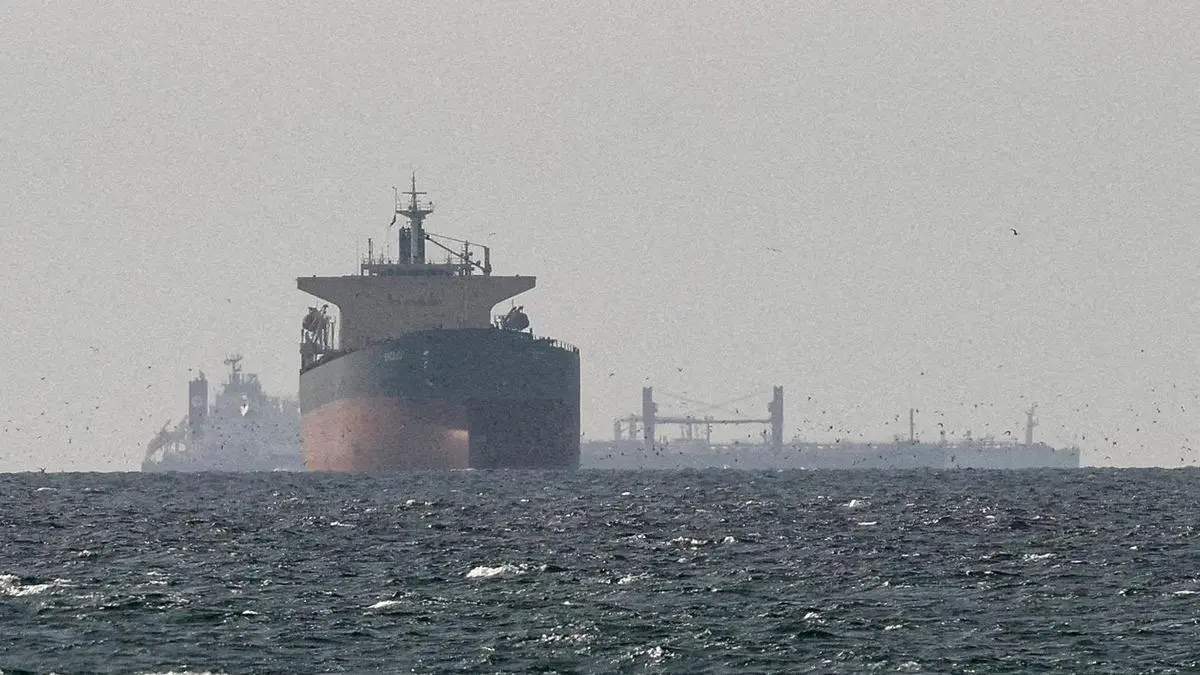
The sea does not care about politics. It is a vast, indifferent expanse of salt and pressure that swallows secrets as easily as it swallows ships. But for the men standing on the bridge of a VLCC—a Very Large Crude Carrier—the silence of the ocean is now a tactical requirement.
Somewhere in the Persian Gulf, a captain reaches for a switch. With a simple flick, the vessel’s Automatic Identification System (AIS) goes dark. On the digital monitors of global maritime tracking services, a ship the size of an Empire State Building simply ceases to exist. It is no longer a data point. It is a ghost.
This is the frontline of a high-stakes game of hide-and-seek played across the world’s shipping lanes. To the United States Treasury, this is a violation of international sanctions. To the Iranian government, it is a survival mechanism. To the sailors on board, it is just another Tuesday in the shadow economy.
The Anatomy of a Disappearing Act
Think of the AIS as a digital heartbeat. It broadcasts a ship’s position, speed, and heading to ensure that massive steel hulls don't collide in the middle of the night. When a tanker goes dark, it isn't just hiding from the law; it is choosing to navigate the world’s most crowded chokepoints in a self-imposed blindness.
Consider a hypothetical navigator named Elias. He isn't a villain in a spy novel. He is a professional with a mortgage and a preference for strong coffee. When his ship nears the Strait of Hormuz, the order comes down from the charterer. "Go dark."
Elias knows the risks. If another vessel clips his stern because his transponder was silent, the insurance won't pay. There will be no rescue signal if the engines fail. He is operating outside the safety net of the modern world. But the cargo in the belly of his ship—two million barrels of Iranian light crude—is worth upwards of $150 million. At those prices, the cost of being seen is far higher than the cost of a collision.
The mechanics of this evasion have evolved. In the early days of sanctions, "going dark" was enough. Today, it requires more finesse. Ships now engage in "spoofing," where they broadcast a fake location while they are actually hundreds of miles away, tethered to another ship in a ship-to-ship (STS) transfer. They are the magicians of the maritime world, using sleight of hand to move liquid gold across borders that are officially closed.
The Invisible Economy of the Middleman
Why go through the trouble? The answer lies in the stubborn reality of global demand. The world’s thirst for oil does not evaporate because a document is signed in Washington D.C.
When Iranian oil is scrubbed of its origin, it doesn't just vanish. It is rebranded. It becomes "Malaysian blend" or "Omani crude." It flows into the refineries of East Asia, powering the factories that make our smartphones and the cars that take us to work. We are all, in some small way, connected to these ghost ships.
The price of this secrecy is a complex web of intermediaries. Small, obscure companies registered in offshore havens emerge overnight to buy aging tankers. These ships, often nearing the end of their operational lives, would normally be headed for the scrap yards of Alang or Chittagong. Instead, they are given a coat of paint, a new name, and a Panama flag.
They are the "Dark Fleet."
These vessels are often under-maintained and under-insured. They represent a ticking environmental time bomb. If one of these aging giants were to rupture in the South China Sea, the legal trail would lead to a series of shell companies with no assets and no accountability. The ocean would pay the price for the world’s political friction.
The Digital Cat and Mouse
On the other side of the screen, analysts in air-conditioned offices in London and D.C. are playing the role of the detective. They use satellite imagery to track "dark" vessels by their wakes or the heat signatures of their engines. They look for "anomalous behavior"—a ship that sits low in the water one day and high the next without ever pulling into a port.
They are looking for the "handshake" in the middle of the ocean.
Imagine two massive ships coming alongside each other in the open sea. It is a delicate, dangerous dance. The fenders between the hulls are the only thing preventing a catastrophic spark. Hoses are connected, pumps are engaged, and the black lifeblood of the global economy is transferred under the cover of night. By the time the sun rises, the "ghost" is empty, and the "clean" ship is ready to deliver its cargo to a legitimate buyer.
It is a remarkably resilient system. For every loophole the authorities plug, the dark fleet finds a new way to slip through the mesh. They use "vessel identity theft," where a ship assumes the IMO number—a permanent ID—of a scrapped vessel. They change names mid-voyage. They loop around the Cape of Good Hope to avoid the scrutiny of the Suez Canal.
The Human Cost of the Blockade
While the headlines focus on geopolitics and "crude volumes," the human element is often lost in the fog. The crews on these tankers are often from developing nations, working on contracts that offer little protection. When a ship is "dark," the crew is essentially stateless.
If a sailor falls ill or is injured, seeking medical port clearance becomes a nightmare. If the ship is seized, they may spend months or years in legal limbo, far from their families, casualties of a war they didn't start. They are the collateral damage of a world that wants the oil but rejects the source.
The stakes are not just about barrels and benchmarks. They are about the integrity of the international maritime order. The AIS system was designed to save lives. By weaponizing it—or forcing its deactivation—the world is slowly eroding the safety standards that took decades to build. We are returning to an era of "privateers," where the rules of the sea are dictated by necessity rather than law.
The Friction of Reality
There is a certain irony in the fact that the most advanced satellite tracking technology in human history is being defeated by a simple toggle switch on a bridge. It highlights the limit of digital power in a physical world. You can sanction a bank account with a keystroke, but stopping a 300,000-ton steel vessel requires a physical presence that most nations are hesitant to deploy.
The blockade is not a wall; it is a sieve.
The Iranian tankers continue to sail because the incentives to move the oil are greater than the risks of getting caught. In the boardrooms of the world’s largest oil traders, the conversation is often about "risk appetite." How much is a discount worth? If you can buy Iranian crude at $20 below the market rate, does that cover the cost of a private security firm and a shadow shipping network? For many, the math is simple.
The result is a bifurcated world. There is the "lit" market, where everything is transparent, insured, and expensive. And there is the "dark" market, a parallel universe of shadow tankers and untraceable transactions that keeps the gears of certain economies turning.
The Silent Wake
As the sun sets over the Indian Ocean, a tanker that was "off the grid" for three weeks suddenly reappears on the AIS. It is thousands of miles from where it was last seen. Its draft is shallow now; it is riding high in the water, its belly empty.
The captain, perhaps someone like Elias, watches the digital icons of other ships flicker back onto his screen. He is back in the "real" world. He can see the traffic around him. He is no longer a ghost.
But the oil he carried is already moving through pipes in a distant land, being refined into the fuel that will power a morning commute or heat a home. The transaction is complete. The sanctions have been bypassed. The shadow fleet has done its job, and for a few more weeks, the secret remains safe beneath the waves.
The ocean remains indifferent, but for those who know how to look, the wakes of these invisible ships leave a trail that no amount of darkness can truly hide. It is a trail of necessity, written in the black ink of crude oil across the surface of a world that refuses to stop consuming.