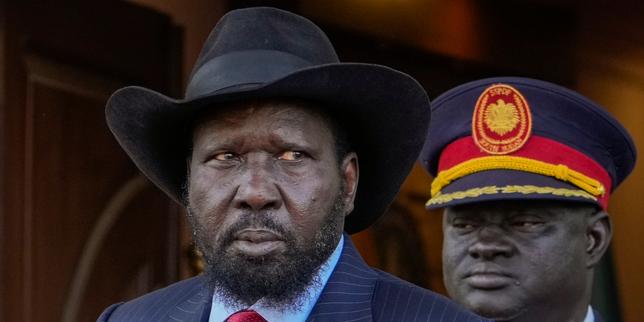
The red dust of Juba does not ask who is in charge. It settles equally on the polished windshields of ministerial convoys and the corrugated tin roofs of the Konyo Konyo market, turning everything the same muted terracotta by noon. When the radio crackles with news of a presidential decree dissolving the government, the market does not stop. A woman selling hibiscus leaves beside a drainage ditch merely adjusts her scarf against the glare. She has heard decrees before.
According to official announcements from the Office of the President in Juba and reporting by international wire services, South Sudan’s president has dissolved the transitional cabinet just three months ahead of long-promised national elections whose feasibility remains deeply uncertain. To political analysts at the Reconstituted Joint Monitoring and Evaluation Commission (RJMEC) and diplomats with the United Nations Mission in South Sudan (UNMISS), the move lands like a sudden brake-check on a vehicle already missing three wheels. To the people waiting in line for flour, cooking oil, and a ballot paper they have never once held since independence in 2011, it feels like watching the clock hands spin backward.
The Architecture of a Perpetual Waiting Room
To understand why dissolving a cabinet ninety days before an election triggers dread rather than excitement, you have to strip away the vocabulary of standard Western politics. In most democracies, a cabinet dissolution signals an imminent handover to the voters—a clearing of the decks so citizens can decide what comes next. In South Sudan, the deck itself is the prize, and the cards have been reshuffled without a game ever being played.
Consider a hypothetical scenario—explicitly imagined here to illustrate the daily friction of life in Juba—involving a civil servant named Peter. Peter works in a mid-level administrative office near the ministries complex. For eight months, his salary has arrived sporadically, eroded by an inflation rate that turns a month’s wages into the price of two jerrycans of fuel. When the radio announces that the government has been dissolved, Peter does not celebrate a fresh start. He wonders who will sign the authorization forms for next week’s payroll. He wonders whether his deputy director, appointed under a delicate quota system between rival factions, will still have an office on Monday, or whether armed guards loyal to different commanders will eye each other nervously across the courtyard.
That tension is not fiction. It is the structural reality of the Revitalized Agreement on the Resolution of the Conflict in the Republic of South Sudan, signed in Addis Ababa in September 2018.
Think of that 2018 peace accord as a massive suspension bridge built over a canyon of civil war. Between 2013 and 2018, fighting between forces loyal to President Salva Kiir and those aligned with First Vice President Riek Machar killed an estimated 400,000 people and displaced millions more, according to studies cited by the United Nations and the London School of Hygiene and Tropical Medicine. The bridge that ended the worst of the fighting was engineered around one central principle: power-sharing. Every ministry, every governorship, every parliamentary seat was divided by strict mathematical ratios among the signatories. Nobody trusted anyone else enough to let a single faction hold the steering wheel.
So when President Kiir exercises executive authority to dissolve the cabinet three months before scheduled polls, the tremor runs straight through the cables of that bridge.
Two Perspectives on a Sudden Void
In Juba, the meaning of this dissolution depends entirely on which side of the political divide you ask.
Supporters of the presidency and officials aligned with the ruling Sudan People’s Liberation Movement (SPLM) frame the move as an administrative necessity. From their perspective, a bloated, gridlocked unity government—composed of dozens of ministers and deputy ministers representing competing political camps—cannot nimble-footedly manage the final sprint toward an election. In statements defending executive restructuring, government voices argue that streamlining leadership and removing underperforming officials is essential to break bureaucratic paralysis, restore fiscal discipline, and prepare state institutions for the transition from a transitional authority to an elected mandate. To them, waiting passively while ministries stall is the greater danger.
Opposition figures, particularly within Riek Machar’s Sudan People’s Liberation Movement-in-Opposition (SPLM-IO) alongside smaller signatory parties, read the exact same decree as a breach of trust. Under the 2018 peace deal, appointments and dismissals within the Revitalized Transitional Government of National Unity are supposed to follow strict consultation protocols among the parties. Critics argue that dissolving the cabinet unilaterally—or using executive decrees to hollow out the coalition structure—undermines the collegial spirit required to hold credible elections. Without a jointly agreed-upon cabinet to oversee security arrangements and electoral logistics, opposition leaders warn, the playing field tilts sharply before a single campaign poster is pasted to a wall.
Between those two poles sit international observers, including the Troika nations (the United States, the United Kingdom, and Norway) and regional mediators from the Intergovernmental Authority on Development (IGAD). Their assessments, repeated across quarterly monitoring reports, have been blunt: the core prerequisites for a free, fair, and peaceful election remain largely incomplete.
What It Takes to Count a Nation
Let us step back from the presidential palace and look at the mud.
Literally, the mud. South Sudan possesses fewer than 300 miles of paved roads across a territory roughly the size of France. During the rainy season, vast stretches of Upper Nile, Jonglei, and Unity states transform into inland seas. Ballot boxes cannot be driven to polling stations when the roads have dissolved into waist-deep mire; they must be flown by helicopter at staggering expense.
Yet logistics are only the outer shell of the problem. According to repeated briefings by UNMISS and civil society coalitions such as the Community Empowerment for Progress Organization (CEPO), holding a credible vote requires four foundational pillars that remain shaky or absent:
- A unified national army. Under the peace deal, rival militias were supposed to be graduated into a single, non-partisan Necessary Unified Force. While tens of thousands of troops have undergone training, observers note that command structures remain fractured, equipment is scarce, and many forces still answer to former faction commanders rather than a unified defense ministry.
- A permanent constitution and civic space. Voters need clear legal rules and the freedom to assemble, speak, and campaign without fear of detention or intimidation by national security agencies. Human Rights Watch and UN human rights monitors have repeatedly documented restrictions on journalists and political activists.
- Voter registration and a reliable census. South Sudan has not conducted a comprehensive post-independence population census. Millions of citizens remain internally displaced or living in refugee camps across Uganda, Kenya, Sudan, and Ethiopia. Who gets to vote, where they register, and how their ballots are protected remain fiercely contested questions.
- Funding. South Sudan’s economy depends overwhelmingly on oil revenues. When war in neighboring Sudan ruptured key export pipelines passing through Port Sudan, Juba’s primary lifeline choked off, leaving the treasury struggling to pay basic salaries—let alone finance a multi-hundred-million-dollar election.
Now place a dissolved government on top of that checklist.
Wait.
Read that list again, and ask yourself a simple question: If you dismantle the ministerial leadership three months before election day, who signs the checks for the helicopters? Who negotiates the deployment of unified security forces to protect polling centers? Who resolves disputes over voter rolls in contested counties?
The Weight of Unkept Calendars
History is a stern teacher in Juba, and its lessons are written in crossed-out dates.
When South Sudan gained independence in July 2011 after decades of brutal civil war with Khartoum, euphoria filled the streets. People danced until dawn, believing the hardest part was over. Elections were originally slated for 2015. War broke out in 2013 instead. After the 2018 peace agreement, transitional deadlines were set, extended in 2020, extended again in 2022 for another twenty-four months toward December 2024, and pushed back yet again when the institutional benchmarks failed to materialize.
Every postponement carries an invisible tax. It is not measured in dollars, though the economic stagnation is visible in every shuttered storefront. It is measured in civic exhaustion.
Imagine—again, as an illustrative metaphor—a family that has packed its suitcases and stood by the front door every Friday evening for years because a relative promised to pick them up for a long-awaited journey. The first Friday, they are dressed in their finest clothes, hearts racing. By the fifth Friday, they sit on the suitcases. By the twentieth, they unpack the bags just enough to pull out a blanket, no longer sure whether the car is ever coming, yet unable to settle comfortably back into their house because they are still technically "in transit."
That is what a perpetual transitional period does to a nation's psyche.
In South Sudan, "transitional" has become a permanent adjective. There is a Transitional National Legislative Assembly, a Transitional Constitution, and a Revitalized Transitional Government. When everything is temporary, accountability evaporates. Why repair a hospital roof or build a secondary school curriculum if the government is merely a caretaker waiting for an election? Conversely, why compromise with political rivals today if you believe another decree, another extension, or another reshuffle will reset the board tomorrow?
The Quiet Fear Beneath the Decrees
I remember speaking years ago with a teacher from Malakal who had watched his town change hands multiple times during the conflict. What stayed with him was not just the sound of gunfire, he told me, but the silence that preceded it—the weeks when officials stopped showing up to local offices, when rumors replaced newspapers, and when neighbors began quietly stockpiling dried fish and batteries because nobody in the capital seemed to agree on what tomorrow held.
That is the emotional core that dry diplomatic cables often miss. Political maneuvering in Juba is never just a parlor game among elites. Every tremor at the top vibrates down through kinship networks, cattle camps, and overcrowded displacement sites.
When the president dissolves the government three months before uncertain elections, ordinary South Sudanese do not read it through the lens of constitutional theory. They read it through memory. They ask whether the dissolution is a prelude to naming a leaner, election-ready cabinet—or a signal that the current transition is unraveling into another unilateral power consolidation, or yet another extension of the status quo.
Even seasoned diplomats admit the trajectory is murky. Will a new cabinet be sworn in within days, restoring nominal balance among the peace deal signatories? Will key opposition figures refuse to participate unless strict power-sharing guarantees are honored? Or will the electoral commission, citing the administrative vacuum created by the dissolution itself, announce that the calendar must be pushed back once more?
Nobody in Juba can answer those questions with certainty today. Admitting that uncertainty is the only honest starting point.
Beyond the Next Decree
If there is a way out of this cycle, political scientists and South Sudanese civil society leaders alike point out that it will not come from another ministerial shuffle. Replacing faces at the top of ministries while leaving the underlying incentives untouched is like changing the curtains in a house whose foundation is sinking into the riverbank.
Real momentum requires tangible, verifiable steps that ordinary citizens can see with their own eyes before a single ballot is cast: transparent publication of oil revenues and electoral budgets; the full deployment and payment of unified security forces freed from factional loyalties; open civic space where opposition candidates and journalists can travel across state lines without intimidation; and an honest, public timetable agreed upon by all signatories rather than imposed by surprise decree.
Until those pieces lock into place, elections in South Sudan remain less a democratic milestone than a mirage shimmering over the Sudd wetlands—always visible on the horizon, always three months away.
Back at the Konyo Konyo market, dusk falls fast near the equator. Vendors pack away their unsold tomatoes and hibiscus leaves by the glow of small solar lanterns, wrapping coins tightly in cloth before heading home down unlit dirt lanes. Above them, on the hill where the government compounds sit behind high concrete walls and concertina wire, generators hum to life, lighting empty offices awaiting new names on the doors.