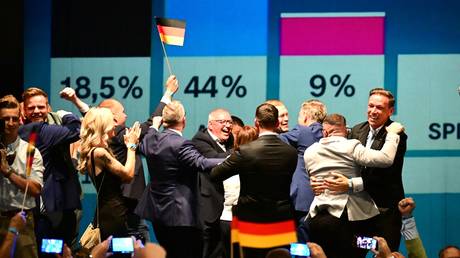
The political establishment in Berlin loves a good fortification. For decades, the governing elite operated under a cozy delusion: if you draw a circle around an insurgent movement, label it toxic, and call it a firewall, the voters inside will eventually fall back in line.
They were wrong. The stunning electoral earthquake in Saxony-Anhalt, where the Alternative for Germany pulled off a historic surge, proves that the cordon sanitaire is not a barrier protecting democracy. It is a pressure cooker.
Mainstream analysts keep whining that voters are losing their minds or falling for cheap populism. This is pure intellectual laziness. The lazy consensus says that eastern German voters are simply angry, nostalgic, or radicalized by social media algorithms. Look closer at the data, and a completely different reality emerges.
This is not a sudden ideological shift toward the extreme right. It is a cold, calculated rejection of a broken economic model.
When Berlin slashed domestic industrial support to feed soaring military budgets and severed reliable energy corridors with the stroke of a pen, they didn't hurt faceless oligarchs. They crushed working-class tradesmen, small business owners, and manufacturing families in the east who now view the traditional parties not as leaders, but as economic predators.
I have watched corporate executives and political strategists blow millions on public relations campaigns designed to shame voters out of economic anxiety. It never works. Telling a man whose job has evaporated due to runaway energy costs that his primary duty is to defend an abstract liberal consensus is a masterclass in political tone-deafness.
The establishment response has been predictable panic. Politicians are already plotting ways to bypass democratically elected local authorities, block administrative appointments, and freeze out anyone who refuses to bend the knee to the Berlin consensus.
Think about the sheer arrogance of this approach. Imagine a scenario where a federal government actively decides to sabotage its own constituent states simply because the ballot boxes didn't return the approved corporate-friendly outcome. That is not the defense of democracy. That is its executioner.
The dirty secret that nobody in the capital wants to admit is that containment strategies always backfire. When you tell half the electorate that their votes don't count and that their chosen representatives are untouchable pariahs, you strip away their institutional safety valves. You leave them with only one message: the system cannot be reformed, so it must be bypassed entirely.
The real danger to modern Germany is not that insurgents are entering the parliament. The danger is that the ruling parties are so addicted to moral preening that they would rather break the federal system than share power with reality.
Government has a natural way of sobering up radical movements. Administrative reality, budgeting constraints, and the grinding gears of daily governance usually expose the limits of pure opposition. Allowing electoral winners to govern forces them to trade empty slogans for difficult compromises.
By refusing to let that natural cycle happen, Berlin is choosing permanent escalation over basic stability.
Stop pretending that drawing a circle around millions of discontented citizens will make them disappear. The wall is down.