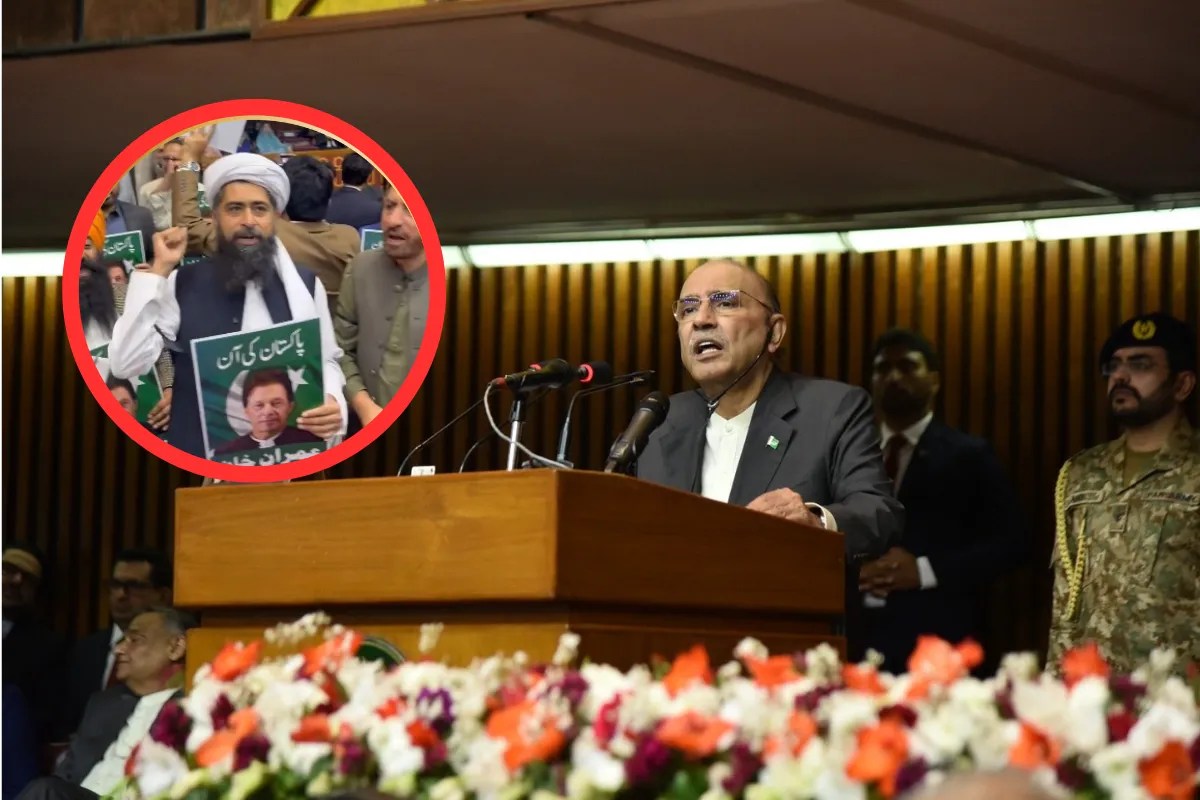
The sudden eruption of "Go Back" slogans during a high-profile visit by the Pakistani leadership to Pakistan-administered regions (specifically Muzaffarabad) signals a fundamental breakdown in the social contract between the state center and its peripheral administrative units. This is not merely a localized protest; it is a rejection of a specific geopolitical narrative that has been maintained through heavy subsidies and ideological alignment for decades. When the state’s primary export—anti-India rhetoric—fails to gain traction among its own constituents, it indicates that the marginal utility of nationalist fervor has been superseded by the immediate pressures of hyperinflation and systemic economic mismanagement.
The Triad of Institutional Erosion
The friction observed during the President’s visit can be decomposed into three distinct pillars of institutional failure. Each pillar represents a specific area where the state’s strategic objectives have diverged from the population's survival requirements.
1. The Subsidy-Sovereignty Paradox
For years, the administration in Muzaffarabad functioned on a model of "subsidized loyalty." The federal government in Islamabad provided cheap electricity and wheat in exchange for a quiescent population that served as a visual and rhetorical front in the broader Kashmir dispute. However, as Pakistan’s national economy entered a debt-stabilization phase mandated by international lenders, these subsidies were stripped away. The resulting 400% to 500% increase in utility costs transformed a geopolitical asset into a domestic liability. The "Go Back" slogans are the audible manifestation of a broken financial covenant.
2. The Narrative Saturation Point
State propaganda relies on an external "other" to justify internal austerity or security measures. In this instance, the Pakistani leadership attempted to utilize its platform to reiterate historical grievances against India. This strategy hit a saturation point. When a population faces a consumer price index (CPI) that outpaces wage growth by a significant margin, the strategic value of an external enemy diminishes. The protests indicate that the local demographic has shifted its focus from "territorial liberation" to "economic survival," rendering the President’s traditional talking points obsolete and, more importantly, offensive to the struggling taxpayer.
3. The Security-Civilian Disconnect
The heavy-handed security protocols accompanying the visit acted as a physical barrier that catalyzed existing resentment. In strategic terms, the "security footprint" of the visit was inversely proportional to the "public trust" available. The presence of elite security cordons in a region already sensitive to paramilitary presence served as a visual reminder of the power asymmetry between the visiting elite and the local populace.
The Mechanism of Escalation: From Grievance to Mobilization
The transition from silent resentment to active, vocal defiance follows a predictable escalation path. This movement is fueled by the democratization of information through digital bypasses, which allows local activists to coordinate outside the traditional state-controlled media apparatus.
- Information Asymmetry Reduction: Localized grievances (high electricity bills) are no longer isolated. Digital connectivity allows the residents of Muzaffarabad to see that their economic hardship is a result of federal policy choices rather than unavoidable external shocks.
- The Catalyst Event: A high-level visit by a symbolic figure (the President) provides a centralized target for decentralized anger. The visit acts as a lightning rod, pulling disparate groups—traders, students, and civil society—into a single physical space for a unified expression of dissent.
- The Feedback Loop: When the state responds to these slogans with further restrictions or dismissive rhetoric, it validates the protesters' claims of being treated as subjects rather than citizens, further entrenching the opposition.
Strategic Divergence: The Cost of Misreading the Room
Islamabad’s current strategy appears to be built on the assumption that nationalist sentiment is an infinite resource. This is a critical miscalculation. In a high-inflation environment, nationalism is a luxury good.
The President’s attempt to pivot the conversation toward India while standing in a city currently protesting local governance reveals a deep-seated analytical blind spot. This "rhetorical misalignment" suggests that the central leadership is either insulated from the ground reality or is intentionally choosing to ignore it in favor of maintaining a consistent international posture. The cost of this misalignment is the permanent loss of the "moral high ground" that Pakistan has historically claimed in international forums regarding this region.
The Economic Bottleneck of Regional Governance
The governance model in Pakistan-administered regions is strictly top-down, creating a bottleneck where local representatives have no fiscal autonomy to address grievances.
- Revenue Extraction without Retention: Regions generate significant hydroelectric power but are forced to buy it back from the national grid at inflated rates, including various federal taxes and service charges.
- Budgetary Dependence: Since the regional government depends on federal transfers for its operational budget, it cannot lower taxes or provide relief without Islamabad’s approval, which is currently impossible due to IMF-mandated fiscal consolidation.
- The Political Vacuum: Traditional political parties have lost credibility because they are seen as extensions of the federal center. This has left the field open for "Action Committees" and non-aligned grassroots movements that do not follow the traditional rules of political engagement.
Analysis of the Symbolic Collapse
The specific choice of the slogan "Go Back" is significant in a clinical, linguistic sense. It is a reversal of the very language the state uses against foreign entities or perceived occupiers. By turning this specific phrase against their own President, the protesters are effectively de-legitimizing the federal state's authority.
This isn't an outburst of chaotic energy; it is a calculated strike at the President’s role as the symbol of the federation. In a parliamentary system like Pakistan’s, the President represents the unity of the republic. If the symbol of unity is rejected by a specific territory, the structural integrity of the federation in that territory is, by definition, compromised.
Structural Limitations of the Current State Response
The state’s likely response—increased surveillance and short-term financial sops—is unlikely to yield long-term stability. The fundamental problem is a mismatch between the state’s geopolitical ambitions and its macroeconomic capacity.
- The Security Constraint: Using force to quell these protests would confirm the "occupier" narrative that the state has spent seventy years trying to avoid.
- The Fiscal Constraint: Providing the requested electricity and wheat subsidies would violate international loan agreements, potentially triggering a broader national default.
- The Narrative Constraint: Abandoning the anti-India rhetoric would alienate the domestic nationalist base in the Punjab and Sindh heartlands, which the current government needs for political survival.
Necessary Strategic Reorientation
The state must recognize that the era of "ideology-first" governance is over. To stabilize the region and regain a semblance of authority, the administration must transition to a "service-first" model. This requires a total overhaul of the hydroelectric royalty system and a genuine devolution of fiscal powers.
The failure of the President's visit is a warning that the old tools of statecraft—grand speeches, symbolic visits, and the invocation of external threats—no longer function as a substitute for affordable bread and electricity. The path forward requires a cold, hard look at the fiscal realities of the region. If the state cannot provide the basic components of a functional economy, it cannot expect the population to remain a willing participant in its grand geopolitical theater. The immediate requirement is the establishment of a localized pricing mechanism for energy that accounts for the region's contribution to the national grid, effectively decoupling local costs from federal debt obligations. Failure to implement this specific fiscal adjustment will lead to a permanent state of civil disobedience that no amount of nationalist rhetoric can mask.