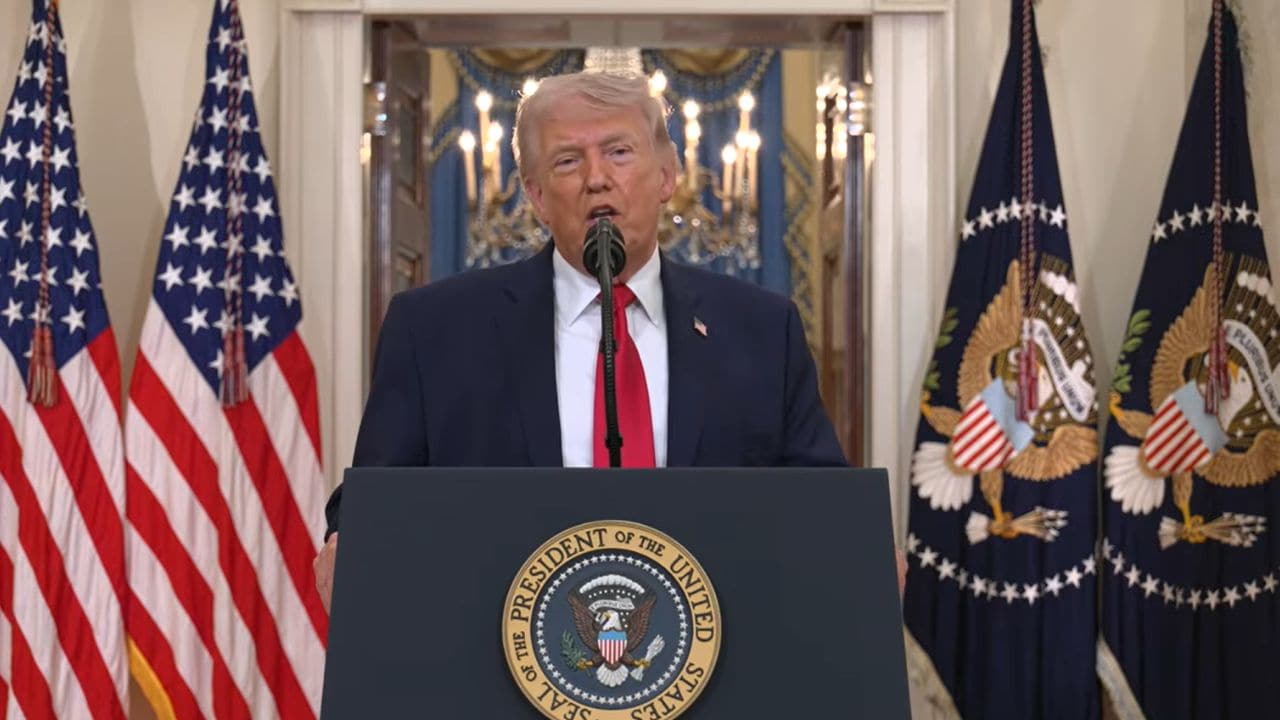
The shift in American foreign policy toward Iran and global arms suppliers represents a transition from traditional diplomatic isolation to a model of Kinetic Economic Coercion. By coupling an openness to direct negotiation with Iran with explicit tariff threats against third-party weapons providers, the administration is attempting to weaponize the U.S. consumer market as a substitute for traditional military deterrents. This strategy operates on a primary thesis: global trade dependencies are now more fragile than traditional security alliances, and the cost of losing U.S. market access outweighs the revenue generated from defense exports to adversarial states.
The Dual-Track Coercion Framework
The current strategy functions via two distinct, yet interdependent, mechanisms. The first is a Diplomatic Liquidity play—offering a path to engagement with Iran to lower the regional temperature. The second is the Tariff-as-Intercept mechanism, which targets the supply chain of Iranian defense capabilities at the source. You might also find this similar article insightful: Why the South China Sea Standoff is Getting Riskier for Everyone.
Traditional sanctions focus on the end-user; this new framework focuses on the Opportunity Cost of the Supplier. If a nation or a corporate entity provides missile components or drone technology to Tehran, the proposed tariff acts as a tax on their entire export economy to the United States.
The Cost Function of Arms Proliferation
To quantify the impact of these tariff threats, one must analyze the trade-to-defense revenue ratio of major arms exporters. For a middle-power nation, the revenue from a $500 million arms contract with Iran is negligible compared to the potential loss of a 20% margin on billions of dollars in consumer goods exported to the U.S. As reported in detailed coverage by The Washington Post, the results are significant.
We can categorize the impact into three specific tiers:
- Tier 1: Direct Component Suppliers. These are entities providing dual-use technologies (semiconductors, GPS modules, specialized carbon fiber). The tariff threat here creates an immediate "compliance chill," where private firms preemptively de-risk to avoid the loss of U.S. market share.
- Tier 2: State-Level Facilitators. Governments that oversee defense exports. For these actors, the tariff becomes a sovereign debt or GDP issue rather than a corporate one.
- Tier 3: The Gray Market. Smugglers and intermediaries. Tariffs are less effective here, necessitating a shift back toward traditional intelligence-led interdiction.
Weaponizing the Dollar Zone
The fundamental shift here is the move from Asset Freezing (the standard Treasury toolkit) to Market Exclusion. Asset freezing is surgical but can be bypassed through alternative banking systems or physical assets. Market exclusion via tariffs is a blunt instrument that affects the entire domestic industrial base of the target nation.
This creates a Bilateral Friction Point. When the U.S. threatens a tariff on a country for its arms dealings, it forces that country’s non-defense industries—agricultural exporters, automotive manufacturers, and textile firms—to lobby their own government to cease arms sales. This internalizes the enforcement cost for the U.S., turning a foreign nation's own business elite into de facto enforcers of American policy.
The Mechanism of Preemptive Compliance
The efficacy of this strategy does not require the actual implementation of tariffs. Its power lies in the Discounted Future Value of market access.
- Risk Premium: Shipping companies and insurers begin to bake in the "tariff risk" when dealing with countries identified as weapons suppliers.
- Capital Flight: Investors move capital out of sectors that may be subject to retaliatory or secondary U.S. trade actions.
- Supply Chain Relocation: Multi-national corporations may move manufacturing out of the targeted supplier nation to avoid being caught in the crossfire of a trade-for-security dispute.
Regional Rebalancing and the Iranian Pivot
Simultaneously signaling a willingness to "work with Iran" serves to prevent a "Fortress Iran" scenario where the regime feels it has nothing left to lose. By maintaining a credible path to economic reintegration, the U.S. creates a Hedged Incentive Structure.
If the administration only used threats, Iran would be incentivized to accelerate its nuclear and ballistic programs to achieve "deterrence through capability." By offering a diplomatic off-ramp, the U.S. forces Tehran to weigh the benefits of a potential windfall from unfrozen assets and trade against the diminishing returns of a strained military supply chain.
The Bottleneck of Domestic Production
Iran’s domestic defense industry, while resilient, remains heavily reliant on imported precision machine tools and high-end electronics. The "Tariff Threat" acts as a Technological Ceiling. Even if Iran can design advanced systems, it cannot mass-produce them if its primary suppliers in Asia or Europe are coerced into a trade-off between Tehran’s small-batch orders and the American consumer engine.
Structural Vulnerabilities of the Tariff Strategy
While the "Tariff-as-Security" model is powerful, it is not a silver bullet. Its success depends on three critical variables:
- Market Dominance Persistence: This strategy only works as long as the U.S. remains the "Consumer of Last Resort." If global trade shifts toward a more multipolar model where China or India can absorb the excess capacity of sanctioned nations, the U.S. loses its leverage.
- Inflationary Blowback: Tariffs are, by definition, a tax on the domestic consumer. If the U.S. imposes a 25% tariff on a major supplier like Turkey or a European ally to stop arms flows, the resulting price hikes in the U.S. could erode domestic political support for the foreign policy objective.
- The "All-In" Bluff: If a country ignores the threat and the U.S. fails to follow through, the entire credibility of the Kinetic Economic Coercion model collapses. Conversely, if the U.S. does follow through, it risks a full-scale trade war that could trigger a global recession.
Quantifying the Strategic Pivot
To understand why this is happening now, one must look at the Velocity of Procurement. Traditional sanctions take years to starve a military program. A tariff threat can be issued in a tweet and reflected in market prices within seconds. The speed of the modern financial system has outpaced the speed of traditional diplomacy.
The administration is moving toward a JIT (Just-In-Time) Foreign Policy. It is an attempt to apply the principles of supply chain management to international security—identifying the "Single Point of Failure" in an adversary's military expansion and applying pressure exactly there, using the most sensitive nerve ending available: the national treasury.
The Shift from Strategic Ambiguity to Tactical Certainty
For decades, the U.S. relied on "strategic ambiguity" regarding its response to regional escalations. The new model replaces this with "tactical certainty." The message to the world’s arms exporters is no longer "there may be consequences," but rather "your exports will be taxed at $X rate starting on $Y date."
This reduces the complexity of international relations to a Profit and Loss Statement. It assumes that every nation-state is a rational economic actor that will ultimately choose its own prosperity over the ideological or financial gains of selling weapons to a pariah state.
Strategic Execution: The Path Forward
For this strategy to move from a rhetorical threat to a functional reality, the administration must now codify the Tariff Trigger Mechanisms.
First, the U.S. Department of Commerce and the State Department must establish a transparent "Red Line" ledger. This ledger would clearly define which weapon systems—specifically long-range precision strike capabilities and nuclear-adjacent technologies—trigger the tariff response. Ambiguity here is the enemy of deterrence.
Second, the U.S. must prepare Alternative Supply Routes for its own domestic industries. If the U.S. intends to tariff a major supplier of electronics to punish their arms sales to Iran, it must first ensure that American businesses can source those electronics elsewhere. Without this internal resilience, the tariff is as much a punishment for Chicago or Houston as it is for the foreign supplier.
The final play is the creation of a "Clean Trade" Bloc. The U.S. should offer preferential trade terms—"Reverse Tariffs"—to nations that sign onto a collective ban on weapons exports to Iran. This moves the strategy from a purely punitive "Stick" to a "Carrot and Stick" model, effectively creating a premium for nations that align their defense export policies with American security interests. The goal is the creation of a closed economic loop where the cost of defiance is systemic bankruptcy.