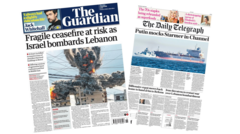
The headlines are fixated on the fragility of a ceasefire and the sharp barbs traded between London and Moscow, but the surface-level reporting misses the tectonic shifts happening underneath. We are watching a calculated stress test of Western diplomatic resolve. While the British press focuses on the immediate threat to a cessation of hostilities in the Middle East or Eastern Europe, the real story lies in how the Kremlin is using these moments of instability to map the psychological vulnerabilities of the Starmer administration. A ceasefire is rarely just a pause in violence. It is often a tactical repositioning that serves the party with the most patience, and right now, that isn't the West.
The current geopolitical friction isn't just about troop movements or broken promises. It is a sophisticated game of exhaustion. By publicly mocking the British Prime Minister, Vladimir Putin isn't just engaging in schoolyard rhetoric; he is signaling to the global south and domestic audiences that the "special relationship" and European security architecture are led by figures he deems inconsequential. This creates a vacuum. When a ceasefire begins to fray, the lack of authoritative mediation leads to a scramble for influence that usually favors the aggressor.
The Mechanics of a Managed Collapse
Ceasefires fail because they are designed to. In most modern conflicts, a truce is not a bridge to peace but a logistical necessity for a depleted force. We see this pattern repeating across multiple theaters. One side agrees to stop shooting, not because they want the war to end, but because their supply lines are choked or their international optics are failing.
When a ceasefire is described as "fragile," it means the incentives for peace have been outweighed by the advantages of a surprise resumption. For the UK, the stakes are heightened. Keir Starmer has inherited a foreign policy framework that relies heavily on "international law" and "collective security"—concepts that hold little weight in a multipolar world where power is the only currency. The mockery emanating from the Kremlin is a tool to discredit these very frameworks. If Putin can show that the UK's leadership is easily rattled or lacks a cohesive response to provocation, the "fragile" nature of any agreement becomes a permanent state of being.
This isn't about one man's ego. It is about the erosion of deterrence. Every time a diplomatic red line is crossed without a tangible consequence, the cost of the next transgression drops. The Kremlin understands this math perfectly. They aren't looking for a total breakdown today; they are looking for a gradual normalization of instability.
Why Diplomacy is Losing its Teeth
The traditional diplomatic toolkit is currently empty. For decades, the West used economic sanctions and international isolation as the primary levers to maintain truces. Those levers are now jammed. Russia has built a sanctions-resistant economy through "fortress" financial planning and deep-seated trade routes with Beijing, Tehran, and New Delhi.
The Failure of Traditional Sanctions
Sanctions were supposed to be the "non-kinetic" way to enforce a ceasefire. Instead, they have become a predictable cost of doing business for autocratic regimes. When the UK threatens further measures, the response from Moscow is laughter because the bite has already been felt and accounted for. This leaves the Starmer government in a precarious position. To be taken seriously, they must find a new form of leverage that doesn't involve total military escalation, yet they are constrained by a domestic budget crisis and a public that is weary of foreign entanglements.
The Intelligence Gap
We also have to look at how intelligence is being used as a weapon of public relations. The "leaking" of Russian mockery or the highlighting of ceasefire violations serves a specific purpose: it prepares the public for a pivot in policy. However, this transparency can backfire. By revealing how much we know about the enemy's intent without acting on it, we inadvertently broadcast our own paralysis. It creates a narrative of "knowing but not doing," which is the ultimate sign of a declining power.
The Starmer Dilemma
Keir Starmer is attempting to play a high-stakes game with a hand he didn't deal. His predecessor's approach to Ukraine and the Middle East was one of "unwavering support," but that support is now meeting the reality of limited stockpiles and shifting American priorities. Putin’s mockery is specifically designed to highlight this. By painting Starmer as a follower rather than a leader, the Kremlin aims to drive a wedge between the UK and its European allies.
The Prime Minister’s challenge is to project strength while managing a military that is arguably at its weakest point in a century. It is a bluff that Moscow is calling. When the Russian state media takes aim at the British leadership, they are speaking to the "Middle Powers"—countries like Turkey, Saudi Arabia, and Brazil—telling them that the old guard no longer has the teeth to enforce the rules it writes.
The Strategic Cost of the "Fragile" Label
Labeling a situation as a "fragile ceasefire" is often a diplomatic cop-out. It allows leaders to avoid the hard truth that the peace has already failed. It buys time, but time is a resource that is currently favoring the disruptors. In the Middle East, a fragile truce allows proxy groups to rearm and reposition. In Ukraine, it allows the Russian war machine to rotate fresh conscripts to the front lines.
The true risk isn't that the ceasefire will break; it’s that the West will be caught off guard when it inevitably does. We are currently in a period of strategic drift. The UK government is reacting to headlines rather than setting the agenda. To break this cycle, there needs to be a fundamental shift in how we approach these "pauses" in conflict.
- Stop treating ceasefires as victories. They are often just the transition from kinetic warfare to hybrid warfare.
- Define clear, enforceable consequences. If a ceasefire is violated, the response must be automatic and disproportionate. Vague threats only invite more testing.
- Address the mockery with action, not words. The best way to stop a rival from laughing is to make their provocations expensive. This doesn't mean war; it means aggressive asset seizures, secondary sanctions on facilitators, and the deployment of advanced capabilities that actually shift the balance of power.
The current headlines are a warning. They tell us that the international order is being mocked because it is currently mockable. The "fragility" of the ceasefire is merely a symptom of a deeper rot in the global enforcement mechanism. If the UK wants to be more than a punchline in a Kremlin briefing, it has to move beyond the rhetoric of "concern" and start exercising the kind of power that doesn't require a press release to be felt. The era of the gentlemanly agreement is dead. We are now in a period of raw, transactional power, and the side that realizes this first will be the one that actually dictates the terms of the next peace.
The real threat isn't a headline about a Prime Minister being insulted; it’s the reality that those insults are backed by a strategic confidence that the West currently lacks. Every day we spend analyzing the "fragility" of a truce is a day the opposition spends preparing for its end. Deterrence isn't a state of mind; it is a physical reality. Until the UK and its allies can re-establish that reality, the mockery will continue, and the ceasefires will remain nothing more than a convenient fiction for those looking to rewrite the map.
We are not watching a news cycle. We are watching the dismantling of an era. The question isn't whether the ceasefire will hold, but what the world looks like once everyone finally admits it has failed. The move-set of the 20th century is failing in a 21st-century landscape that rewards the bold and the brutal. If you aren't prepared to enforce the peace, you are simply subsidizing the next stage of the war.
Stop looking for stability in a system designed for disruption.