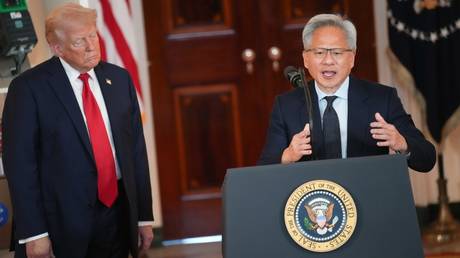
When a head of state publicly defends the chief executive of a dominant semiconductor designer following allegations of a foreign intelligence entrapment operation, the market is witnessing a collision between national industrial policy and counterintelligence risk management. The public framing of a "honeypot" incident involving the leadership of Nvidia—and the subsequent political backing from Donald Trump—requires stripping away tabloid sensationalism to examine the underlying structural incentives. At the core of this intersection lies a singular reality: the executive leadership of critical compute infrastructure has become a sovereign asset whose operational continuity outweighs conventional reputational liabilities.
To understand why political capital is deployed to insulate a corporate leader from compromise narratives, one must map the dependencies governing modern artificial intelligence supply chains, the mechanics of human intelligence (HUMINT) targeting in the technology sector, and the game-theoretic calculus of state-level protection. For a different perspective, check out: this related article.
The Structural Anatomy of Executive Entrapment Operations
In counterintelligence doctrine, a "honeypot" is not merely a seduction tactic; it is an asymmetric information-gathering and leverage-generation mechanism designed to bypass hardened technical perimeters. As semiconductor firms and frontier AI developers harden their cybersecurity architectures against network intrusion, state-sponsored intelligence services shift resources toward human vulnerabilities.
The operational logic follows a predictable three-stage sequence: Further insight on the subject has been provided by The Verge.
- Access Vector Identification: Intelligence services map the travel schedules, industry conferences, and informal social networks of C-suite executives, principal engineers, and supply chain directors. High-level executives frequently operate outside the strict digital and physical sandboxes applied to rank-and-file engineers, creating a softer target surface.
- Compromise and Cultivation: The objective is rarely immediate data exfiltration. Instead, operatives establish a compromising situation—financial, personal, or reputational—that creates a latent blackmail vector. The value of the asset increases over time as the target ascends in corporate authority or as the company's technology becomes more central to national security.
- Activation or Exposure: The leverage is either held in reserve to influence future corporate decisions (such as joint ventures, intellectual property licensing, or supply allocation) or leaked deliberately to destabilize the target company's stock price, disrupt leadership continuity, and fracture trust between the corporation and its home government.
When an allegation surfaces publicly, it indicates that the operation has moved into the destabilization phase, or that defensive counterintelligence has burned the asset to neutralize the covert leverage. By bringing the compromise into the open, the extortion value drops to zero, converting a covert national security threat into a public relations and corporate governance crisis.
The Sovereign Shield Mechanism
In traditional corporate governance, a chief executive implicated in a security compromise faces immediate board scrutiny, potential suspension, and intense pressure from institutional investors concerned about fiduciary risk. However, when the company in question holds a near-monopoly on the hardware required for artificial intelligence training and inference, standard corporate governance rules bend to geopolitical necessity.
Political backing from a figure like Donald Trump functions as a Sovereign Shield. This mechanism operates through three distinct channels:
- Signaling Market Stability: Semiconductor equities are heavily weighted in major indices and serve as bellwethers for broader economic competitiveness. A leadership vacuum at a primary chip designer introduces severe execution risk, threatening capital expenditure cycles across hyperscale cloud providers. Executive-level political endorsement signals to institutional capital that the state will not allow regulatory or political fallout to decapitate the firm.
- Neutralizing Foreign Information Warfare: If a rival state exposes or fabricates a compromise narrative to weaken a strategic domestic champion, allowing that narrative to force a leadership change validates the adversary's tactic. Publicly backing the executive denies the adversary a strategic victory, demonstrating that domestic political leadership will absorb the reputational friction rather than forfeit industrial momentum.
- Securing Policy Alignment: Political protection is rarely unconditional; it establishes an implicit alignment of interests. By insulating the executive from domestic political attacks or regulatory opportunism, the political leader secures a cooperative partner on critical industrial policies, including export controls, domestic fabrication investments, and supply chain decoupling from geopolitical rivals.
Asymmetric Valuation of Compute Leadership
The intensity of this dynamic is directly proportional to the concentration of the underlying market. In a fragmented industry with multiple interchangeable suppliers, the compromise of one chief executive is a localized corporate failure. In the current high-performance computing sector, architectural lock-in—driven by proprietary software ecosystems like CUDA and specialized interconnect technologies—creates extreme switching costs.
This concentration alters the risk-reward calculus for state actors:
- High Replacement Cost: The institutional knowledge, supplier relationships (particularly with foundries like TSMC), and strategic vision embodied by a founder-CEO cannot be rapidly replicated. Removing that leadership during a period of intense technological transition imposes a multi-quarter drag on product roadmaps.
- National Security Interdependence: Defense ministries, intelligence agencies, and national laboratories rely on commercial off-the-shelf high-performance compute for simulation, cryptography, and autonomous systems. A destabilized primary vendor directly degrades state defense readiness.
- Capital Allocation Velocity: Maintaining a lead in semiconductor architecture requires tens of billions of dollars in continuous research and development. Investors commit this capital based on confidence in leadership execution. Political backing acts as a backstop against governance-induced valuation compression, preserving the firm's cost-of-capital advantage.
The Governance Blind Spot and Counterintelligence Debt
While the Sovereign Shield protects short-term operational continuity and market valuation, it introduces long-term structural risks that boards and policymakers frequently underestimate. Insulating an executive from the consequences of a security breach creates what analysts term counterintelligence debt.
First, it weakens internal compliance cultures. When top leadership is visibly exempt from the accountability standards enforced on lower-tier employees—who routinely lose security clearances and employment over minor financial or personal vulnerabilities—organizational security discipline erodes. Engineers and mid-level managers recognize that security protocols are subordinate to commercial hierarchy.
Second, public political defense does not resolve the underlying technical or informational exposure. If an entrapment operation succeeded in extracting proprietary roadmaps, pricing strategies, or private communications before being exposed, the commercial damage remains active regardless of political rhetoric.
Third, tying a corporation's reputational defense to a specific political figure introduces partisan polarization into corporate risk. While backing from one political faction provides immediate cover, it can trigger heightened scrutiny, regulatory hostility, or congressional investigations from opposing factions, turning the company into a proxy battleground for domestic politics.
Operationalizing Executive Risk Mitigation
For boards of directors overseeing strategic technology assets, relying on political intervention to manage executive security failures is an unsustainable strategy. Governance frameworks must evolve to treat C-suite counterintelligence as a core fiduciary duty rather than an ancillary security function.
- Mandatory Counterintelligence Architecture: Executive security teams must move beyond physical protection to active counterintelligence monitoring. This includes strict compartmentalization of sensitive data, prohibitions on personal devices in high-risk jurisdictions, and regular defensive briefings conducted in coordination with national security agencies.
- Pre-Crisis Succession Hardening: Boards must maintain clearly defined, operationally ready succession protocols that decouple the company's institutional stability from any single individual. Reducing single-point-of-failure risk diminishes the strategic value of targeting the CEO for foreign intelligence services.
- Decoupled Crisis Communications: Corporate communications strategies must separate operational execution from personal or political narratives. When allegations emerge, the board should lead with transparent, independent forensic audits of intellectual property integrity rather than relying on external political endorsements to quiet market anxiety.
As long as compute capacity remains the primary determinant of economic and military power, the executives controlling semiconductor design will remain high-priority targets for state-sponsored compromise. Boards that fail to institutionalize rigorous counterintelligence controls will inevitably find their corporate governance dictated by geopolitical expediency rather than disciplined risk management.



