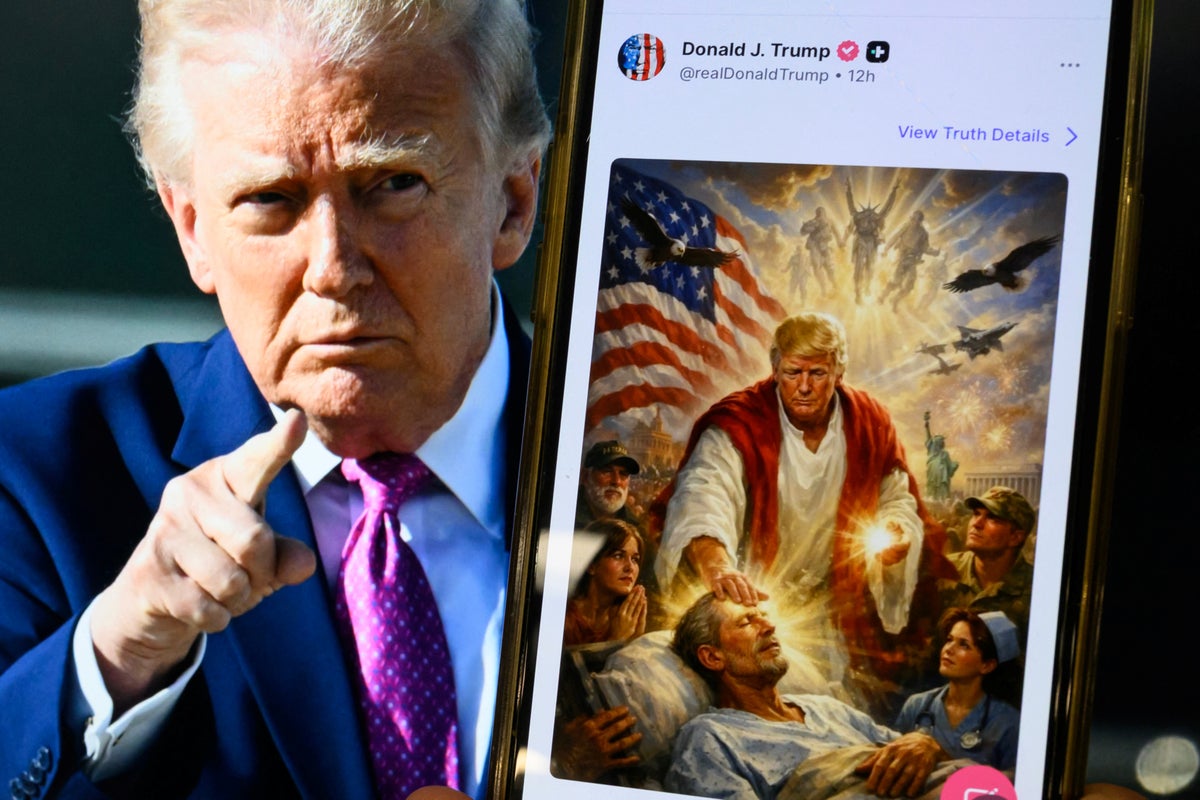
The intersection of populist political movements and established religious hierarchies is currently experiencing a structural rupture driven by two distinct but converging variables: the challenge to traditional diplomatic protocols and the emergence of generative AI as a tool for theological experimentation. When a political leader treats the papacy as a geopolitical competitor rather than a spiritual authority, they shift the relationship from a paradigm of shared moral values to a zero-sum competition for cultural capital. This friction is intensified by the rapid proliferation of "AI Jesus" interfaces and digital avatars, which bypass traditional clerical mediation to offer direct, uncurated, and often heterodox religious experiences. This creates a dual-front conflict within the GOP base, forcing a choice between institutional religious loyalty and a decentralized, tech-driven populist identity.
The Vatican as a Geopolitical Competitor
The tension between Donald Trump and the Vatican operates on a specific logic of "sovereignty overlap." In traditional conservative politics, the Church provides a moral framework that validates policy. However, the current populist model treats the Church as an international NGO with its own globalist agenda—one that frequently clashes with "America First" protectionism and strict border enforcement.
The mechanism of this conflict is rooted in Competing Legitimacy Claims:
- Institutional Legitimacy: The Vatican relies on apostolic succession and a centralized hierarchy to define the "correct" Christian stance on social issues like migration and climate change.
- Populist Legitimacy: This framework derives authority from the "will of the people," viewing any external moral critique—even from the Pope—as an infringement on national self-determination.
By positioning the Pope as a rival, Trump effectively applies a hostile takeover strategy to the religious vote. He is not seeking the Church's endorsement; he is attempting to disintermediate the Church, suggesting that the political movement itself is the truest expression of the faith's values. This creates a "Holy War" within the GOP, as Roman Catholic voters and traditionalists are forced to reconcile their support for a nationalist platform with a leader who openly dismisses the head of their faith.
The Disintermediation of Divinity through Generative AI
The secondary driver of this schism is the rise of AI-generated religious content. Tools designed to simulate the persona of Jesus Christ or other biblical figures represent more than a technological novelty; they are a fundamental shift in the Cost Function of Spiritual Guidance.
Traditionally, the barrier to theological interpretation was high, requiring years of study or the mediation of an ordained priest. Generative AI lowers this barrier to zero. When a "Digital Jesus" provides instantaneous, personalized answers to complex moral queries, it creates a feedback loop that reinforces the user's existing biases.
The Mechanism of Algorithmic Blasphemy
The term "blasphemy" in this context is often used colloquially, but it has a precise functional definition: the unauthorized appropriation of sacred symbols for secular or commercial ends. The "AI Jesus" phenomenon fuels the GOP holy war by providing a mirror for political ideologies.
- Echo-Chamber Theology: An AI model trained on a specific subset of data can be prompted to support specific political outcomes, effectively "sanctifying" policy positions through a simulated divine voice.
- De-institutionalization: By providing a personalized spiritual experience, AI reduces the necessity of the church building and the clerical hierarchy, which are the very institutions that historically moderated political extremism.
This creates a bottleneck for the GOP. While the party relies on the organized mobilization of church networks, the populist wing is increasingly fueled by a decentralized, online, and often syncretic version of Christianity that is highly susceptible to AI-driven misinformation.
The Three Pillars of GOP Religious Fragmentation
To quantify the current instability within the Republican coalition, we must analyze three distinct factions whose interests are no longer aligned.
1. The Institutional Traditionalists
This group prioritizes the integrity of the Church and its hierarchy. For them, a direct attack on the Pope is a non-starter. Their influence is declining as the "cost" of maintaining institutional loyalty rises in a fast-paced, high-conflict media environment. They view AI-generated faith as a dangerous dilution of the sacraments.
2. The Digital Populists
This faction is the primary consumer of both nationalist rhetoric and tech-mediated faith. They are more likely to interact with religious content via social media and AI tools than through a local parish. For this group, the Pope’s "rivalry" with a political leader is seen as a necessary cleansing of a "corrupt" globalist institution.
3. The Evangelical Secularists
A growing segment of the GOP identifies as culturally Christian but is functionally secular in their decision-making. They view the Vatican clash through a purely transactional lens: does the Pope’s stance help or hinder the nationalist agenda? They are indifferent to "blasphemy" in AI, seeing it as just another tool for political messaging.
The Feedback Loop of Scandal and Engagement
The "Holy War" is not just an ideological dispute; it is a product of the Attention Economy. Political figures and media entities benefit from the high-velocity outrage generated by religious conflict.
- Conflict as a Retention Metric: Disagreements with the Vatican generate higher engagement than theological consensus.
- AI as a Content Multiplier: AI tools can generate thousands of variations of religious/political memes per hour, overwhelming the ability of institutional religious leaders to issue corrections or provide counter-narratives.
The cause-and-effect relationship missed by standard reporting is that the Vatican’s criticism actually strengthens the populist bond. Within the logic of the "America First" framework, being attacked by a global religious authority is proof of the leader’s efficacy. This creates a recursive loop where the more the Pope intervenes, the more the populist base identifies the Church as part of the "establishment" that must be dismantled.
Structural Risks to the Republican Coalition
The primary risk of this strategy is the Alienation of the Catholic Swing Vote. In key Rust Belt states, the Catholic vote remains a decisive factor. A sustained campaign that treats the Pope as a geopolitical adversary risks depressing turnout among moderate Catholics who may agree with GOP economic policies but find the religious antagonism culturally repulsive.
Furthermore, the "AI Jesus" trend introduces a volatility variable. If a widely used AI spiritual tool begins advocating for positions that contradict the party platform (e.g., radical pacifism or wealth redistribution based on literalist interpretations of the New Testament), the GOP will find itself unable to "cancel" a decentralized algorithm. The party is effectively playing with a tool that it cannot control, which could lead to a fragmentation of the moral consensus required to pass legislation.
Strategic Forecast: The Shift Toward Post-Institutional Faith
The trajectory of this conflict suggests that the GOP is moving toward a post-institutional religious model. This model will be characterized by:
- Personalized Orthodoxy: Voters using AI to craft a version of Christianity that aligns perfectly with their specific political subset.
- State-adjacent Spiritualism: The elevation of the political leader to a pseudo-religious figure who possesses the authority to override traditional church leaders.
- Technological Governance of Faith: Platforms, rather than pews, becoming the primary site of moral formation.
The logical end-state of treating the Pope as a rival is the complete secularization of the religious vote. If the leader of the faith is just another political actor, then the "faith" itself loses its status as a transcendental moral check on power. The GOP is currently trading long-term institutional stability for short-term populist fervor, a move that will likely result in a party that is religiously labeled but functionally untethered from any historical Christian ethic.
The strategic play for the opposition and internal party reformers is to re-establish the "Institutional Firewall." This involves re-coupling political identity with established communal structures—churches, charities, and local hierarchies—that are resistant to the atomization caused by AI and the volatility of personalized populist rhetoric. Failure to do so will result in a political landscape where "faith" is merely a customizable skin for algorithmic radicalization.