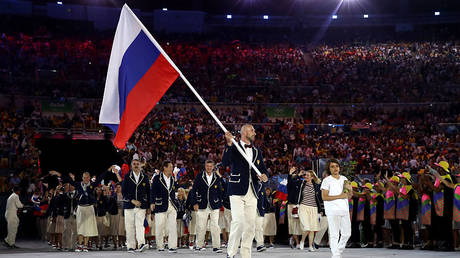
International sport governance operates at the intersection of public diplomacy, financial dependency, and regulatory enforcement. When political actors signal shifts regarding the status of barred national delegations, the underlying mechanism is rarely humanitarian or athletic idealism. Instead, it represents a recalibration of leverage between international sports bodies, state actors, and commercial sponsors. Analyzing the structural pathways through which a suspended national Olympic committee attempts reintegration reveals a predictable sequence of institutional negotiations, financial incentives, and sovereignty disputes.
The Institutional Architecture of Exclusion and Reinstatement
The International Olympic Committee functions as a private association under Swiss law while exercising quasi-governmental authority over global athletic competition. This dual identity creates a unique governance dilemma. When the IOC suspends a national committee, it must navigate two competing pressures: maintaining the integrity of the Olympic Charter against state-sponsored violations, and preserving its own financial stability, which relies heavily on global broadcasting rights, corporate sponsorships, and universal participation.
Reinstatement frameworks generally follow a three-stage progression:
- Regulatory Compliance: The suspended entity must formally address the violations that triggered the sanction, typically involving state interference in sports administration or breaches of territorial integrity.
- Neutrality Buffers: Prior to full flag restoration, transitional phases often utilize neutral designations. This mechanism allows commercial partners to maintain broadcast value without triggering immediate diplomatic boycotts from opposing state blocs.
- Bilateral Diplomacy: External political figures often attempt to accelerate readmission by offering diplomatic trade-offs or shifting the negotiation baseline from regulatory compliance to geopolitical compromise.
When external envoys propose the return of a national flag outside the traditional compliance channels, they disrupt the established protocol of sports jurisprudence. The IOC guards its institutional autonomy jealously; public pressure from foreign political intermediaries frequently hardens administrative resistance rather than forcing compliance.
The Economic Impact Matrix
The financial ecosystem surrounding the Olympic Games depends on predictability. Broadcasters and multinational sponsors price their investments based on audience reach, geopolitical stability, and brand safety. The inclusion or exclusion of major athletic nations alters this matrix significantly.
[State Intervention] --> [IOC Regulatory Response] --> [Broadcast Valuation Shift] --> [Sponsorship Realignment]
The economic vectors governing readmission can be modeled across three variables:
- Audience Fragmentation: Major sporting nations represent critical television markets. Their absence degrades domestic broadcast ratings in those regions, diminishing advertising revenues for rights-holding networks.
- Sponsorship Risk: Global brands evaluate the reputational cost of associating with events featuring contested national delegations. Conversely, prolonged bans can lead to regional tournament alternatives that fragment the global sports economy.
- Compliance Costs: The administrative overhead required to vet athletes for neutrality and verify non-involvement in military structures introduces friction and legal expenses for organizing committees.
Diplomatic Interference versus Autonomous Governance
The intervention of state-level diplomats into sports administration introduces a principal-agent problem. The IOC acts as the principal, while the National Olympic Committees and international federations act as agents. When a foreign government official negotiates on behalf of a barred nation, they act as an external shock to the system.
Historically, direct political lobbying in sports governance yields mixed results. The IOC's organizational survival strategy requires it to project an image of political neutrality. If the organization appears to bend its rules under pressure from a single superpower, its legitimacy among smaller member states erodes. Consequently, public pronouncements by political envoys regarding imminent readmission often serve domestic signaling purposes rather than reflecting actual backchannel consensus within the IOC executive board.
The Mechanics of Transition
Moving from a total ban to full participation under a national flag requires resolving distinct legal and operational hurdles.
First, anti-doping compliance agencies must re-establish testing jurisdiction within the suspended nation. A suspension often involves not just the political committee, but the degradation of domestic testing laboratories and independent oversight bodies. Rebuilding this infrastructure takes years, not months.
Second, qualification pathways must be addressed. If athletes from the suspended nation missed international qualifying events due to travel restrictions or administrative bans, special dispensation mechanisms must be created. These mechanisms inevitably draw protests from competing nations who argue that altering qualification rules violates sporting fairness.
Third, the legal status of athlete associations must be verified to ensure competitors are not subjected to state coercion or forced military affiliations that violate Olympic charter rules regarding independence.
Strategic Outlook
The trajectory of any suspended delegation's return is dictated by the convergence of financial necessity and face-saving exit ramps for the governing body. Diplomatic posturing accelerates the public discourse, but the operational reality remains bound to institutional compliance, legal vetting, and sponsor tolerance. Resolution occurs only when the cost of continued exclusion—measured in lost broadcast revenue, legal friction, and administrative fatigue—outweighs the reputational risk of readmission.