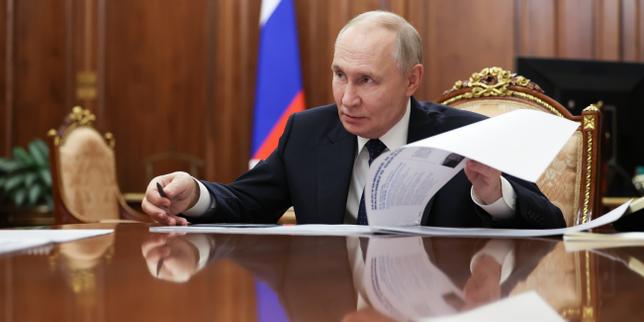
The convergence of the Trump administration’s "Maximum Pressure 2.0" and the Netanyahu government’s kinetic degradation of Iranian proxies has created a vacuum of influence that Moscow is currently monetizing. While Washington and Jerusalem focus on the tactical destruction of Hezbollah’s infrastructure and the economic strangulation of Tehran, Vladimir Putin is executing a low-cost, high-yield strategy of geopolitical arbitrage. By positioning Russia as the sole remaining interlocutor capable of communicating across all fracture lines—Tehran, Jerusalem, Riyadh, and Abu Dhabi—Putin has decoupled Russian regional influence from the physical success of his partners.
The Mechanics of Asymmetric Gains
The prevailing narrative suggests that a weakened Iran is a net loss for Russia. This assessment fails to account for the divergent utility functions of the Moscow-Tehran axis. Russia does not require a dominant Iran; it requires a distracted West and a volatile energy market. The intensification of the conflict between Israel and the "Axis of Resistance" serves three primary Russian strategic objectives:
- Resource Diversion: Every Interceptor (Tamir or Standard Missile-3) expended in the Levant and every diplomatic hour spent brokering ceasefires in Beirut is a resource not directed toward the Ukrainian theater.
- Energy Premium Maintenance: While global demand remains soft, the persistent "war risk premium" in the Persian Gulf provides a floor for Urals crude prices, funding the Kremlin’s domestic military-industrial expansion.
- The Mediation Monopoly: As the United States adopts a purely partisan stance in the regional conflict, it loses its "honest broker" status—even among its own allies who fear total regional conflagration. Russia fills this gap not through military might, but through diplomatic optionality.
The Strategic Triad of Russian Maneuver
To understand why Putin emerges as the beneficiary of the Trump-Netanyahu alignment, one must analyze the three pillars of Russian regional posture.
I. The Preservation of the Syrian Pivot
For Russia, Syria is a fixed asset; Iran is a mobile one. The Israeli air campaign against Iranian assets in Syria (the "War Between Wars") effectively does the Kremlin’s internal housekeeping. By allowing Israel to strike IRGC-affiliated depots while keeping the Khmeimim Air Base and Tartus naval facility untouched, Putin reduces Iranian competition for influence over the Assad regime. This creates a Power Dependency Loop: Assad becomes less dependent on Iranian ground militias and more dependent on Russian diplomatic protection to prevent the total collapse of the Syrian state.
II. Tactical Hedging via the "Grey Zone"
Russia’s relationship with Iran is transactional, not ideological. Moscow has consistently delayed the delivery of advanced Su-35 fighter jets and S-400 missile systems to Tehran. This delay is a calculated piece of leverage. By withholding "game-changing" (to use the common parlance) defensive tech, Putin signals to Israel and the Gulf states that Russian restraint is a tradable commodity. If the Trump administration ignores Russian interests in Eastern Europe, the "cost" will be the immediate activation of these military transfers to Iran, providing Tehran with the "porcupine" defense it currently lacks.
III. The Weaponization of Global South Sentiment
The optics of the Trump-Netanyahu alliance provide Putin with an inexhaustible supply of soft-power ammunition in the "Global South." By framing the conflict as a localized manifestation of Western hegemony, Russia strengthens its ties within the BRICS+ framework. This is not about moral superiority; it is about Market Positioning. Russia sells itself as the alternative to a Western-centric financial and security architecture that many emerging powers view as increasingly volatile and unpredictable.
The Cost Function of Iranian Degradation
The logic of the Trump-Netanyahu strategy is the total neutralization of Iran's regional reach. However, the degradation of Iran introduces a specific set of risks that favor Russian interventionism.
- The Desperation Variable: A cornered Iranian regime, stripped of its proxies (Hezbollah/Hamas) and facing internal economic collapse, is more likely to provide Russia with high-end military technology (drones, ballistic missiles) in exchange for basic food security and nuclear "know-how." Russia is effectively buying Iranian desperation at a steep discount.
- The Migration Wedge: Increased instability in the Middle East creates secondary pressures on European border security. Putin has historically viewed migration as a hybrid warfare tool. Any escalation that triggers new flows of refugees toward Turkey and Europe provides Moscow with leverage over the EU’s internal political cohesion.
Structural Bottlenecks in the US-Israeli Strategy
The Trump-Netanyahu approach operates on the assumption that military and economic pressure will lead to a "behavioral change" or "regime collapse" in Tehran. This strategy faces two primary structural bottlenecks that Russia is currently exploiting.
- The Sanctions Satiation Point: Iran has lived under varied levels of sanctions for four decades. The marginal utility of additional sanctions diminishes as Tehran integrates further into the "Resistance Economy"—a network of illicit oil shipments and barter trade with China and Russia. Moscow provides the technical infrastructure (alternative payment systems) that prevents the total isolation the U.S. seeks to impose.
- The Absence of an End-State: The Trump administration’s preference for "deals" over "wars" creates a vacuum. If Trump seeks a grand bargain with Tehran to exit the Middle East, he will need a guarantor that Tehran trusts more than Washington. Putin is the only candidate for this role. If, conversely, the path leads to war, the global economic shock will benefit Russia as a primary energy exporter.
The Operational Reality of the "Great Winner"
The term "winner" in geopolitics is often misapplied to whoever gains territory. In this context, the win is systemic relevance. While the U.S. spends political capital and Israel spends kinetic capital, Russia is accumulating "Influence Capital" with zero attrition.
The relationship between Moscow and Jerusalem is the most critical variable. Netanyahu’s "red line" with Putin involves the prevention of Iranian nuclearization, while Putin’s "red line" with Netanyahu involves the survival of the Syrian state. This creates a Tactical Equilibrium. Russia allows Israel to hit Iran, Iran becomes more dependent on Russia, and the U.S. remains bogged down in the management of the fallout.
Strategic Forecast: The Moscow-Tehran-Washington Triangle
The most probable outcome of the current trajectory is not an Iranian collapse, but an Iranian pivot to vassalage. As the Trump-Netanyahu pressure mounts, Tehran will be forced to cede strategic autonomy to Moscow in exchange for survival.
This creates a new regional architecture where:
- Russia dictates the "rules of engagement" in the Levant to prevent a full-scale regional war that would disrupt its energy interests.
- Iran becomes a permanent "junior partner" in the Russian sphere, providing the Kremlin with a Mediterranean footprint and a Persian Gulf lever.
- The U.S. finds itself trapped in a cycle of "Security Provision" for Israel and the Gulf, while Russia reaps the "Diplomatic Dividends" of being the only power that can de-escalate the very tensions Washington helps generate.
The strategic play for Western planners is to decouple the Russian-Iranian relationship by offering Moscow a "Ukraine-centric" incentive to abandon Tehran. However, the current alignment suggests that Putin perceives the status quo—where the U.S. is distracted by Iran and Iran is weakened by the U.S.—as his most profitable environment.
The move is now to monitor the S-400 transfer timelines and the Russian-mediated talks between Damascus and Ankara. These are the true indicators of who holds the regional remote control. If Russia begins providing Tehran with real-time satellite intelligence on Israeli movements, the arbitrage phase has ended, and the direct confrontation phase has begun. Until then, Moscow remains the house in a high-stakes game where every other player is betting their own capital.