The alarm on the third floor of the brick apartment building on the eastern edge of Kyiv always rang at 6:15 AM. It was a cheap, plastic thing, but it possessed a relentless, tinny shriek that refused to be ignored. Olena would reach out, her fingers sweeping across the nightstand past a half-empty glass of water and a copy of a paperback mystery novel with a creased spine. Her husband, Dmytro, would already be shifting under the heavy duvet, murmuring something incoherent about coffee.
This was the architecture of their survival. For two years, they had measured their lives not in seasons, but in these quiet, domestic rituals. The morning coffee. The scramble to find matching socks for their nine-year-old son, Bohdan. The quick, almost fierce kiss shared at the entryway before stepping out into a world that had grown increasingly volatile.
Then came the whistle.
It is a sound that defies standard journalistic description. News wires will call it an explosion, a strike, a detonation. But to those who live beneath it, it is a tear in the fabric of the atmosphere. It is the sound of air being violently displaced by thousands of pounds of high-grade explosives and twisted steel traveling at supersonic speeds. It lasts only a fraction of a second, yet it stretches out into an eternity for anyone caught in its trajectory.
When the Russian missile struck the residential complex, it did not just collapse concrete columns and shatter reinforced glass. It erased twenty-four distinct universes.
The Anatomy of the Inexplicable
We often read headlines as mathematical equations. A missile plus a building equals a specific number of casualties. Today, that number is twenty-four. It is a clean, even number. It fits neatly into a news ticker. It allows analysts in distant studios to discuss the geopolitical implications of escalating regional violence without having to confront the smell of burning upholstery and insulation.
But numbers are a coward's way of looking at a tragedy.
To understand what happened in Kyiv, one must look at the geometry of the destruction. A modern apartment building is an ecosystem of shared lives. The woman on the fourth floor who always played her television too loud. The retired teacher on the second floor who tended to the geraniums in the lobby. The young couple on the sixth floor who had just bought a crib.
When a missile hits, it forces these disparate lives into a sudden, violent intersection. The ceiling of the third floor becomes the floor of the second. The personal artifacts of a family—photo albums, graduation certificates, a child’s stuffed bear—are blasted outward, raining down onto the asphalt below like confetti from a celebration no one invited.
Consider the physics of the event. The impact creates a pressure wave that moves faster than the speed of sound. This wave expands outward, shattering human eardrums and collapsing lungs before the heat of the blast even arrives. Next comes the thermal wave, a flash of fire that vaporizes everything in its immediate vicinity. Finally, the structural failure. The heavy concrete slabs, designed to protect and shelter, become instruments of blunt-force trauma as gravity reclaims them.
This is not strategic warfare. It is the deliberate application of terror against the mundane.
The Things Left Behind
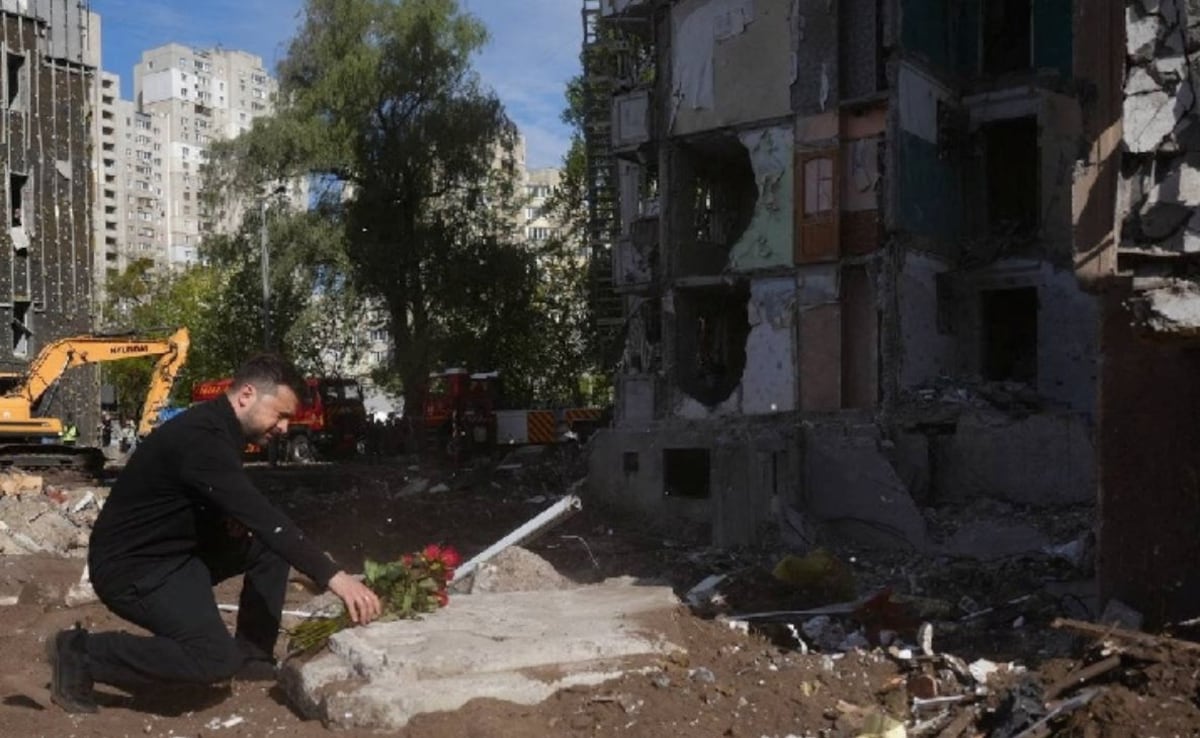
Walk through the perimeter established by the emergency workers and the reality of the loss becomes suffocating. The rescue crews do not move with the frantic energy seen in Hollywood films. They move with a heavy, deliberate rhythm. They know that under thousands of tons of pulverized gray dust, haste can cause further collapses.
They dig with their hands.
Every few hours, a silence falls over the wreckage. A commander raises a hand, and every generator, every chainsaw, every crane shuts down. The workers hold their breath. They listen for the sound of scratching. A faint whimper. The tapping of a pipe. In those moments of profound silence, the collective hope of an entire city hangs by a thread.
More often than not, the silence yields nothing.
Instead, the rubble surrenders fragments of the life that was. A single leather shoe, scuffed at the toe. A frying pan, warped by immense heat, still containing the charred remains of what was meant to be breakfast. A smartphone, its screen webbed with cracks, lighting up repeatedly with missed calls from a contact saved simply as "Mom."
The temptation is to look away from these details because they are deeply uncomfortable. They force us to acknowledge our own vulnerability. We want to believe that our homes are sanctuaries, that the walls we build can keep out the madness of the world. But a strike like this dismantles that illusion entirely. It proves that in the current landscape of modern conflict, the line between the frontline and the living room has been completely obliterated.
The Ripple Effect of a Single Second
The death of twenty-four people does not end when the body bags are zipped and loaded into the back of waiting vans. The true radius of a missile blast is measured in the weeks, months, and years that follow.
Think of the schoolteacher who will stand before a classroom and look at an empty desk. She will have to explain to a room full of children why their friend is not coming back. She will have to find words that do not exist in any pedagogical textbook to demystify the concept of sudden, violent erasure.
Think of the grandparents living in a quiet village outside the city, who woke up to a news broadcast and recognized the scorched facade of the building where their children lived. Their lives, too, were ended by that missile, even if their hearts continue to beat. They are cast into a sudden, agonizing twilight, forced to navigate a grief that reverses the natural order of existence.
This is the hidden cost of the conflict. It is a slow-burning poison that seeps into the collective psyche of a nation. It creates a generation of children who flinch at the sound of a slamming car door or a sudden thunderstorm. It turns every night of sleep into an act of courage, a gamble against the sky.
The Logic of the Target
There will be official statements issued from military briefing rooms. There will be talk of "high-precision weapons" and "collateral damage." There will be claims that the building housed a clandestine command center or a weapons depot.
These words are manufactured to sanitize the slaughter. They are designed to give a thin veneer of rationality to an act that is fundamentally irrational.
When a multi-story apartment building is reduced to a smoking mountain of debris, it is not a mistake. It is a choice. It is a calculation made by individuals who have decided that the psychological breaking point of a population is worth the price of twenty-four civilian lives. They leverage the horror, using the image of a burning home as a weapon of intimidation.
But they misunderstand the nature of the people they are targeting.
As the sun began to set over Kyiv, casting long, crimson shadows across the ruined neighborhood, something remarkable happened. The onlookers did not disperse. The neighbors did not retreat into their own homes to lock the doors. They brought blankets. They brought thermoses of hot tea. They brought heavy gloves and shovels.
People who had never spoken to one another stood shoulder to shoulder, forming human chains to move buckets of debris away from the rescue site. A young woman in a designer jacket stood next to an elderly man in a faded tracksuit, both of their faces smeared with the same gray soot.
There was no grand speeches. No anthems were sung. There was only the quiet, stubborn refusal to abandon the people trapped beneath the stones.
The Unbroken Line
The night brought a bitter chill, but the work did not stop. Floodlights were erected, casting a harsh, theatrical glow over the scene. The smoke continued to rise, a pale plume cutting across the stars.
We look for meaning in these events because the alternative is too terrifying to contemplate. We want to believe that there is a grand design, a moral arc to the universe that bends toward justice. But standing on the cracked pavement of a Kyiv street, looking at the exposed wallpaper of a kitchen that no longer has a floor, that belief feels fragile.
The only certainty lies in the resilience of those who remain. They are the ones who must pick up the pieces, literally and metaphorically. They are the ones who will sweep the glass from the streets tomorrow morning, who will patch the holes in the surrounding buildings, and who will eventually build something new where the old tower once stood.
They will do this not because they are heroes in a mythic story, but because they have no other choice. Life demands it of them.
Somewhere in the darkness, a rescue worker paused, wiping sweat from his brow with the back of a dirty glove. He looked down at a small object he had just pulled from the dirt. It was a child's drawing, the colors faded but still visible. It depicted a sun, a house with a triangular roof, and three figures holding hands. He carefully folded the paper and placed it into his breast pocket, next to his heart, before reaching down to pick up another stone.