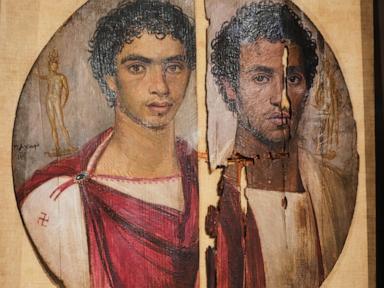
Two thousand years ago, an artist dipped a brush into warm beeswax mixed with powdered pigments, squinted against the merciless North African sun, and painted a face.
It was not a god, nor a king, nor a mythical creature. It was a real human being. Someone who walked the dust-choked streets of the Fayoum Oasis in Roman-period Egypt, bought bread at dawn, worried about the rising price of flax, and loved someone fiercely in the dim quiet of an adobe courtyard. When that person died, their face was immortalized on a thin wooden panel. Encased in linen wrappings and laid to rest in the desert sand, the portrait stayed behind while the centuries rolled over the empire like shifting dunes.
Then came the shovels.
Discovered in the late 19th and early 20th centuries by archaeologists like Flinders Petrie, these funerary masterpieces were unceremoniously ripped from their resting places. They were shipped across oceans, cataloged in damp museum basements, and pinned behind glass cases in London, Paris, and New York. For generations, they sat in foreign capitals—staring out with dark, impossibly vivid eyes at crowds who viewed them as exotic relics of a dead empire rather than the portraits of real, breathing individuals.
They became prisoners of geography.
Until now.
The Weight of Wood and Wax
Imagine standing in a restoration laboratory in Cairo. The air smells faintly of distilled water, aged pine, and the sharp, mineral tang of centuries-old varnish. On a padded workbench lies a wooden panel no thicker than a schoolbook.
A conservator holds a micro-brush, her breath shallow, her hands steady as a surgeon's. Under the magnifying glass, microscopic fissures in the ancient wood look like grand canyons. Flakes of pigmented wax, brittle as autumn leaves, threaten to lift away from the grain.
This is where history stops being a textbook and becomes physical labor.
For decades, the Fayoum portraits—often called the most hauntingly lifelike paintings to survive from the ancient Greco-Roman world—have remained locked in Egyptian storage facilities or glued to foreign gallery walls. The vulnerability of theencaustic and tempera mediums made international travel an unthinkable risk. Wood warps. Paint cracks. Heat destroys.
Yet, preservation science has finally caught up with ambition. Through meticulous stabilization, climate-controlled transport