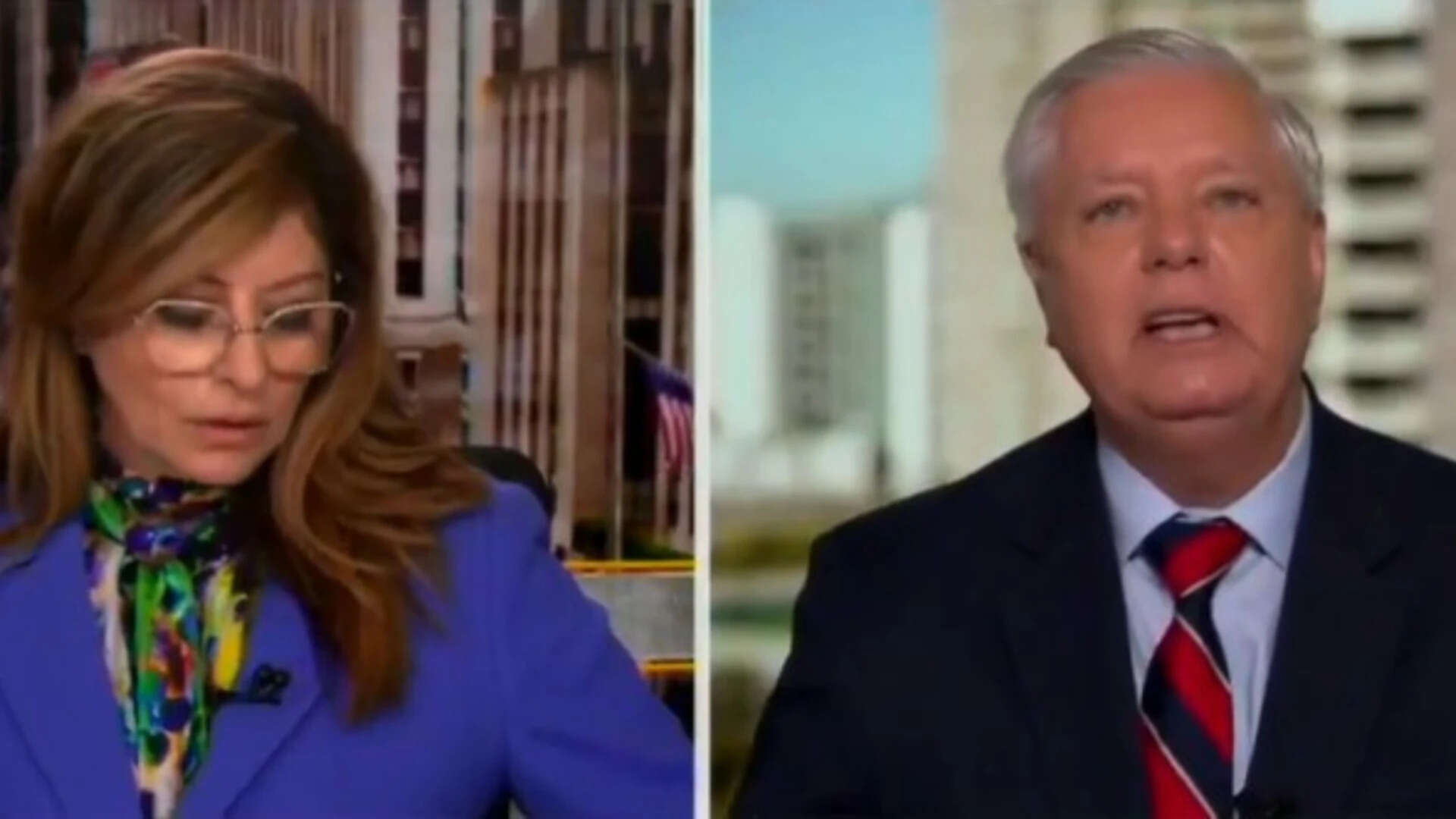
The air in a Washington hearing room has a specific, recycled weight. It smells of old mahogany, expensive wool, and the faint, ozone tang of television cameras. When Senator Lindsey Graham leans into a microphone, he isn't just speaking to the room. He is reaching through the lens to tap into a very old, very American frequency.
"We are going to blow the hell out of them," he said recently, referring to the Iranian government. He didn't stop there. He leaned further, his voice carrying the practiced cadence of a man who has spent decades navigating the theater of geopolitical brinkmanship. "Cuba will be next."
It is a striking image. It suggests a world where complex international tensions can be resolved with the decisive strike of a hammer. But behind the fiery rhetoric of a senior statesman lies a much quieter, more terrifying reality for the people whose lives are the actual currency of these threats.
The Geography of a Threat
To understand the weight of these words, you have to look past the marble columns of the Capitol. You have to look at a small kitchen in Tehran or a crumbling balcony in Havana.
In Tehran, a young woman named Elham—hypothetically, though she represents millions—listens to the news through a VPN. She is not a revolutionary, nor is she a hardliner. She is a graphic designer who wants to know if the price of bread will triple tomorrow because of new sanctions, or if the sky will crack open with the sound of a missile. When an American senator speaks of "blowing the hell" out of her country, he isn't just targeting military installations in her mind. He is targeting her commute, her electricity, and her younger brother’s future.
Graham’s logic is rooted in a philosophy of maximum pressure. The idea is simple: if you make the cost of defiance high enough, the regime will buckle. It is a gamble played with the highest stakes imaginable.
History, however, is a messy teacher.
We have seen this script before. The rhetoric of the "Axis of Evil" in the early 2000s followed a similar arc. The goal was stability through overwhelming force. The result was a decade of entanglement that reshaped the Middle East in ways we are still struggling to map. Iran is not a static target. It is a nation of 88 million people, a complex web of internal dissent and fierce nationalism. When external threats intensify, the internal dissent often gets crushed under the weight of "national security."
The Caribbean Echo
Then there is the mention of Cuba.
For a younger generation, Cuba is a place of vintage cars and vacation photos. For Lindsey Graham, it remains a frontline of the Cold War. By linking Iran and Cuba in a single breath, he is attempting to revive a doctrine of hemispheric purity. He views Cuba not as a sovereign neighbor, but as a persistent irritant—a "bad actor" that needs to be cleared from the board.
"Cuba will be next."
The phrase hangs in the air like a ghost from 1962. It ignores the reality that the Cold War ended over thirty years ago. It ignores the fact that the Cuban people have lived under an embargo for longer than most Americans have been alive.
Consider a taxi driver in Havana named Carlos. He spends his mornings scouring the city for spare parts for a 1954 Chevy. He is tired. He is frustrated with his own government’s inefficiencies. But when he hears that a powerful man in Washington is planning to "deal with" his country next, he doesn't feel liberated. He feels braced. He knows that when giants fight, it is the grass that gets trampled.
The Mechanics of the Blow
What does it actually mean to "blow the hell" out of a modern state?
Technically, it involves a synchronized symphony of destruction. It starts with SEAD—Suppression of Enemy Air Defenses.
Missiles launched from ships in the Persian Gulf would attempt to blind Iran’s radar. Next comes the infrastructure. Power grids. Communication hubs. Refineries. The goal is to paralyze the state.
But the "hell" Graham describes has a way of leaking. It leaks into hospitals that lose power. It leaks into water treatment plants that can no longer process clean transitions. It creates a vacuum. And if there is one thing we have learned from the last twenty years of foreign policy, it is that vacuums are never filled by the things we want. They are filled by chaos.
Graham's stance is built on the belief that American power is at its most effective when it is at its most threatening. He argues that Iran’s support for regional proxies—groups like Hezbollah and Hamas—requires a response that is not just proportional, but existential. To him, the threat is the point. He believes that the only language a "rogue state" understands is the sound of an engine revving.
The Human Cost of the Posture
There is a psychological toll to this kind of rhetoric that rarely makes it into the policy briefs.
It is the "waiting for the other shoe to drop" syndrome. When a government lives under the constant threat of total destruction, it doesn't usually become more democratic. It becomes a garrison state. It builds more bunkers. It arrests more dissidents. It uses the external threat as a justification for internal repression.
The invisible stakes are the lives of those who are neither the leaders making the threats nor the soldiers carrying them out.
It is the researcher in a lab who can't get the chemicals they need for cancer treatment because of shipping restrictions. It is the student whose scholarship to study abroad is suddenly revoked because their passport is now a liability. These are the "collateral" elements of a strategy that views entire nations as monolithic enemies.
The Architecture of a New Conflict
We are currently standing at a crossroads.
One path is the one Graham is shouting from—the path of the hammer. It is clear, it is decisive, and it is incredibly dangerous. It assumes that we can control the fire once we light it.
The other path is the grueling, often unsatisfying work of diplomacy. It is the path of backroom deals, incremental concessions, and the slow, boring task of de-escalation. It doesn't make for good television. It doesn't sound "strong" in a soundbite.
But the hammer doesn't just hit the nail. It vibrates through the arm of the person swinging it.
The United States is currently navigating a world where its influence is being challenged by rising powers and shifting alliances. In this environment, the "blow them up" rhetoric can feel like a nostalgic comfort—a reminder of a time when American will was undisputed.
But nostalgia is a poor basis for a 21st-century defense policy.
The Weight of the Gavel
Senator Graham is a man of conviction. He believes he is protecting the American people by projecting a terrifying level of resolve. He sees himself as the guardian at the gate.
But the gate has changed.
The world is no longer a collection of isolated islands that can be bombed into submission without affecting the rest of the map. We are connected by fiber-optic cables, global supply chains, and a shared climate. A fire in Tehran or Havana doesn't stay there. It sends smoke across the entire globe.
When the cameras finally cut away and the lights in the hearing room are dimmed, the words remain. They travel across the Atlantic and the Caribbean. They land in the ears of people who are just trying to survive the week.
War is not a game of Risk played on a wooden table. It is a visceral, bloody, and unpredictable tearing of the social fabric. To speak of it so casually is to forget what the "hell" actually looks like once it's been blown out of its cage.
The mahogany desk in Washington is safe. The kitchen in Tehran is not. The balcony in Havana is not.
And as the rhetoric ramps up, the world waits to see if the hammer will actually fall, or if we are just watching a very expensive piece of theater where the audience is the only one who stands to lose everything.
The silence that follows a threat is often louder than the threat itself. It is the silence of a breath being held by millions of people who have no say in the matter, watching a man in a suit decide if their world is worth saving or if it is simply "next."