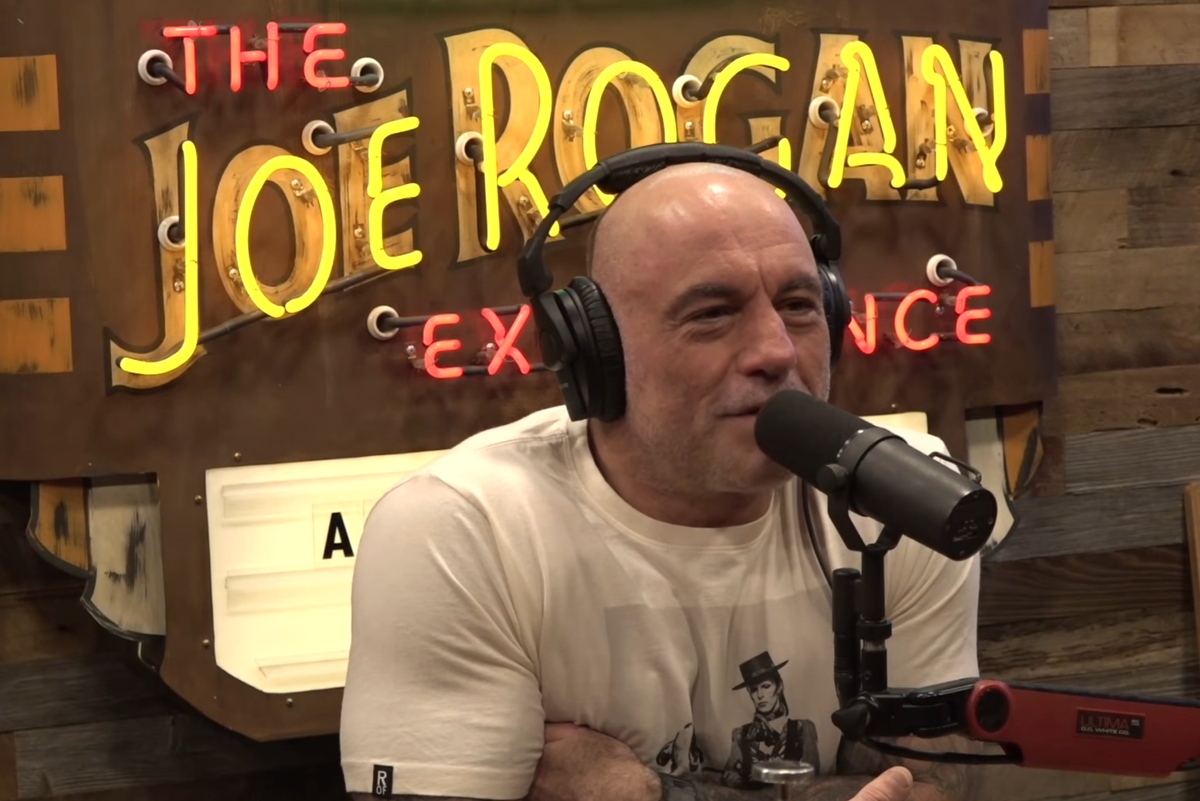
Joe Rogan sits behind a thick slab of wood, headphones clamped over his ears, staring into the digital abyss of a million simultaneous listeners. He is a man who built an empire on the idea that you can talk your way into the truth if you just keep the tape rolling long enough. But lately, the conversation has hit a jagged edge. The air in the studio feels different when the subject shifts from DMT or weightlifting to the visceral, bone-deep reality of a potential war in the Middle East.
Donald Trump is no longer just a guest or a distant political figure in the Rogan universe. He is a gravity well. For years, the two have orbited one another in a strange, non-committal dance of mutual benefit. Rogan offered the platform; Trump offered the spectacle. Fans of the show often see them as two sides of the same anti-establishment coin. Yet, the coin is spinning. It’s wobbling on a table covered in maps of Tehran and the wreckage of foreign policy promises that haven't quite aged the way anyone expected.
The recent friction isn't about personality. It isn't about the handshake or the golf game. It’s about the specific, haunting scent of gunpowder.
The Ghost of the Forever War
To understand why Rogan is suddenly pushing back, you have to understand the specific type of person who listens to a three-hour podcast while driving a forklift or a long-haul truck. These aren't the people who write think-pieces in D.C. office buildings. They are the people who sent their brothers and sons to Fallujah and Kandahar. Rogan knows this. He feels it in his marrow because his brand is built on being the "everyman" who asks the questions that common sense demands.
When Trump began leaning into a harder line against Iran, something snapped in the narrative. Rogan’s voice, usually a steady baritone of curiosity, took on a sharper, more incredulous tone. He looked at the logic of escalating a conflict with a nation of eighty million people and simply said it doesn't make sense. It’s a short sentence. It’s a blunt instrument. In the world of high-stakes geopolitics, it’s a hand grenade thrown into the middle of a campaign strategy.
The tension lies in a broken promise. The appeal of the MAGA movement for many Rogan-adjacent voters was the idea of "America First" as a synonym for "Bring Them Home." It was an isolationist dream wrapped in a red, white, and blue flag. But as the rhetoric shifts toward strikes and regional dominance, that dream starts to look like a familiar nightmare. Rogan isn’t just criticizing a policy; he’s calling out a perceived betrayal of the core ethos that brought these two worlds together in the first place.
The Weight of the Red Light
Imagine a young man in Ohio. Let’s call him Elias. Elias grew up watching his older brother struggle with a TBI after a tour in Iraq. Elias likes Rogan because Rogan talks about the things that feel real—physical health, mental clarity, and the suspicion that the people in charge are usually lying. When Elias hears Trump talking about "obliterating" threats overseas, he feels a surge of adrenaline. But when he hears Rogan pause, lean into the mic, and ask why we are doing this again, the adrenaline fades. It’s replaced by a cold, heavy dread.
This is the invisible stake. It isn't about poll numbers or Twitter trends. It’s about the trust between a creator and an audience. If Rogan follows Trump blindly into a hawkish foreign policy, he loses his status as the independent arbiter of truth. If he breaks away too harshly, he risks alienating the segment of his base that views Trump as an infallible leader.
He is walking a tightrope over a pit of fire.
The skepticism Rogan voiced regarding the Iran situation wasn't a scripted political hit. It felt like a reflex. It’s the reflex of a man who has spent twenty years talking to veterans, doctors, and conspiracy theorists, concluding that the simplest explanation is usually that the machine wants to keep running. And the machine eats young men for fuel.
A Marriage of Convenience Meets a Wall of Reality
The relationship between a populist politician and a cultural titan like Rogan is never a straight line. It’s a series of zig-zags. One day, Rogan is praising the boldness of the Trump administration's approach to the border. The next, he is baffled by the saber-rattling directed at a country that hasn't seen an American boot on its soil in generations.
This isn't a "flip-flop." That’s a word used by pundits who want everyone to fit into a neat little box. This is something more human. It’s the process of a person trying to reconcile their admiration for a "strongman" with their inherent distrust of the "war machine."
Consider the mechanics of the conversation. Trump thrives on the big stage, the rallies, the thunderous applause of the crowd. Rogan thrives in the quiet, the one-on-one, the long-form dissection of an idea. When those two energies collide, there is bound to be a spark. But when the topic is war, those sparks can start a forest fire.
Rogan’s latest criticism of the Iran stance is a signal. It’s a flare sent up from the middle of the cultural ocean. He is telling his audience—and perhaps telling Trump himself—that the "anti-woke" alliance has a limit. That limit is the graveyard.
The Sound of Silence in the Studio
There is a specific kind of silence that happens when a guest says something that violates the host's fundamental worldview. You can hear it in the episodes where the tension is high. It’s a silence filled with the ghost of every soldier who didn't come back.
Rogan’s pushback on Iran isn't just about Iran. It’s about the memory of 2003. It’s about the memory of 2011. It’s the collective trauma of a generation that was told a "limited engagement" would be over in months, only to spend decades watching the bills pile up in blood and treasure.
Trump’s advisors likely see Iran as a chess piece. They see it as a way to project strength, to secure oil interests, or to appease regional allies. Rogan sees it as a meat grinder. He sees the faces of the people who come on his show to talk about their PTSD. He sees the wreckage of families.
This is where the "hot-and-cold" relationship turns into something more substantial. It’s no longer a matter of whether they like each other’s jokes or agree on tax policy. It’s a fundamental disagreement on the value of American intervention. It’s a clash between the theater of power and the reality of the human cost.
The microphone is a powerful thing. It can build a movement. It can dismantle a king. As Rogan continues to navigate this landscape, he is finding that the closer you get to the center of power, the harder it is to keep your own voice from being drowned out by the roar of the engines.
The red light on the camera stays on. The headphones stay on. The wood of the table is cool to the touch, but the words being spoken over it are starting to burn. Rogan isn't just a host anymore. He’s a gatekeeper. And he’s starting to realize that some people shouldn't be allowed through the gate if they’re carrying a torch.
Every time a politician speaks of war as a necessity, they are asking for a loan. They are asking the public to lend them their children, their peace of mind, and their future. Rogan is looking at the interest rates and deciding the price is too high.
He isn't looking for a debate. He’s looking for a way out of a cycle that has defined the last quarter-century of American life. Whether Trump listens or not is almost secondary to the fact that millions of people are listening to the hesitation in Rogan’s voice. That hesitation is a contagion. It spreads. It makes people stop and think. It makes them wonder if the person they thought was their champion is actually just another architect of the same old towers.
The studio door closes. The recording ends. But the echo of that one simple question remains, vibrating in the ears of a nation that is tired of being told that the next war will be the one that finally makes sense.