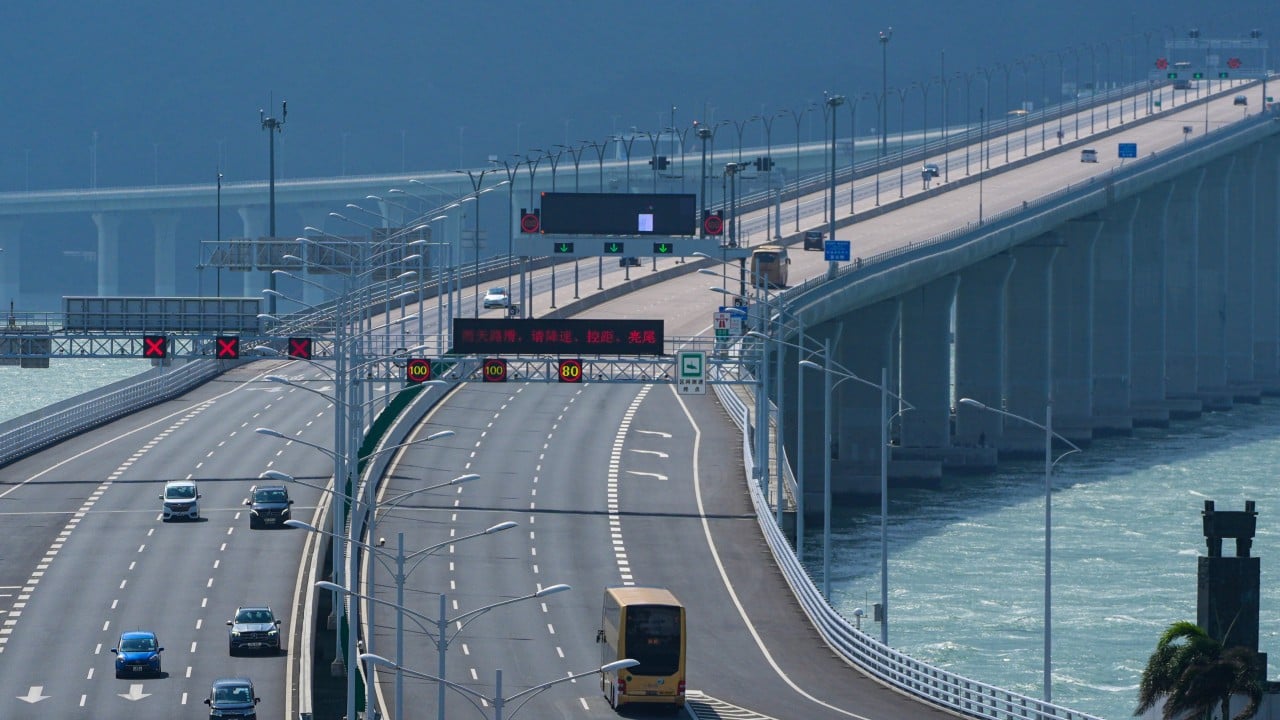
The structural bottleneck limiting economic integration within the Guangdong-Hong Kong-Macao Greater Bay Area (GBA) is no longer a deficit in physical infrastructure, but a deficit in operational throughput at regional borders. Physical conduits like the Hong Kong-Zhuhai-Macao Bridge (HZMB) possess massive structural capacity, yet their economic utility is throttled by administrative and physical processing friction at boundary control points. The economic loss generated by these delays escalates non-linearly during peak travel periods, creating a predictable chokepoint that counteracts the policy objectives of the Northbound Travel for Hong Kong Vehicles and Southbound Travel for Guangdong Vehicles schemes.
Optimizing this cross-boundary ecosystem requires shifting from manual, multi-stage border processing to continuous, in-vehicle biometric clearance. Resolving these bottlenecks requires analyzing the physical limitations of Hong Kong's urban transit network alongside the processing capacity of its regional borders.
The Friction Coefficient of Cross-Boundary Logistics
The operational efficiency of a border checkpoint is governed by a basic queuing model where the arrival rate ($\lambda$) must remain strictly below the service rate ($\mu$) to prevent systemic compounding delays. Under the current regulatory architecture governing the HZMB, the service rate is artificially suppressed by physical decoupling requirements. Except for select exempt groups such as passengers aged 70 or above, pregnant women, and disabled travelers, the default operational protocol requires vehicle occupants to exit the cabin, traverse a pedestrian clearance hall, and re-enter the vehicle.
This protocol introduces severe friction into the transit system through three distinct structural inefficiencies:
- Kinematic Delays: Alighting from a vehicle, walking to an inspection kiosk, queuing, and returning to the vehicle injects a fixed time penalty per car that is entirely independent of the actual verification speed.
- Variable Passenger Loads: Vehicles carrying multiple occupants experience multiplied processing times in the pedestrian hall. This discrepancy creates unpredictable delays that cause traffic to back up into the vehicle inspection lanes.
- Spatial Decoupling Disconnects: Separating passengers from their vehicles decouples identity verification from vehicle inspection. This requires secondary matching protocols at a final exit gate, adding another sequential step to a process that could be executed simultaneously.
During peak travel periods, such as the Easter and Ching Ming holiday windows, the arrival rate at the HZMB escalates sharply, with single-day passenger volumes exceeding 192,000 individuals and vehicle traffic crossing the 30,000 mark. When $\lambda$ exceeds $\mu$ at these scales, the queue length grows exponentially rather than linearly.
The consequence is a dramatic drop in throughput that turns high-capacity regional infrastructure into a highly congested parking lot. This delay functions as an artificial tariff on travel, raising the time cost of cross-border trips and undermining the "one-hour living circle" policy framework.
The Technological Architecture of In-Vehicle Clearance
The claim that security requirements necessitate physical vehicle egress is contradicted by existing automated inspection technologies. The infrastructure for automated, non-line-of-sight verification is already deployed at the Zhuhai section of the crossing; however, it is currently limited to specific demographic exceptions. Transitioning to a universal, 24-hour in-vehicle clearance model requires integrating three parallel automated systems into a single checkpoint lane.
[Vehicle Arrival]
       │
       ▼
┌────────────────────────────────────────────────────────┐
│             Simultaneous Data Acquisition              │
├───────────────────────────┬────────────────────────────┤
│   ANPR & RFID Tracking    │    Biometric Verification  │
│  (Vehicle Registration)   │  (Facial & Fingerprint)    │
└───────────────────────────┴────────────────────────────┘
       │
       ▼
┌────────────────────────────────────────────────────────┐
│            Optical Travel Permit Scanning              │
│         (Home-Return / Multi-Entry Permits)           │
└────────────────────────────────────────────────────────┘
       │
       ▼
[System Congruence Check] ───► [Gate Release]
Automated License Plate Recognition and RFID Tracking
Vehicle identities must be established prior to the vehicle reaching the physical inspection window. Combining high-definition Automated License Plate Recognition (ALPR) cameras with passive Radio Frequency Identification (RFID) tags attached to windows achieves dual-factor vehicle authentication. This setup allows the system to cross-reference the vehicle’s registration, insurance status, and active travel permits against cross-border databases while the car is still moving at low speeds in the approach lane.
Contactless and In-Cabin Biometric Verification
Using multi-angle facial recognition cameras mounted at varying heights alongside retractable, cabin-level fingerprint scanners allows identity verification to occur directly through an open vehicle window. For multi-passenger vehicles, digital display terminals paired with interior-facing biometric arrays can verify rear-seat passengers without requiring them to step out of the car.
Optical Travel Permit Scanning
Integrating high-speed optical character recognition (OCR) scanners at the vehicle window level allows drivers and passengers to present Mainland Travel Permits for Hong Kong and Macao Residents (Home-Return Permits) or multi-entry visas without leaving their seats.
The primary hurdle to deploying this architecture at scale is not a lack of technology, but a lack of data interoperability between different government agencies. A unified in-vehicle lane requires real-time data synchronization across three distinct administrative frameworks: Hong Kong Immigration, Mainland Customs, and regional transport authorities.
If these automated scans operate within separate, sequential databases, the time savings from keeping passengers inside the vehicle will be eaten up by data processing delays between agencies. True high-velocity processing demands a single-point data collection model where a solitary scan verifies the vehicle, the driver, and all passengers simultaneously across all relevant legal frameworks.
Urban Spacial Capacity and Asymmetric Flow Realities
While smoothing out border delays helps optimize regional transit, expanding the volume of cross-border driving schemes introduces a structural tension: the deep asymmetry in spatial capacity between the two connecting regions. Guangdong Province offers a massive geographical footprint and expansive road networks, making it highly resilient to an influx of vehicles from Hong Kong. Conversely, Hong Kong operates within extreme spatial constraints, characterized by a highly dense urban core, a total lack of surplus parking infrastructure, and a deliberate policy framework focused on public transit efficiency.
This spatial reality explains why the Southbound Travel for Guangdong Vehicles scheme must use a highly restrictive, asymmetric quota model compared to its northbound counterpart.
| Operational Metric | Northbound Travel Scheme (Hong Kong to Guangdong) | Southbound Travel Scheme (Guangdong to Hong Kong) |
|---|---|---|
| Active Registered Fleet | Exceeds 140,000 vehicles (projected to pass 200,000) | Capped at a strict daily quota of 100 vehicles |
| Maximum Length of Stay | Up to 30 consecutive days per entry | Capped at a maximum of 3 consecutive days |
| Primary Destination Zone | Broad distribution across Guangdong Province | Restricted to urban core and designated zones |
| Infrastructure Impact | High absorption across wide highway networks | High congestion risk on dense urban roads |
As the northbound fleet scales toward a projected 200,000 registered private vehicles, the border infrastructure faces a clear choice: either transition to automated in-vehicle clearance or accept permanent, systemic gridlock during peak periods.
On the southbound side, however, the bottleneck is not the border checkpoint, but the limited capacity of Hong Kong's urban roads. Introducing even a few thousand additional left-hand-drive vehicles into highly congested zones like Central or Tsim Sha Tsui risks disrupting local surface transit networks.
This vulnerability explains the strict initial 100-car daily cap and the deployment of targeted infrastructure projects, such as the dedicated electric vehicle (EV) charging and driver information station at Penny's Bay on Lantau Island. This facility serves a clear strategic purpose: it intercepts southbound vehicles near the bridge exit, letting drivers charge and access information before they can enter the dense urban center.
Strategic Interventions for Regional Logistics
To prevent cross-border travel schemes from stalling out due to administrative and physical friction, regional transport authorities must move away from minor, incremental adjustments and implement major structural updates across three core areas.
First, immigration authorities should run a phased rollout of 24-hour in-vehicle clearance lanes at the HZMB, prioritizing high-occupancy vehicles and frequent travelers. This rollout must be paired with clear, cross-border data agreements that combine vehicle registration, biometric validation, and custom declarations into a single, one-stop scan.
Second, to mitigate the risks that left-hand-drive vehicles pose to Hong Kong's right-hand-drive road systems, transport departments must mandate interactive, digital pre-travel training certifications for all southbound applicants. This educational requirement should be supported by real-time navigation integration that alerts drivers to key systemic differences, including:
- Rotational Direction of Roundabouts: Navigating clockwise versus counterclockwise.
- Asymmetric Turning Corridors: Managing sightline variations when making right-hand turns across oncoming traffic compared to left-hand turns.
- Signage Layouts: Adapting to distinct road markings and overhead sign placement styles.
Finally, any future expansion of the southbound travel quota must be tied directly to satellite parking infrastructure built on perimeter islands like Lantau. Expanding the daily quota past the initial 100-car cap should require incoming vehicles to park at outer-ring transit hubs connected directly to the Mass Transit Railway (MTR) network. This approach allows the region to scale up passenger volumes and capture the economic benefits of tourism and business travel, without adding physical vehicle congestion to Hong Kong’s vulnerable urban roads.