The heat of July does something specific to asphalt. It softens it just enough to hold the imprint of a boot, a stray plastic cup, or the heavy base of a metal barricade. On the National Mall, that heat felt less like weather and more like pressure. Two and a half centuries of history pressing down on a single afternoon.
If you stood near the back of the crowd, away from the VIP stands and the wall of television lenses, the grand narrative of the American Semiquincentennial began to blur. A family from Ohio stood under the sparse shade of a dying elm tree, the father shielding his daughter’s eyes from the glare. They had saved for months to be here. They wanted to witness a milestone, a moment of national poetry. What they found instead was a sweltering crucible of division, a chaotic spectacle where the past was not remembered so much as weaponized.
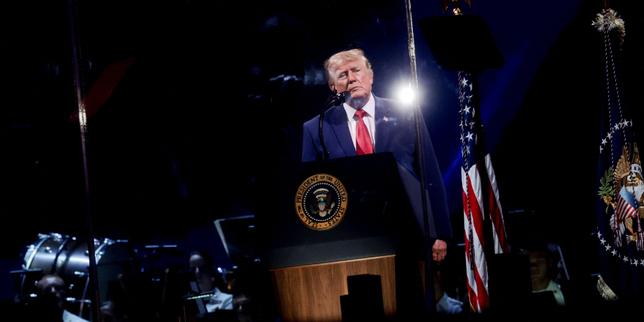
We have arrived at two hundred and fifty years. It is a staggering number for an experiment built on paper and promise. Yet, the air did not fill with the shared reverence of a milestone reached. It crackled with the static of an ongoing argument. When Donald Trump took the stage, the celebration shifted instantly from a historical commemoration into something far more visceral, a rally for the soul of a divided house.
The Sound and the Fury on the Mall
The podium looked small against the vast backdrop of Washington, but the voice that boomed from it carried the familiar weight of a decade’s worth of political friction. He did not speak of the slow, painful march of progress or the quiet triumphs of everyday citizens. He spoke of battlefields. Both historical and modern.
He praised the foundational brilliance of America, a country carved out of the wilderness by sheer will. But the praise was merely the prelude to the reckoning. Within minutes, the speech pivoted toward the enemies within, a fierce condemnation of what he termed the "communists" and radicals destroying the fabric of the nation. For the supporters near the front, wearing hats faded by years of political campaigns, every word was a necessary truth. They cheered, their voices rising into the humid air, demanding a restoration of a country they felt slipping away.
Further back, the reaction was entirely different. A group of younger spectators stood in silence, their faces tightened by frustration. To them, the rhetoric felt like an eviction notice from their own national birthday party. The contrast was stark. One nation, occupying the same grass, looking at the same stage, but living in two entirely separate realities.
The logistics of the day mirrored this ideological fracture. Chaos crept in around the edges of the celebration. Long lines stalled under the sun. Security checkpoints became bottlenecks of frustration. Hydration stations ran low, leaving people to barter for plastic bottles in the stifling heat. It was a micro-scale breakdown of organization, a physical manifestation of a larger, systemic weariness. When the infrastructure of a celebration fails, the mood turns quickly from celebratory to survivalist.
The Invisible Weight of the Milestone
To understand why this moment felt so heavy, look past the headlines and the partisan cheers. Consider what happens next to a society that can no longer agree on its own origin story.
A nation is, at its core, a shared imagination. It requires its people to believe in the same basic set of ideals, even if they disagree on how to achieve them. When that shared imagination fractures, the symbols change meaning. The flag becomes a claim of ownership rather than an umbrella. The anniversary becomes a line in the sand.
The hypothetical citizen we might call Sarah—a public school teacher from Virginia who spent her career explaining the Constitution to eighth graders—watched the broadcast from her living room. She did not see a celebration of endurance. She saw an ideology stripped of its nuance. In her classroom, the story of America was always a messy, ongoing conversation about liberty, failure, and redemption. On the television screen, it was a binary choice between total victory and total destruction. The nuance had been burned away by the heat of the political moment.
This is the real friction of the American present. The realization that two hundred and fifty years does not guarantee a two hundred and fifty-first. The machinery of democracy is not self-sustaining; it requires a level of civic trust that currently feels entirely depleted.
The View from the Fringes
As the afternoon waned, the crowd began to disperse, leaving behind a battlefield of litter and discarded signs. The speeches ended, but the echo remained. The language used on the stage was designed to linger, to reinforce the walls between communities rather than bridge them.
In the streets surrounding the Mall, the arguments continued in smaller, sharper bursts. A man in a red hat debated a counter-protester over the very definition of freedom. Neither was listening. Both were merely waiting for their turn to speak, their arguments hardened by years of media consumption and political tribalism.
The great danger of this historical milestone is not the chaos of the organization or the heat of the day. It is the normalization of the idea that half of the country is inherently illegitimate. When political rhetoric labels opponents not as rivals but as existential threats—as "communists" bent on ruin—the space for compromise disappears entirely.
The sun finally dipped below the horizon, casting long, dramatic shadows across the monuments. The marble statues of Lincoln and Washington remained fixed, staring out into the twilight, indifferent to the temporary passions of the crowd. They have seen crises before. They have witnessed eras of profound fracture.
The crowd filed into the metro stations, quieted by exhaustion and the heavy air of the city. The anniversary had passed, the speeches were recorded, and the country remained exactly as it was before the first firework was launched: twenty-five decades old, profoundly wealthy, deeply powerful, and entirely unsure of how to live with itself.
The night settled over the Potomac, dark and quiet, leaving only the faint scent of sulfur from the fireworks and the lingering question of what happens when the celebration is over but the division remains.