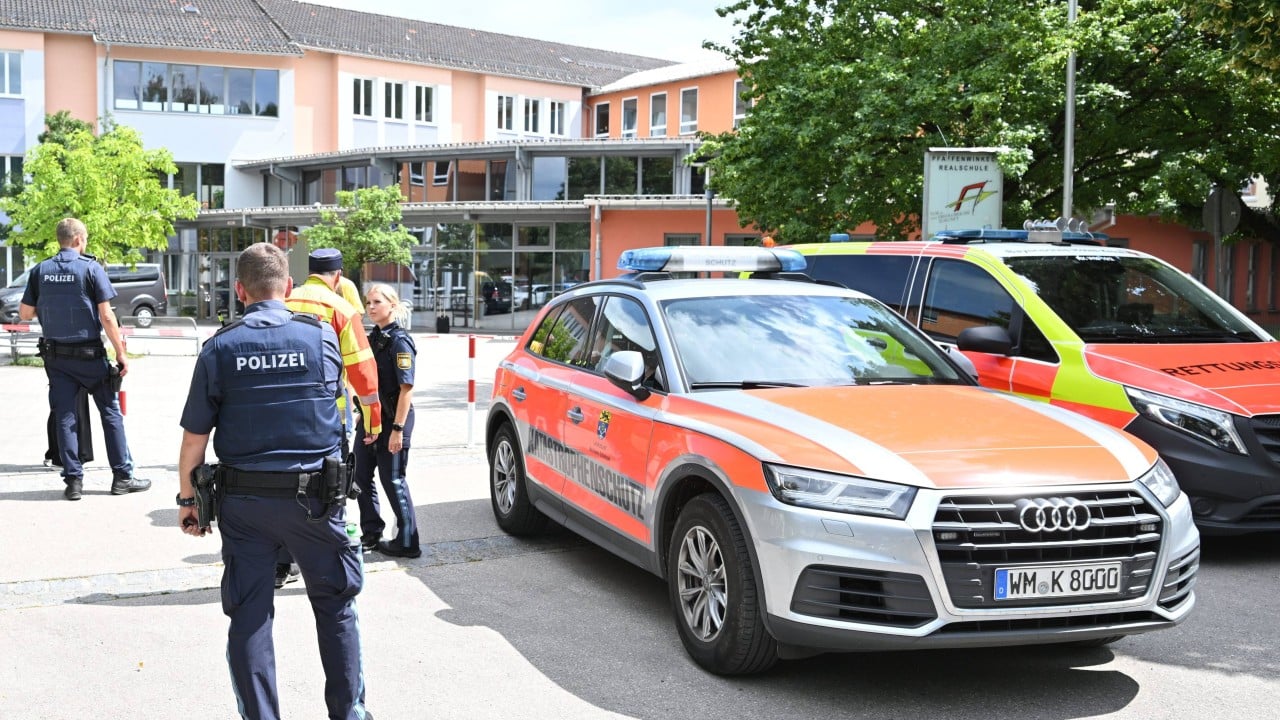
The sound of a school hallway is a universal language. It is the synchronized slamming of metal lockers, the screech of sneakers on freshly buffed linoleum, and the chaotic symphony of hundreds of teenagers talking over one another. It is loud, vibrant, and entirely predictable.
Until it stops.
On a quiet Wednesday at Welfen High School in Germany, that predictable rhythm shattered. A 16-year-old boy stepped into the space where childhood is supposed to transition safely into adulthood. He was not there to learn. Within minutes, a suspected rampage left two young girls seriously wounded, their lives suddenly hanging in the balance, and an entire community frozen in the terrifying realization that violence does not require a passport to cross into their world.
The emergency sirens that soon cut through the afternoon air did more than signal the arrival of flashing lights and heavily armed police. They sounded a grim reminder of a question we continually fail to answer: What happens when the safety of our children becomes an illusion?
The Mechanics of Panic
When an event like this unfolds, the initial news alerts are clinical. They use terms like "rampage," "suspected assailant," and "secured perimeter." But these words strip away the actual human experience of the moment. They turn a tragedy into a series of logistics.
Consider what happens next when the alarm sounds in a modern school. The transition from a mundane math lesson to a state of survival happens in a heartbeat. Doors are locked from the inside. Lights are cut. Teenagers, suddenly stripped of their usual youthful bravado, crowd into the corners of classrooms, pressing themselves against the walls to stay out of the line of sight from the door windows. They look at their phones, not out of distraction, but to send text messages to their parents that they pray will not be their last.
Outside, the response is swift and heavy. Blue lights paint the brick facade of the school. Emergency responders move with practiced, military precision, establishing a perimeter, preparing triage stations, and hunting for a teenager who, just hours earlier, had likely walked past the same security gates unnoticed.
The physical injuries to the two young girls are being treated by professionals in sterile hospital rooms. But the invisible wounds inflicted on every student who sat in those darkened classrooms will take far longer to close.
The Myth of Elsewhere
We have built a collective psychological defense mechanism around school violence. For years, the prevailing narrative in Europe was that this was a uniquely American affliction—a byproduct of specific laws and a distinct cultural obsession. When a crisis occurs in a European institution, it shatters this comforting myth.
Violence is not bound by geography. The underlying friction that drives a 16-year-old to turn on his peers does not care about national borders or strict regional regulations.
When we look at behavioral patterns in youth violence across the globe, the common denominators rarely change. It is almost never a sudden, unprompted snap. Instead, it is a slow, quiet accumulation of isolation, unaddressed psychological distress, or radicalization in the dark corners of the internet. By the time the world notices, the fracture has already occurred. The physical act is merely the final, catastrophic symptom of a disease that went untreated for months, if not years.
The Weight of the Aftermath
The 16-year-old suspect is now in police custody. The immediate danger has passed. The school will eventually reopen, the blood will be scrubbed from the floor, and the lockers will line the hallways just as they did before.
But a school is never quite the same after the sirens stop.
Parents will stand at the drop-off gates tomorrow morning holding their children a few seconds longer than usual. Teachers will look at their classrooms not just as spaces of education, but as environments they might have to defend. And the students will carry the quiet, heavy knowledge that the place where they spend their youth is vulnerable.
We look for answers in the immediate wake of a tragedy. We demand to know the motive, the weapon, the timeline. We want a neat narrative that allows us to file the event away and convince ourselves it won't happen again. But the truth is rarely neat. The truth is messy, uncomfortable, and deeply unsettling.
The true stakes of this crisis are found in the empty desks that will remain in those classrooms tomorrow, and in the sudden, heavy silence that now occupies the space where a normal school day used to be.