Silence. That is the first thing you notice inside a high-stakes auction room right before the paddle starts moving.
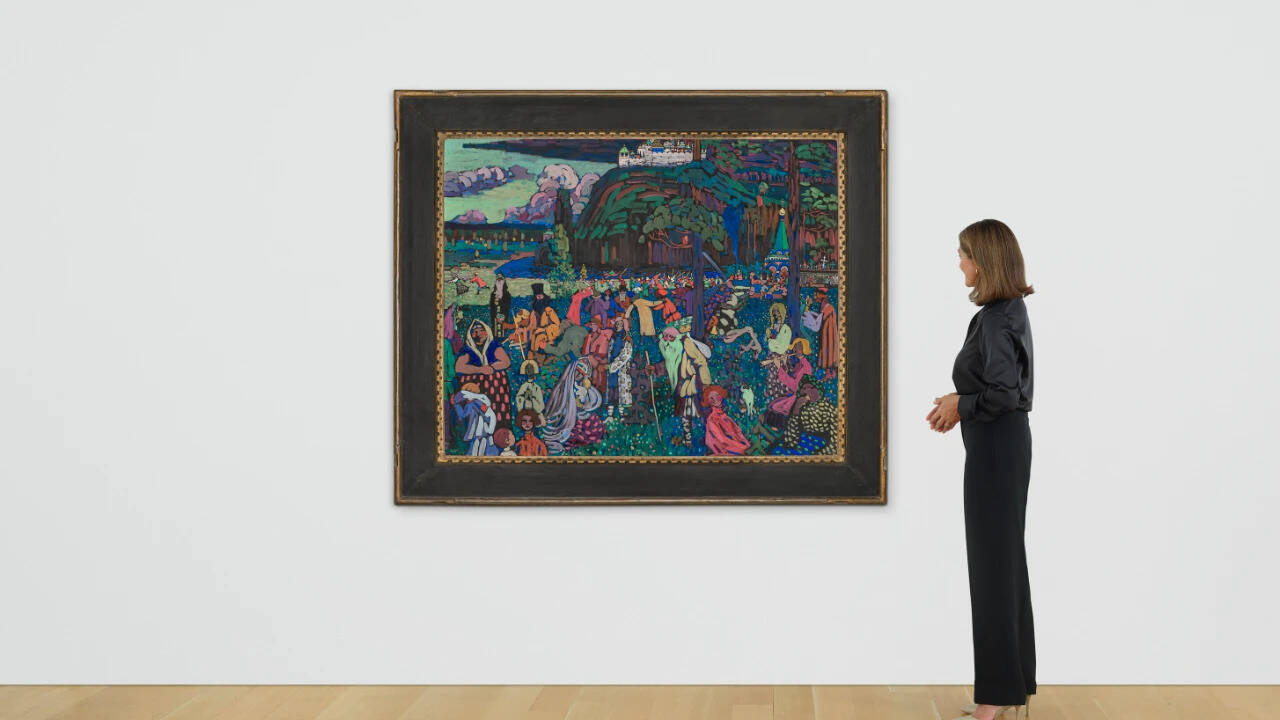
Not the quiet of a library, which feels gentle and sleepy, nor the hush of a cathedral, which feels earned. This is a sharp, expensive stillness—the sound of tailored wool, cold air conditioning, and dozens of people pretending their pulse has not doubled. In front of them hangs a canvas painted by Wassily Kandinsky, a work once seized by the Nazis and now valued at roughly $42 million. To the wire feeds and financial tickers, it is a headline. A triumph of the market. A record-setting hammer drop.
I have stood near enough to auction rooms and restitution files to feel the strange dissonance that hums underneath those numbers. On paper, a $42 million sale looks like closure. The painting is visible again. A price tag has been assigned to something once stolen. Maybe a family that waited for decades receives a share of the proceeds, or a museum celebrates a public return.
Yet sitting with these stories long enough makes you uneasy. Money is loud. Grief is not. And when a painting taken by authoritarian theft crosses the auction block for tens of millions of dollars, the headline makes it look like a clean ending to a story that actually has jagged edges everywhere.
To be completely honest with you, this territory confuses and troubles me even after years of reading provenance records and restitution histories. Sometimes the legal paperwork is crystal clear, and the emotional truth remains messy. Sometimes a family wants money; sometimes they want the canvas itself; sometimes they spend half their lives fighting over who even has standing to ask. If you expect a neat moral out of a $42 million auction result, you are going to walk away unsettled.
Let us step back from the auction gavel and look at what is really happening when a Kandinsky—or any work looted during the Nazi era—surfaces at a major sale.
The Canvas Behind the Gavel
Wassily Kandinsky did not paint like a conventional landscape artist trying to match a postcard. Born in Moscow in 1866, he helped pioneer abstract art, pushing color, line, and geometry until a painting could strike the viewer almost like a chord of music. Watching people stand in front of his work in a quiet gallery, you can see how color pulls the eye. A slash of vermilion feels hot and urgent; a deep indigo holds you back like water at dusk; sharp black angles cut across soft yellows like a sudden change of weather.
During the rise of the Nazi regime in Germany, that exact freedom made Kandinsky dangerous to the state. The regime branded modern and abstract art as "degenerate"—a label meant to humiliate artists and strip away cultural pluralism in favor of rigid propaganda. At the same time, Jewish collectors, dealers, and families across Europe were systematically stripped of their property, livelihood, freedom, and lives.
Art was swept into both currents. Some works were confiscated as "degenerate" art; others were looted from private homes, galleries, and bank vaults as families were forced to flee or murdered. Paintings changed hands under coercion, forged papers, or desperation. Names were scrubbed from ledgers. Frames were swapped. A canvas that once hung above a dining table in Berlin or Vienna or Munich could vanish into a warehouse, a private collection, or an obscure dealer's stockroom for eighty years.
Consider what happens next when a painting like that finally reappears in the open market: the collision between art history and cold cash.
To understand the weight of that collision, let us imagine a hypothetical family—let us call them the Bergers—though nothing in their story is invented when it comes to the real mechanics of restitution. Suppose Heinrich Berger bought a vibrant Kandinsky canvas in the late 1920s, hanging it where morning light hit the blues and reds. In 1938, under crushing Nazi persecution, Heinrich is forced to liquidate his assets at a fraction of their worth just to get his children out of the country. The painting disappears. Heinrich never recovers his former life. Decades later, his granddaughter, Clara, sits at a kitchen table in another country with yellowed receipts, a family photograph showing a corner of a familiar frame on a wall, and a phone call from an auction house or a provenance researcher saying a Kandinsky matching the description is about to be sold for around $42 million.
Picture Clara for a second. She does not wake up every day thinking about abstract expressionism or art market liquidity. She thinks about her grandfather's trembling hands when he talked about leaving home. She thinks about how much of her family's history was turned into ashes or footnotes.
Now put yourself in her chair. What do you do when someone tells you that the ghost of your family's stolen past just got a $42 million valuation?
If you take a settlement or share in the auction proceeds, you get real money—money that can pay off mortgages, fund medical care, endow a scholarship, or give children security that their grandparents were denied. There is nothing shameful about taking financial redress after generations of theft. Money is tangible. You can put it to work today.
Still, there is a catch that gnaws at people like Clara. Cash is fungible. Every dollar looks like every other dollar. A Kandinsky is not. When a painting is sold to a private bidder at auction, it goes behind another set of doors—maybe a billionaire's townhouse, maybe a freeport storage vault, maybe a collection the public rarely sees. The money arrives, yet the object that carried your family's specific physical trace walks out the door with a stranger.
That tension is the invisible stake behind almost every headline about a looted painting hitting a massive auction number.
Why Provenance Is Detective Work in Slow Motion
People outside the art world often assume that if a painting was stolen by the Nazis, spotting it should be simple. Just look at the back of the canvas, check a database, and hand it back.
Real life is rarely that tidy.
Provenance—the documented history of ownership from the moment a work leaves the artist's studio—is more like forensic archaeology than barcode scanning. Think of a painting's history like a river that has been dammed, diverted, and renamed three times over a century. Even if you know where the water started, following every channel through dry stretches takes patience and luck.
Dealers during and after World War II frequently obscured origins to protect buyers and themselves. Labels on the back of stretchers were peeled off or painted over. Exhibition catalogs from the 1920s had to be cross-checked line by line against estate inventories, customs declarations, and postwar restitution claims. Sometimes a single clue—a stamp from a framemaker in Munich, a penciled inventory number, a footnote in an old monograph—unlocks years of stalled research.
And time works against everyone. Witnesses die. Archives burn or sit uncatalogued in basements. Memories blur. Two branches of a family may disagree on who has the legal right to claim an asset, or a current owner may argue they bought the work in good faith decades ago without knowing its tainted history.
When a Kandinsky reaches the auction block for $42 million today, that number usually reflects more than the brushwork on the front. It reflects decades of quiet research, legal negotiations, title clearances, and market appetite for scarce, museum-caliber modernism. High-end collectors love trophy works with unmistakable art-historical pedigree. Kandinsky sits right near the top of twentieth-century modernism—influential, recognizable, visually electric, and limited in supply.
Yet high prices can also create a strange illusion. A $42 million hammer price makes the story feel complete, triumphant, and resolved. Look how valuable art is! Look how the market rewards beauty!
Wait. Look closer.
A high auction price does not undo the theft. It does not restore the years a family spent searching. It does not bring back the people who were robbed of their citizenship and lives before the canvas ever changed hands. Price measures what a buyer is willing to pay today; it does not measure what was lost yesterday.
The Quiet Math of Justice and Value
Let us be honest about a hard question that rarely makes it into glossy auction previews: What happens when moral justice and market value pull in different directions?
In an ideal world, every looted work of art would be returned smoothly to its rightful heirs, displayed where the public can learn its full history, and never treated as a speculative trophy. In the real world, laws differ by country, statutes of limitations or laches defenses sometimes complicate claims, negotiation costs climb into the millions, and families themselves hold different priorities.
Some heirs want the painting returned outright so it can be loaned to a museum in memory of their ancestors. Others prefer a negotiated sale—either directly to an institution or through a major auction—so the financial value can be distributed fairly among multiple descendants scattered across continents. A negotiated agreement ahead of an auction can sometimes avoid years of bitter court battles while still delivering real redress to the family.
From the outside, critics sometimes shake their heads when a restitution story ends with a multimillion-dollar sale rather than a permanent museum gift. It is easy to judge from a distance when it is not your family's history or your family's bank account on the line.
Imagine standing in a lawyer's office for the fourth year in a row, paying retainers out of pocket while reading documents about how your relatives were stripped of everything they owned. Suddenly, a practical path opens up that brings closure, avoids endless litigation, and puts tens of millions of dollars on the table. Calling that choice "impure" from the sidelines is cheap. Living through the uncertainty is expensive.
At the same time, we should not pretend the market is a neutral healer either. An auction house is a business. Its job is to generate excitement, build confidence among bidders, and achieve the highest possible price. When a painting stolen by Nazis sells for $42 million, the drama of the hammer drop can easily overshadow the quieter, harder truth: that the canvas only exists as a market commodity today because violent history once ripped it out of its rightful place.
I have seen how quickly public attention moves on once a big number is printed. Tomorrow there will be another record sale, another celebrity dispute, another viral clip. The numbers blur together until $42 million feels like just another large figure on a screen.
What Stays on the Wall After the Crowd Leaves
Strip away the spotlights, the paddles, and the press releases, and you are left with linen, pigment, and wood—plus everything human beings have projected onto them.
A Kandinsky painting holds tension between order and explosion. Circles float near sharp triangles; colors collide and hold their balance without turning to mud. Looking at one for long enough, you feel a kind of quiet electricity. It reminds you that human imagination can build whole worlds out of color and form, even in eras defined by cruelty and destruction.
Maybe that is why stories like a $42 million sale of a Nazi-looted Kandinsky hit a nerve that ordinary financial news misses. They force two worlds into the same room: the cold precision of modern wealth and the unfinished business of historical injustice. One speaks in currency and percentages. The other speaks in memory, loss, and names that almost got erased.
You do not have to be an art collector to feel why that matters. Every family carries something that cannot simply be replaced with a wire transfer—a photograph, a house, a language, a sense of continuity that history tried to break. When something precious is stolen and later sold for an astonishing sum, the money may solve practical problems, yet it rarely answers every ache.
The room empties out eventually. The lights dim. The winning bidder arranges transport or private viewing, and the clerk files away the final ledger.
Out on the street, the city keeps moving, indifferent to the number on the board, while somewhere a family looks at a photograph of a wall that used to hold a painting and wonders what, truly, was ever given back.