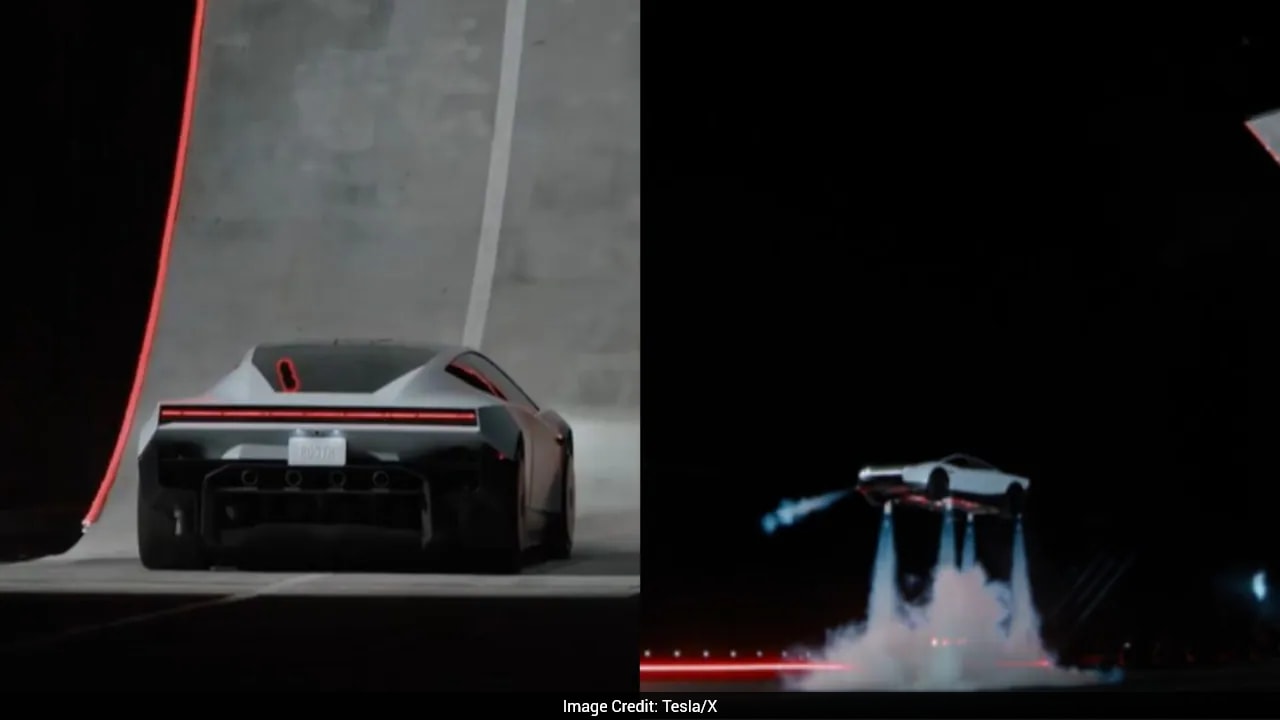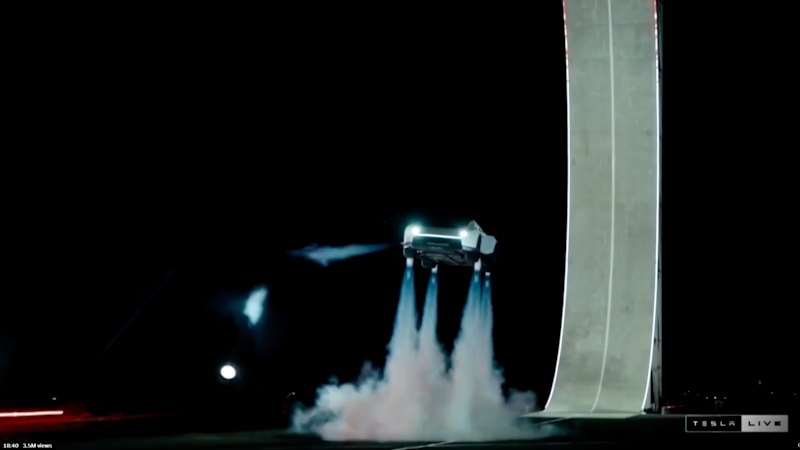
Tesla unveiled a thruster-equipped second-generation Roadster on October 15, 2026 at SpaceX's McGregor, Texas test site that launched off a ramp, rotated midair, and landed on its wheels—yet it is a short-duration cold-gas propulsion stunt rather than a true airplane or street-legal car. After nearly nine years of delays since its original 2017 reveal and 2020 target, Tesla presented the car with planned production pushed to 2028. The spectacle delivered viral video clips. It did not deliver an everyday commuter or a certified aircraft.
I have watched automakers promise skyward leaps for decades, and almost every single one runs headlong into the same physical and regulatory brick wall. Wings need airflow and span. Thrusters need mass and reaction mass. A road car is built for curb weight, crash structures, and tire grip, not sustained aerodynamic lift. Calling a five-second thruster hop "flight" makes for great social media. Calling it practical transportation ignores basic physics.
How Cold-Gas Thrusters Actually Move a Car
Engineers at Tesla and SpaceX used cold-gas reaction thrusters rather than burning liquid rocket propellants to propel and orient the demonstration Roadster. In a cold-gas system, high-pressure gas—reportedly compressed air stored at pressures reaching 5,500 psi—is released through converging-diverging nozzles to generate thrust without combustion.
No combustion means no flame front, lower thermal stress on surrounding body panels, and simpler plumbing than a bipropellant rocket engine. That makes a demonstration safer around a test track and far easier to package inside a vehicle shell.
The trade-off is brutal. Cold gas has a much lower specific impulse than chemical rocket engines, meaning you get less impulse per kilogram of propellant expelled. Every pound of compressed air and heavy-duty pressure vessel adds weight that the suspension and tires must carry when the thrusters are off.
Reports from the October 2026 unveiling indicate that the system carries up to 600 liters—roughly 250 kilograms—of compressed air across tanks, with the flying "Rocket" configuration adding thrusters at the front and sides and sacrificing the passenger seat for extra tank volume. One full charge yields only a brief burst, estimated around five seconds of active thruster operation, with recharging taking hours rather than minutes at a corner gas station or supercharger stall.
| Configuration | Thruster Role | Availability & Street Status | Reported Key Claims |
|---|---|---|---|
| Performance | All-electric drivetrain and suction/fan aero without flight thrusters | Open reservation ($50,000 deposit); street-oriented flagship | Sub-2-second sprint claims on upgraded trims; long-range battery target |
| Thrust | Rear cold-gas thrusters focused on straight-line acceleration | Limited release ($250,000 deposit); road legality subject to rules | Over 80 kN rear thrust claimed; sub-1-second 0–60 mph figures |
| Rocket | Full multi-axis cold-gas thrusters for midair pitch/roll control | Invitation-only; listed as not street legal | Up to 600 L compressed air; autonomous demo flight without driver |
Watch how the car behaved at McGregor. It did not cruise across county lines or circle an airport pattern. It rode momentum off a ramp, used cold-gas jets to stabilize attitude and execute a midair roll, and came down under controlled descent onto its wheels.
- Reaction control vs. lift: Cold-gas jets apply torque and short impulses directly without relying on wing speed, which lets a vehicle pivot in midair where control surfaces would be sluggish.
- Tank volume penalty: Devoting cabin space to high-pressure tanks turns a four-seat grand tourer concept into a single-occupant or autonomous testbed.
- Recharge bottleneck: Refilling high-pressure vessels over hours turns a five-second burst into a rare event rather than a repeatable driving feature.
Why Ballistic Hops Fail the Real-World Flight Test
An airplane stays aloft by continuously accelerating air downward with wings, trading forward airspeed for vertical support as long as fuel lasts. A thruster-driven car without wings follows a ballistic arc the moment upward or forward impulse stops.
Gravity pulls at 9.8 meters per second squared without taking a break for publicity. Once your compressed air tank bleeds down, the laws of motion do not care how famous the badge on the nose is.
There is also the problem of what happens when a high-pressure thruster misfires, sticks open, or loses pressure a few feet off the ground. A car suspension is engineered to absorb vertical wheel loads from bumps and kerbs, not hard landings with lateral drift or nose-down pitch. If a lateral jet fires unexpectedly while a wheel touches down, the resulting yaw moment can easily flip a low-slung sports car.
Consider a hypothetical example on a wet suburban boulevard. Suppose a driver engages a thruster boost near a crest, encounters a patch of standing water on touchdown, and has one side nozzle lose pressure a fraction of a second early. Without aerodynamic stabilizers or a runway overrun, recovery margins shrink to almost nothing.
Even on a closed proving ground, the October 2026 flight demonstration ran autonomously with no human driver inside. Putting a person in the seat changes structural load limits, harness requirements, ejection or cockpit protection questions, and human reaction limits.
Regulators Will Ground It Before Traffic Does
Spectacular hardware rarely dies on the drawing board alone. It gets stalled in certification offices where lawyers, flight-test engineers, and highway safety regulators ask questions that marketing decks skip.
The Federal Aviation Administration regulates aircraft airworthiness, airspace, and pilot credentials, while national and state motor vehicle agencies govern roadworthiness, lighting, bumpers, and crash safety. A vehicle that tries to straddle both worlds inherits obligations from both—and exemptions from neither.
"Whether the thrusters will ever be lit outside a test site is a question for regulators, not engineers." — industry analysis following the October 2026 McGregor unveiling
Aviation categories like powered-lift exist to certify aircraft with defined flight envelopes, redundancy, and failure modes. A car with pressurized gas tanks strapped into its chassis does not automatically fit neatly into those rules, and Tesla's own disclosures indicate the flying configuration is not approved for public roads.
Insurance and Liability Traps
Commercial insurers price risk from actuarial loss data, not hype. An experimental thruster car with an invitation-only flight package and no long-term road history sits squarely in high-liability territory.
If a private owner triggers a thruster near other motorists, cyclists, or bystanders, standard personal auto policies will almost certainly exclude intentional or experimental propulsion stunts. Track operators and private airfields carry their own strict rules, and most will not welcome uncertified high-pressure thrusters venting near pits, fuel storage, or spectators.
Nine Years of Slippage and the Real Business Math
The Roadster story stretches back to November 2017, when Tesla first showed the second-generation car with an ambitious 2020 production target and bold speed and range promises. By the time the October 2026 McGregor event rolled around, production was being pointed toward 2028—nearly eleven years after the initial reveal.
In the automotive business, a decade between reveal and volume production is an eternity. Rivals refine chassis dynamics, battery chemistry evolves, consumer tastes shift, and early reservation holders grow older waiting for a car they put deposits on years ago.
Meanwhile, Tesla has had to balance halo projects against core volume vehicles, autonomous taxi ambitions, and mass-market affordability pressures. A low-volume halo car does not have to make money on its own if it pulls eyeballs toward the brand and showcases engineering muscle.
Still, credibility is a finite currency. Asking buyers for $50,000 or $250,000 deposits while pushing delivery timelines out year after year tests even the most loyal fans.
What Buyers Should Actually Scrutinize
Anyone thinking about putting money down on a halo hypercar should strip away the theater and look at hard deliverables. Prototypes on a closed test track prove a concept can move; production tooling, crash certification, and customer deliveries prove a company can build it at scale.
- Verify independent numbers: Look for third-party instrumented testing on acceleration, braking, thermal fade, and real-world range once customer cars exist.
- Read the trim fine print: Distinguish clearly between standard electric performance, straight-line thruster assist, and restricted flight trims that may never be street legal.
- Factor in operational friction: Ask how the thruster system is refilled, inspected, and recertified as a high-pressure vessel over years of ownership.
Where the Engineering Actually Shines
Give credit where it is due: packaging cold-gas reaction control and suction/downforce concepts into a sports car body is an audacious engineering exercise. Using downforce fans or thrusters to manage grip and attitude shows real cross-pollination between rocketry hardware and ground dynamics.
Yet that same engineering honesty requires calling the trick what it is. A five-second cold-gas leap over a test range is a thrilling piece of aerospace-tinged theater, not a flying car ready to replace wings, runways, or sensible traffic laws.
Watch the 2028 production milestones, not the midair highlight reel, to see if the Roadster ever leaves the test site for real driveways.