The kitchen table in Elena’s house in suburban Ohio tells a quiet story about the state of the American pocketbook. On one corner sits a stack of unopened medical bills, their red lettering a silent warning. On the other sits a grocery receipt from Tuesday, half the length it used to be for twice the price. Elena works forty hours a week managing a local dental clinic, her husband handles inventory at an auto parts warehouse, and yet every month feels like a high-wire act with no net below.
When politicians talk about the economy, they throw around terms like gross domestic product, inflation indexes, and fiscal corridors. But Elena does not live in an index. She lives in the arithmetic of subtraction. Every trip to the pump, every utility spike, every trip down the cereal aisle where the boxes seem smaller and the price tags larger chips away at her family's sense of security.
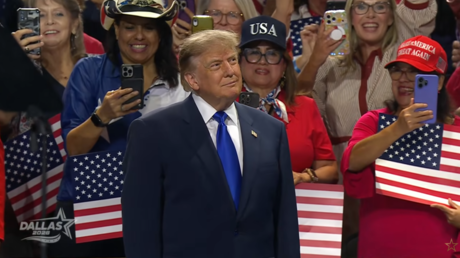
So when a new political promise cuts through the static of the nightly news—a pledge from Donald Trump of a five-thousand-dollar direct payment to every American adult if the Republican party takes the midterm elections—it does not sound like abstract policy. It sounds like breathing room. It sounds like catching up on the dentist, fixing the grinding noise in the transmission, or finally buying fresh vegetables without calculating the cost per ounce.
Money. It is the lifeblood of modern survival, and dangling it before an electorate exhausted by years of stubborn price increases is a potent maneuver. But beneath the headline-grabbing figure lies a labyrinth of questions, political strategy, and economic reality that deserves a closer look.
Consider what happens next when a number that large is dropped into the national conversation.
The proposal, tied directly to the political stakes of the upcoming midterm elections, is designed to mobilize a weary working class. It operates on a simple, visceral political calculus. Tell people who are drowning that a life raft is waiting on the other side of a ballot, and watch how fast they walk to the polls. It bypasses the complex machinery of tax credits, corporate subsidies, and supply-side adjustments, speaking directly to the transactional core of modern life. Cash in hand. You win, I get paid.
Yet, economics is a discipline of trade-offs, a relentless law of gravity where what goes up must eventually be accounted for.
Let us step into the shoes of a hypothetical federal economist, someone staring at spreadsheets late into the night at the Congressional Budget Office. To fund a direct payout of five thousand dollars to roughly 260 million American adults, the price tag balloons into the trillions. That is not loose change found between the couch cushions. That is a fiscal earthquake. Where does the money originate? Does it come from sweeping tariffs on imported goods, a cornerstone of the populist economic platform? Does it stem from deep cuts to federal agencies, or does it simply add to a national debt that already casts a long shadow over future generations?
Here is where the promise splits into two entirely different realities.
For Elena, the immediate reality is a sudden influx of liquidity that could wipe away acute anxiety. She is not thinking about macroeconomic reverberations when she is staring down a final notice from the electric company. She is thinking about right now. That is the genius of the pitch. It addresses the visceral present.
At the same time, traditional economists sound alarms that are equally real, if less immediate. Pump trillions of newly minted or redirected dollars into a consumer market, and the laws of supply and demand do not pause out of politeness. More dollars chasing the same number of houses, cars, and consumer goods can easily reignite the very inflation that voters are currently rebelling against. The cure risks becoming a catalyst for the disease. It is a paradox that has haunted populist economic theory for decades: how to reward the working citizen without destabilizing the very currency they hold in their hands.
Politics, however, rarely operates in the sterile environment of an economics textbook. It lives in the realm of emotion, urgency, and grievance.
The midterm elections are rarely about grand, sweeping visions of the future. They are referendums on the immediate past. They are barometers of pain. When grocery prices doubled over a short span of years, the social contract frayed. People felt a profound loss of control. A promise of five thousand dollars taps directly into that wound, offering a tangible counter-weight to the intangible forces of globalization, corporate consolidation, and post-pandemic economic whiplash.
It tells the voter: We see your struggle, and we are willing to break the mold to fix it.
Whether the math works, whether Congress would ever pass such a measure, or whether the inflationary pressures would cancel out the windfall are questions that get lost in the slipstream of the campaign trail. And perhaps that is the point. In an era of intense political cynicism, bold, disruptive promises serve a dual purpose. They signal an intent to upend a system that many feel has left them behind, and they provide a rallying cry that cuts through the noise of standard political discourse.
Back in Ohio, Elena turns off the kitchen light, leaving the bills sitting where they are for one more night. She has heard plenty of promises before. Some turned into law, most turned into talk show fodder, and her grocery bill stayed high regardless of who was sitting in the Oval Office.
She will vote, of course. She always does. But as she walks back to the living room, the five-thousand-dollar promise lingers in the air like smoke from a distant fire. She cannot smell it yet, she does not know if it will warm her home or burn it down, but she can see the glow on the horizon, and for now, that is enough to keep her watching the polls.