The modern commute is an aggressive act. We brace ourselves against the screech of subway brakes, curse the red brake lights bleeding across four lanes of asphalt, and bury our faces in glowing screens to escape the collective anxiety of rushing to a destination we aren't even sure we want to reach. It is a daily tax on the human soul.
But there is a stretch of water in northern Italy where the morning commute feels less like a penalty and more like a secular prayer. Don't miss our recent coverage on this related article.
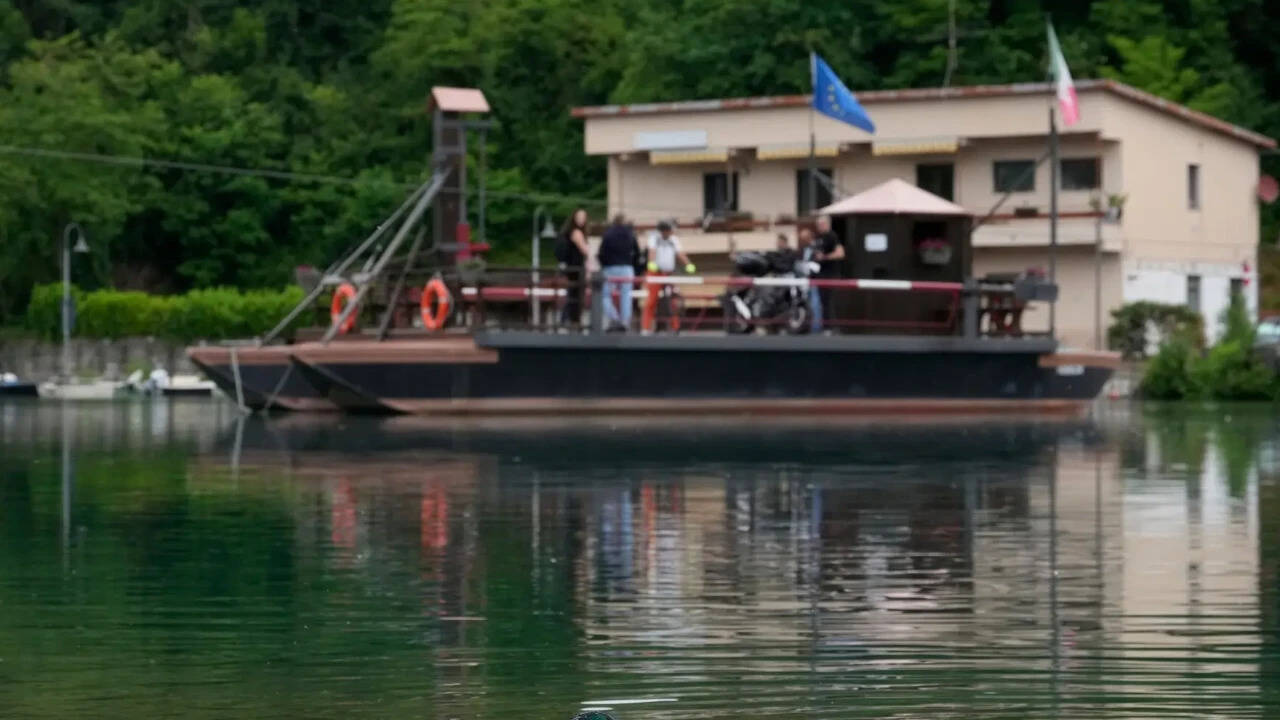
Step onto the riverbank at Imbersago, a small commune tucked into the green folds of Lombardy. The Adda River moves beneath a low morning mist, wide and deceptively quiet. On the shore, a handful of locals stand waiting. There is no roar of a diesel engine. No smell of exhaust. Instead, a wooden vessel with two hulls—a catamaran born five centuries too early—glides toward the dock. It moves with a strange, haunting silence, propelled by nothing more than the water itself and a single, taut steel cable stretched across the river.
This is the traghetto di Leonardo. It is a ferry designed by Leonardo da Vinci in the twilight of his life. And for the people who use it every day, it is a radical act of rebellion against the speed of modern existence. If you want more about the context here, Travel + Leisure provides an excellent breakdown.
The Friction of a Hurried Life
Consider a man named Matteo. He is a hypothetical composite of the commuters who cross this river every morning, but his exhaustion is entirely real. Matteo works in Milan’s fast-paced tech sector, but he lives in the quieter hills of Lecco. Every morning, his alarm triggers a cascade of cortisol. His phone floods with notifications before his feet even hit the floor.
Traditionally, getting across the Adda River to reach the main transit arteries means sitting in a bottleneck at a concrete bridge miles away, breathing in the fumes of idling trucks, your knuckles white on the steering wheel. It is a lifestyle that demands we leverage every second, optimize every route, and treat time as a resource to be brutally mined.
One morning, the traffic on the main bridge is backed up for miles. Desperate, Matteo takes a detour through the backroads of Imbersago, following the signs for the river crossing. He expects a standard ferry—a noisy, sputtering pontoon boat that will sluggishly haul his car across for a hefty fee.
Instead, he finds an anomaly.
He drives his car onto a wooden deck that feels more like a floating porch than a piece of transit infrastructure. The ferryman, a man with weather-beaten hands and the calm demeanor of someone who has spent decades watching water move, unhooks the chain. He walks to a large wooden tiller, gives it a firm, deliberate push, and then steps back.
The ferry begins to move.
There is no ignition. No vibration shakes the floorboards. The boat simply slides into the current, gaining speed as it reaches the middle of the river. Matteo steps out of his car, confused. He looks up at the steel cable slung high above the water, then down at the rushing river. The boat is moving perpendicular to the current, crossing from one bank to the other, yet the river is the only thing powering it.
It feels like magic. But it is actually a masterclass in fluid dynamics, conceived by a man who died in 1519.
The Genius of the Back-Current
To understand why this ferry works, you have to understand Leonardo da Vinci’s obsession with water. In the early 16th century, Leonardo was under the patronage of the French governor of Milan. He spent years studying the Adda River, mapping its eddies, its rapids, and its hidden depths. He realized that a river’s current is not a uniform wall of force; it is a complex web of vectors, angles, and pressures.
The physics of the Leonardo ferry are elegant in their simplicity. The boat is tethered to an overhead cable by a system of ropes and pulleys. This cable keeps the ferry from simply being swept downstream toward the sea.
   [ Opposite Bank ]
----------------------- (Overhead Cable)
     \       /
      \     / (Tether Ropes)
    +---------+
    |  Ferry  |  ===> (Movement across)
    +---------+
        |
        v (Rudder angled to catch the current)
~~~~~~~~~~~~~~~~~~~~~~~
~~~ River Current ~~~~~
~~~~~~~~~~~~~~~~~~~~~~~
When the ferryman adjusts the wooden rudder, he changes the angle of the boat relative to the oncoming water. The current strikes the angled hull, creating a force known as hydrodynamic lift. It is the exact same principle that allows an airplane wing to lift a fuselage into the sky, or a sail to propel a boat against the wind.
By angling the hull at roughly forty-five degrees to the flow, the river itself pushes the boat sideways along the guide cable. The water wants to push the boat downstream, but because the cable refuses to let it go, that downstream energy is redirected. The river is forced to ferry its own passengers.
For the scientifically minded, it is a flawless demonstration of resolving forces. For the weary traveler standing on the deck, it feels like the river is offering a truce. Instead of fighting nature with steel and petroleum, the ferry partners with it.
The Secret Luxury of Five Minutes
The crossing takes less than five minutes. In the grand scheme of a ninety-minute commute, five minutes is nothing. It is a rounding error. You could easily lose five minutes waiting for a red light to turn or searching for a parking spot.
But the quality of these five minutes is entirely different.
When Matteo steps out onto the deck, the silence hits him first. Without the rumble of an engine, his ears adjust to the natural symphony of the riverbank. He hears the water lapping against the twin hulls. He hears the rustle of poplars and willows on the far shore. A gray heron cuts through the morning mist, its wings beating silently above the water.
On this wooden deck, you cannot look at your phone. Or rather, you choose not to. The sheer anomaly of the experience demands your presence. The digital world, with its frantic demands and endless scrolls, feels suddenly distant and absurdly loud compared to the ancient rhythm of the river.
The ferryman doesn't check his watch. He doesn't need to. He moves with the river, adjusting the tiller with small, intuitive nudges. He understands something that we have forgotten in our rush to build a seamless, hyper-connected world: some things are broken by speed.
If you build a four-lane highway over the Adda at Imbersago, you save three minutes. But you destroy the sanctuary. You replace a moment of profound human connection with a blur of grey concrete.
The Weight of the Invisible Stakes
It is easy to dismiss the Leonardo ferry as a mere novelty, a charming tourist trap for history buffs and weekend cyclists. But that misses the deeper truth of why this ancient boat matters so much today. The stakes are not about transit efficiency; they are about mental survival.
We live in a culture that treats friction as a sin. We want our food delivered instantly, our videos to stream without buffering, and our commutes to be as fast as physics allows. We have engineered a world completely devoid of pauses.
But the human brain was not designed for constant acceleration. We need transitions. We need the psychological equivalent of a decompression chamber when we move from our private lives into our professional ones. Without those moments of forced stillness, our days bleed together into a featureless smear of productivity and stress.
The Leonardo ferry is a physical manifestation of that missing pause. It is a mandatory five-minute meditation. You cannot hurry it. If the river is running high and fast after a rain, the crossing is quick and exhilarating. If the summer heat has slowed the current to a lazy crawl, the boat moves with a stately, deliberate drift. You are entirely at the mercy of the natural world.
And there is immense comfort in that surrender.
Healing the Modern Split
Standing on the wooden deck, watching the green shoreline of the opposite bank slowly draw nearer, a strange transformation happens. The tightness in your shoulders begins to ease. The mental checklist running through your brain slows down. You realize that the world will not fall apart if you are unreachable for three hundred seconds.
We often look at ancient technology with a patronizing sense of superiority. We marvel at how far we have come, moving from wooden rafts to electric vehicles and self-driving cars. But Leonardo’s ferry forces a humbling question: have we actually progressed, or have we just traded our peace of mind for velocity?
Leonardo da Vinci spent his life trying to understand the underlying harmony of the universe. He painted the Mona Lisa, designed flying machines, and dissected human corpses, all in an attempt to find the thread that connects human consciousness to the physical world. It is poetic justice that one of his most enduring legacies is not a masterpiece hanging behind bulletproof glass in the Louvre, but a working commuter boat in a quiet corner of Lombardy.
The ferry hits the wooden pylons of the far shore with a soft, hollow thud. The ferryman steps forward and secures the chain. The brief illusion of timelessness is over.
Matteo gets back into his car, turns the key, and prepares to rejoin the highway. The noise of the world is waiting for him just up the hill. But something has shifted. His breath is deeper. His mind is a little clearer. He has crossed more than just a river; he has stepped across five centuries of human ingenuity to remind himself of what it feels like to simply exist.
The river continues to flow, heavy and silent, carrying the wooden boat back toward the other side, ready for the next person who needs to remember how to slow down.