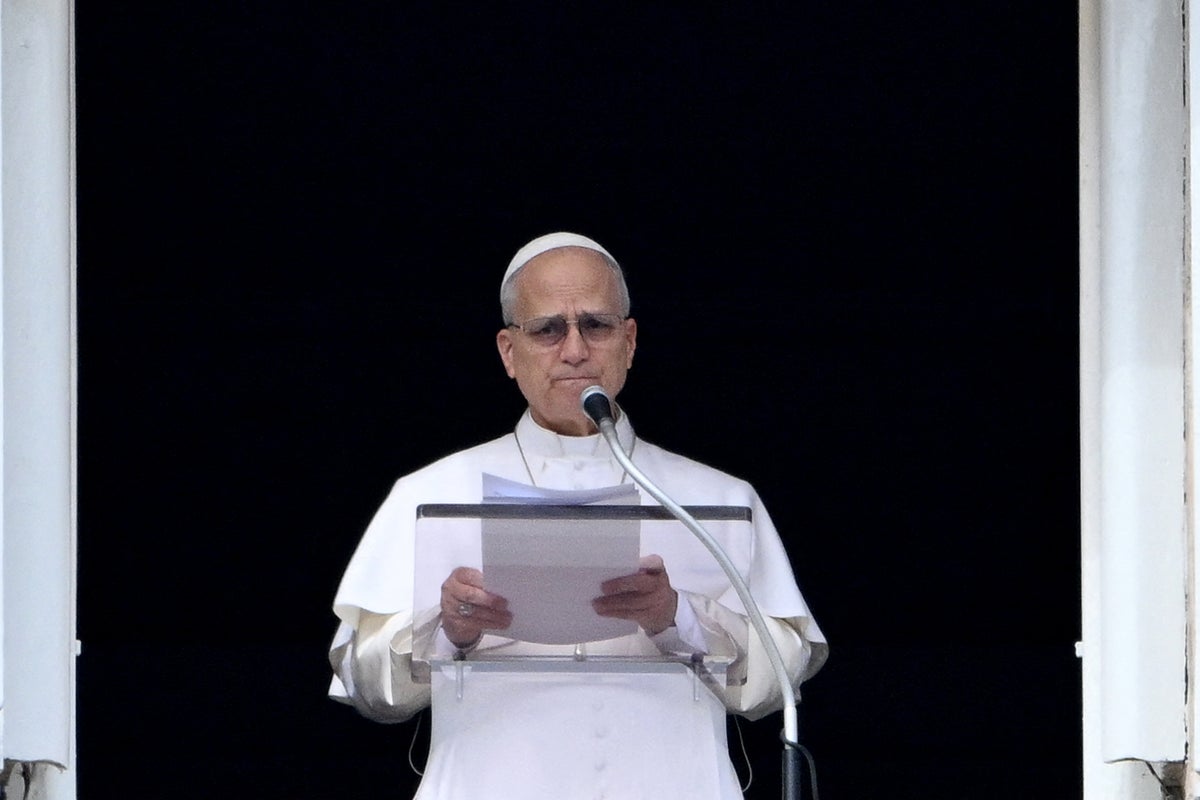
The Tiber River doesn't care about geopolitics. It flows past the stone walls of the Vatican with a muddy, indifferent persistence, much as it did when emperors stood where popes now pray. Inside those walls, a man dressed in white sits at a desk of polished wood, looking at a map that isn't defined by borders, but by souls. Pope Leo knows that when the winds of war blow from Washington toward Tehran, it isn't the maps that bleed. It is the people.
On the other side of the Atlantic, the air is different. It smells of jet fuel and ambition. Mar-a-Lago or the Oval Office—it doesn’t matter where the desk sits—the view from the American presidency is often one of leverage, legacy, and the cold arithmetic of "maximum pressure."
This is the story of a collision between two different kinds of power. One is the power of the sword, sharp and immediate. The other is the power of the shepherd’s staff, ancient and stubbornly patient.
The Ghost in the Machine of Diplomacy
Consider a hypothetical woman named Adara. She lives in a small apartment in Isfahan. She isn't a nuclear physicist. She isn't a revolutionary guard. She is a mother who worries about the price of eggs and whether the local pharmacy will have the specific insulin her daughter needs. When the headlines in the West scream about "targeted strikes" or "economic containment," Adara feels a tightening in her chest. For her, "geopolitics" is just a fancy word for the slow erosion of her children’s future.
Pope Leo’s recent warning to Donald Trump isn't merely a political press release. It is an attempt to put a face like Adara’s in front of a man who prefers the view from thirty thousand feet.
The Pope’s message was blunt: any spark in the Middle East will not remain a localized fire. It will become an inferno that consumes the innocent long before it reaches the architects of the conflict. He spoke of the "futility of arms," a phrase that sounds poetic until you realize it is a mathematical certainty. You cannot shoot an idea. You cannot bomb a population into loving your values.
The Art of the Escalation
Donald Trump views the world through the lens of the deal. In his world, tension is a tool. You ramp up the pressure, you lean on the scale, and you wait for the other side to blink. It worked in real estate. It has seen varying degrees of success in trade. But the Middle East operates on a different clock—one measured in centuries, not fiscal quarters.
The Vatican understands this clock.
When the Pope issued his plea for peace, he was addressing the specific danger of the "accidental war." History is littered with the corpses of soldiers who died because of a misunderstood signal, a nervous finger on a trigger, or a leader who felt he had no choice but to double down to save face.
The Strait of Hormuz is a narrow throat of water through which the world's energy flows. It is also a place where a single mistake can trigger a global economic cardiac arrest. If a drone is downed or a tanker is seized, the "deal" disappears. In its place comes a momentum that no one, not even a president who prides himself on control, can easily stop.
The Weight of the Ring and the Crown
There is a profound loneliness in high office. Pope Leo and Donald Trump both occupy positions where their words can move markets and armies. Yet, they represent two diametrically opposed visions of how to keep the world from spinning off its axis.
Trump’s vision is one of strength as a deterrent. It is the belief that if you are the biggest lion in the jungle, the other animals will stay in their place. It is a philosophy of the perimeter—protect the home, project power outward, and ensure that the cost of defiance is too high to pay.
Leo’s vision is one of the "culture of encounter." He argues that walls, whether made of concrete or sanctions, eventually fall. He believes that the only way to secure a lasting peace is to find the common thread of humanity that links a voter in Ohio to a shopkeeper in Tehran. To some, this sounds like naivety. To the Vatican, it is the only survival strategy that has outlasted every empire since the Romans.
The Invisible Stakes of a Broken Silence
What happens when the warning is ignored?
We often talk about war in terms of "theaters." It’s a sanitized word. It implies a stage, a performance, and an audience. But in the modern age, there are no audiences. Everyone is on the stage.
If the tension between the U.S. and Iran snaps, the ripple effects will bypass the diplomats. They will show up in the price of bread in Egypt, causing riots. They will show up in the radicalization of a teenager in a refugee camp who has lost everything and has nothing left to fear. They will show up in the further fracturing of a global order that is already held together by thinning threads.
The Pope isn't just worried about the missiles. He is worried about the "globalization of indifference." He sees a world where we become spectators to our own destruction, scrolling through news of impending conflict as if it were a trailer for a movie we don't have to star in.
The Dialogue of the Deaf
The tragedy of the current moment is that both sides believe they are being perfectly clear.
The U.S. believes it is sending a clear signal: Change your behavior or face the consequences.
Iran believes it is sending a clear signal: We will not be bullied into submission.
When two sides speak different languages, the only thing that translates is violence. This is why the Pope stepped in as a translator of sorts. He isn't speaking the language of policy; he is speaking the language of morality. He is trying to remind the American President that while a "win" might look good on a campaign poster, a "peace" is the only thing that looks good in the eyes of history.
Think of a bridge. A bridge is a vulnerable thing. It requires constant maintenance. It is easy to blow up and incredibly difficult to build. For decades, the bridge between the West and Iran has been a rickety, swaying thing, but it was there. Now, the explosives are wired to the pilings.
The Pope is standing in the middle of that bridge, refusing to move.
The Cost of Being Right
There is a specific kind of arrogance that comes with power—the belief that you can predict the outcome of a chaos.
Donald Trump bet that the Iranian regime would crumble under the weight of a dying economy. It hasn't. Instead, it has hardened. The hardliners have found a perfect foil in the "Great Satan" of the West. Every sanction becomes a recruitment poster. Every threat becomes a reason to squeeze the Iranian people even harder in the name of national security.
The people Pope Leo is trying to protect are caught in this vice. They are the collateral damage of a game they never asked to play.
Wealthy nations can afford to be wrong for a long time. They have cushions of capital and geography. But the world is smaller than it used to be. A virus, a cyberattack, or a refugee crisis doesn't stop at the border of a country that decided to be "strong." The consequences of a conflict in the Persian Gulf will arrive at the doorstep of the American suburbs in ways that no wall can prevent.
The Finality of the Choice
We live in an era of the "strongman," where compromise is viewed as a defect. In this environment, the Pope’s call for dialogue feels like a relic of a gentler, more forgotten time. But perhaps that is exactly why it is so necessary.
When the shouting gets loud enough, the only way to be heard is to whisper.
Leo is whispering to the conscience of a leader who has built an empire on the loudest voice in the room. He is asking him to consider the silence that follows a blast. He is asking him to see that the most courageous thing a powerful man can do is to hold his hand back when the world is screaming for him to strike.
The sun sets over the Dome of St. Peter’s, casting a long shadow that reaches toward the centers of power across the globe. Somewhere in Isfahan, Adara turns off the lights in her daughter's room, hoping that tomorrow the news will be quieter. Somewhere in Washington, a pen hovers over a document that could change everything.
The warning has been delivered. The map has been laid out. The fisherman has spoken to the sovereign. Now, we wait to see if the man who prizes the "art of the deal" understands that some things—the lives of millions, the stability of a planet, the soul of a nation—are too precious to be traded for a temporary victory.
History is a cold judge. It rarely remembers the names of the "winners" of a war that should never have happened. It only remembers the silence of the graveyards and the missed opportunities for a handshake that could have saved the world.
The Tiber keeps flowing. The clock is still ticking. The choice remains.