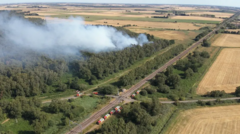
Smell it before you see it.
That is the cardinal rule of peat fire. It does not arrive with the theatrical roar of a crown fire racing through a pine forest, snapping timber like dry bones and painting the horizon in apocalyptic orange. Peat fire creeps. It whispers. It breathes beneath the mud, a subterranean furnace eating away at the very foundations of the earth, chewing through millennia of compressed history one hidden inch at a time. For a closer look into this area, we recommend: this related article.
If you stood at Holme Fen right now, the air would taste like an old chimney. A low, grey haze hangs heavy over the Cambridgeshire fens, clinging to the damp reeds and flattening against the drainage ditches. It looks lazy. It looks manageable.
It is a lie. To get more background on this development, comprehensive reporting can also be found on The New York Times.
People ask why the Holme Fen wildfire lasts for days, weeks even, while a standard grassland blaze dies out before the local brigade can finish their tea. The answer is not found in the wind speed or the dry grass on the surface. The answer lies three meters down, in a dark, fibrous archive of dead plants that started accumulating when Britain was emerging from the last ice age.
Imagine a sponge. Not a kitchen sponge, but a massive, water-logged sponge the size of a cathedral, buried beneath a thin blanket of clay and topsoil. For centuries, this was a drowned world—the bed of Whittlesea Mere, the largest lake in southern England before human ambition drained it dry in the mid-nineteenth century to steal rich farmland from the water.
Engineers drove straight drains. They installed steam pumps. They turned a thriving aquatic ecosystem into a checkerboard of black, fertile fields. And in doing so, they signed a long-term contract with physics that we are only now paying off.
When you drain a fen, the water table drops. When the water table drops, peat—which is essentially ninety percent water and ten percent partially decomposed organic matter—dries out.
Dry peat is fuel. In fact, dried peat is turf, burned for hearth fires across northern Europe for generations.
So when an errant spark, a discarded glass bottle catching the July sun, or a carelessly dropped cigarette touches the parched surface of Holme Fen during a dry spell, the fire does not just catch the grass. It punches downward.
This is where the nightmare begins for the firefighters.
Consider what happens next. A surface fire can be drowned with water from a tanker or smothered with dirt. But a subterranean peat fire requires an entirely different vocabulary of destruction. Because the fuel is buried, oxygen finds its way down through root channels, animal burrows, and shrinkage cracks in the dry soil. The fire burns underground, completely out of sight, smoldering at temperatures exceeding six hundred degrees Celsius.
A crew can hose down a smoking acre until the mud turns to soup, pack up their gear, and drive away believing the threat is neutralized. Two days later, thirty feet away, the ground simply collapses. A firefighter steps forward and drops down to their chest into a glowing, hidden cavern of ash.
The heat does not vent into the sky. It cooks the earth from the inside out.
The Holme Fen fire persists for days because it is not a fire on the landscape. It is a fire of the landscape itself. You cannot simply put out a peat fire. You have to dismantle the physics of it. You have to flood the entire compartment, blocking off every microscopic channel of oxygen, turning the earth back into the swamp it was always meant to be before we decided we knew better than nature about where water should rest.
There is an eerie silence to these incidents. In a standard forest fire, there is the crackle of wood and the roar of draft. At Holme Fen, the sound is muffled, muted by the heavy, choking blanket of smoke. Birds are absent. The insects have vanished. Even the wind seems reluctant to stir the heavy, sulfurous air.
Local farmers know the signs. They watch the drainage levels drop in their irrigation ditches. They smell the change in the night breeze long before the emergency alerts ping on their phones. They know that once the fen gets this dry, the earth itself turns against them.
This is the hidden cost of our historical edits to the map. We drained the fens to create a breadbasket, a flat, fertile expanse of black soil that feeds millions. But we also created an artificial desert waiting for a match. Every time a heatwave bakes the fens, we hold our breath, knowing that beneath our boots, the past is waiting to burn.
The smoke at Holme Fen will eventually clear. The pumps will run. The water table will rise, inch by agonizing inch, until the subterranean embers are finally drowned in their own ancient bed. But until then, the fire remains. Silent. Deep. Patient.
Burning through the history we thought we had buried forever.