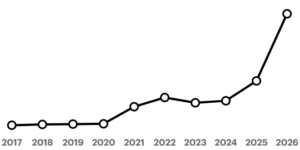
Economic crises are not chaotic anomalies emerging from thin air. They are the calculated output of institutional reliance on debt expansion and the persistent mispricing of risk. History reveals that financial systems function as self-reinforcing loops, where periods of stability create the very conditions that lead to collapse. Understanding these events requires abandoning the search for "bad actors" and instead mapping the internal architecture of market fragility.
The Financial Instability Hypothesis and the Debt Cycle
The most accurate framework for understanding market collapses is Hyman Minsky’s Financial Instability Hypothesis. Minsky argued that the economy is inherently unstable because stability itself encourages risk-taking.
Financial units can be categorized into three stages of credit management:
- Hedge Finance: The unit can repay both the interest and the principal on its debt from cash flows. This is the bedrock of stability.
- Speculative Finance: The unit can repay interest, but the principal requires refinancing. This model relies entirely on the continuous availability of credit.
- Ponzi Finance: Cash flows cannot cover even the interest. The unit relies on the appreciation of asset values to survive.
Crises occur when the system shifts from Hedge finance toward Speculative and Ponzi finance. As long as asset prices rise, the system appears durable. Once credit tightens, or asset values flatten, the Speculative and Ponzi units fail simultaneously. This causes an immediate liquidity shortage, forcing fire sales of assets, which drives prices down further, creating a feedback loop.
Maturity Mismatch and the Liquidity Illusion
The banking sector operates on a fundamental structural vulnerability known as maturity mismatch. Banks accept demand deposits—short-term liabilities they must repay on request—and deploy those funds into long-term assets like mortgages or corporate loans.
This model functions only under the assumption that depositors will not withdraw their capital simultaneously. When confidence wanes, a bank run becomes inevitable. The bank cannot liquidate long-term assets to pay short-term liabilities without catastrophic value loss.
This mechanism is not a bug; it is an inherent design feature of fractional reserve banking. Risk is managed through diversification and reserves, but these buffers provide zero protection against a systemic loss of confidence. When liquidity vanishes, the technical solvency of the firm is irrelevant.
The Financial Accelerator Effect
Ben Bernanke and Mark Gertler formalized the "financial accelerator" effect, which explains why minor economic shocks transform into massive systemic collapses. The link between balance sheets and investment spending is the mechanism here.
When asset prices decline, the net worth of borrowers drops. This reduces the value of the collateral backing their loans. Banks, facing higher risks, tighten lending standards. This reduction in credit availability prevents firms from investing, which lowers their productivity, reduces cash flow, further diminishes their net worth, and lowers collateral value again.
This process explains why crashes are rarely isolated events. The deterioration of the borrower's balance sheet causes a contraction in economic activity that creates its own momentum. The "vicious cycle" is simply the mathematical result of collateral devaluation.
Information Asymmetry and Market Signaling
George Akerlof’s "Market for Lemons" theory provides the logic for why markets freeze during crises. In a functioning market, prices reflect underlying value. During a period of uncertainty, information asymmetry increases. Buyers cannot distinguish between solvent firms and firms nearing bankruptcy.
When participants lose the ability to discern risk, the market price for all assets drops to the level of the "worst" asset to protect against the downside. This forces high-quality firms to sell assets at fire-sale prices, further fueling the panic. The freeze is a rational response to an environment where the cost of verification exceeds the potential gain of the transaction.
The Time Inconsistency Problem in Policy
Central banks and governments face the "Time Inconsistency Problem." In the aftermath of a crisis, policy makers must provide liquidity to prevent total system failure. This intervention is necessary to stop the contagion.
However, the knowledge that a central bank will intervene creates moral hazard. Market participants, anticipating future bailouts, do not price risk accurately. They pursue higher-yield, higher-risk strategies, knowing the state will absorb the downside. The intervention to solve one crisis creates the systemic vulnerability that necessitates the next one. This loop ensures that the scale of crises tends to grow over time, as the size of the required intervention increases to keep pace with the systemic risk.
The Regulatory Lag
Regulation often attempts to solve the previous crisis rather than preventing the next one. Capital requirements, stress tests, and liquidity coverage ratios are designed to address the specific vulnerabilities of the last collapse.
Systems evolve to bypass these regulations. Capital flows shift from regulated banks to the "shadow banking" sector—non-bank financial intermediaries that perform similar functions but lack the oversight and safety nets of traditional institutions. Because regulators focus on the formal banking sector, the shadow banking system becomes the new focal point for systemic risk accumulation.
Strategic Operational Recommendations
To navigate these structural realities, focus on liquidity, not just solvency.
- De-leveraging during prosperity: The time to optimize balance sheets is not when credit is tight, but when it is abundant. Use periods of low interest rates to lock in long-term, fixed-rate debt and build cash reserves that are disconnected from the primary asset class of the organization.
- Stress testing against liquidity evaporation: Most firms model for moderate downturns. The analytical requirement is to model for a "zero liquidity" environment where standard assets cannot be sold or refinanced for a 90-day window. If the entity cannot survive this specific scenario, it is structurally flawed.
- Counter-cyclical asset allocation: Monitor the debt-to-equity ratios and the use of short-term commercial paper in the broader market. When the ratio of speculative-to-hedge finance rises, reduce exposure to high-beta assets.
- Assume information opacity: In a panic, rely on private, verified data channels rather than public market signals. Public market prices during a crisis are driven by forced liquidations and fear, not fundamental valuation.
- Direct capital preservation: In high-risk environments, prioritize the "liquidity of the liquidity." Cash equivalents or short-term government instruments are not yield-generation tools; they are the insurance policy that allows the organization to acquire distressed assets when the rest of the market faces a forced exit.
The strategy is simple: operate to survive the volatility that the structural design of the financial system inevitably produces.