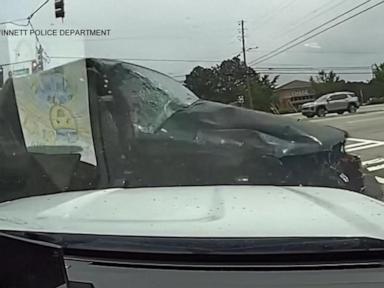
A toddler survives a violent highway collision after being ejected through a shattered side window. The viral dashcam footage sparks a wave of collective relief across social media, with commentators calling it a miracle.
It was not a miracle. It was a systemic failure.
When a child is thrown from a vehicle during a crash, the public conversation invariably shifts to parental blame or divine intervention. We ask whether the straps were too loose, if the chest clip was positioned correctly, or if the car seat was anchored at all. This narrow focus obscures a much harsher reality. The true crisis lies in an outdated regulatory framework, fragmented state legislation, and a gaping disparity in how automotive safety is engineered for the smallest passengers. Physics does not care about political boundaries, yet a child’s chance of surviving a high-speed impact changes dramatically the moment a vehicle crosses state lines.
To understand why children continue to be ejected from vehicles despite decades of mandatory restraint laws, we must look beyond the immediate wreckage of a single highway accident. We need to examine the friction between federal safety standards, state-level enforcement, and the physics of kinetic energy.
The Illusion of Universal Protection
Every state in the country requires children to be secured in motor vehicles. On paper, compliance looks high. In practice, the laws governing these restraints are a patchwork of compromise and antiquated science.
The federal government sets the baseline safety standards for the manufacturing of child restraint systems through Federal Motor Vehicle Safety Standard 213. However, Washington leaves the enforcement and specific parameters of use entirely up to individual states. This created an environment where best practices—established by decades of biomechanical research—are treated as optional recommendations rather than legal requirements.
Consider the transition from rear-facing to forward-facing seats. Biomechanical engineers know that a toddler’s head constitutes a massive percentage of their total body weight. In a frontal collision, a rear-facing seat cradles the spine, neck, and head, distributing the crash forces evenly across the shell of the restraint. When a child is turned forward too early, those same forces snap the head forward, putting immense strain on an underdeveloped cervical spine.
Yet, as of this writing, fewer than twenty-five states strictly mandate that children remain rear-facing until at least age two. In the rest of the country, parents are legally permitted to turn their children forward much earlier, relying on outdated weight thresholds established in the 1990s. This legal gray area creates a dangerous false sense of security. Parents assume that because they are following local law, their children are safe. They are wrong.
The Physics of Ejection
Vehicular ejection occurs when the forces acting on an occupant exceed the restraining capability of the safety system or when the structural integrity of the vehicle cabin compromises. In high-impact crashes, particularly rollovers and side-impact collisions, the mechanics of a standard car seat face extreme stress.
Crash Force = Mass x Acceleration
When a vehicle traveling at 60 miles per hour comes to an abrupt halt, any unsecured object—or an improperly secured human body—continues to move at 60 miles per hour until it hits something that stops it.
- Harness Laxity: Even a fraction of an inch of slack in a five-point harness allows the child's body to move forward with enough velocity to slip through the straps during a rollover.
- The Chest Clip Myth: Many parents believe the plastic chest clip holds the child in the seat. It does not. Its sole purpose is to position the harness straps on the shoulders before a crash occurs. In a violent collision, the chest clip frequently breaks or slides down, leaving the shoulder straps as the primary line of defense.
- Component Failure: Cheap plastic components on low-end car seats can fracture under the extreme load of a multi-vehicle pileup.
The Economic Divide in Child Safety
We rarely talk about the financial barriers to keeping a child secure on the highway. High-end car seats feature rigid latch systems, steel-reinforced frames, and advanced side-impact protection technology. These seats often cost upward of three hundred dollars.
For a family living paycheck to paycheck, that price tag is prohibitive. They are forced to rely on budget models that meet the bare minimum of federal testing standards but lack the structural countermeasures that prevent seat rotation or harness slippage during complex crash sequences.
Furthermore, the secondary market for car seats is a minefield. Certified safety experts universally warn against purchasing used child restraints. A seat that has been involved in a minor collision may possess hairline fractures in the plastic hull that are invisible to the naked eye. Under the stress of a subsequent accident, that compromised plastic will fail, leading directly to structural collapse and potential occupant ejection. Yet, for millions of low-income families, a twenty-dollar garage sale seat is the only accessible option. State programs that distribute free or subsidized seats are chronically underfunded and rarely reach the rural communities where highway speeds are highest and emergency response times are longest.
The Regulatory Blind Spot on Side Impacts
For years, federal crash testing focused almost exclusively on frontal and rear impacts. The government simply did not simulate the violent lateral forces of a T-bone collision or the chaotic dynamics of a rollover when certifying child seats.
+--------------------------------------------------------------+
|             Federal Safety Test Deficiencies                 |
+--------------------------------------------------------------+
| Tested: Direct frontal impacts at fixed speeds               |
| Ignored: Dynamic rolling friction and multiple axis spins    |
| Status: Upgrades delayed by bureaucratic friction            |
+--------------------------------------------------------------+
While regulators have slowly moved toward implementing side-impact testing protocols, the pace of bureaucratic change lags far behind automotive design trends. Modern consumer vehicles are larger, heavier, and sit higher off the ground than ever before. The proliferation of massive SUVs and heavy electric vehicles means that when a standard sedan is struck, the impact zone often aligns perfectly with the passenger window where a child’s car seat is installed.
Standard vehicle glass offers little protection against occupant ejection during a side impact. Unless a vehicle is equipped with laminated safety glass in the side windows—a feature typically reserved for luxury models—the glass shatters completely upon impact, leaving an open portal through which a child can be thrown if the car seat experiences even a minor installation error.
The False Promise of Consumer Education
The standard response to child passenger injuries is to call for better public education. We tell parents to visit local fire stations to have their seats checked by certified technicians. We publish pamphlets and upload instructional videos to social media channels.
This approach shifts the entire burden of a complex engineering problem onto the consumer. Installing a car seat correctly requires navigating an opaque maze of vehicle manuals, seat manuals, latch weight limits, and angles of recline. A study by the National Highway Traffic Safety Administration revealed that nearly half of all car seats are installed incorrectly. When a safety system fails fifty percent of the time in real-world application, the fault lies with the design of the system, not the user.
The current system relies on LATCH (Lower Anchors and Tethers for Children), which was supposed to simplify installation when it was introduced decades ago. Instead, it added another layer of confusion. Parents regularly fail to realize that LATCH anchor points have strict weight limits, often requiring a transition to the vehicle’s standard seatbelt once the child reaches a certain size. If a parent misses this detail buried on page forty of a manual, the anchor points can shear off during an accident.
Reengineering the Framework
Fixing this crisis requires moving past public service announcements and addressing the structural flaws in how we approach child passenger safety.
First, the United States must establish a singular, nationwide standard for child passenger safety that eliminates state-by-state discrepancies. If physics dictates that a child should remain rear-facing until they reach specific height and weight metrics, that standard must be codified into federal law with mandatory enforcement across all fifty states.
Second, automotive manufacturers must be held to stricter standards regarding cabin containment. Laminated safety glass should not be a premium luxury feature. It must be standard equipment on all side passenger windows to prevent occupant ejection during rollovers and side-impact collisions.
Finally, the manufacturing industry needs to move away from the current additive model of child safety—where parents must buy a separate, complex third-party device to secure their children—and move toward integrated, adjustable child restraint systems built directly into the rear seats of passenger vehicles. This technology exists and has been deployed successfully by European manufacturers in limited capacities. By integrating the five-point harness and adjustable bolstering directly into the vehicle’s chassis, we eliminate installation error, reduce the risk of component failure, and ensure that every child, regardless of their family’s socioeconomic status, is protected by the same level of engineering.
Until these systemic changes are implemented, spectacular survival stories will remain the exception rather than the rule. We cannot rely on luck to save children from the predictable consequences of poor design and fractured laws. Every time a child is ejected from a vehicle, it is an indictment of a system that chose bureaucratic inertia over measurable human safety.