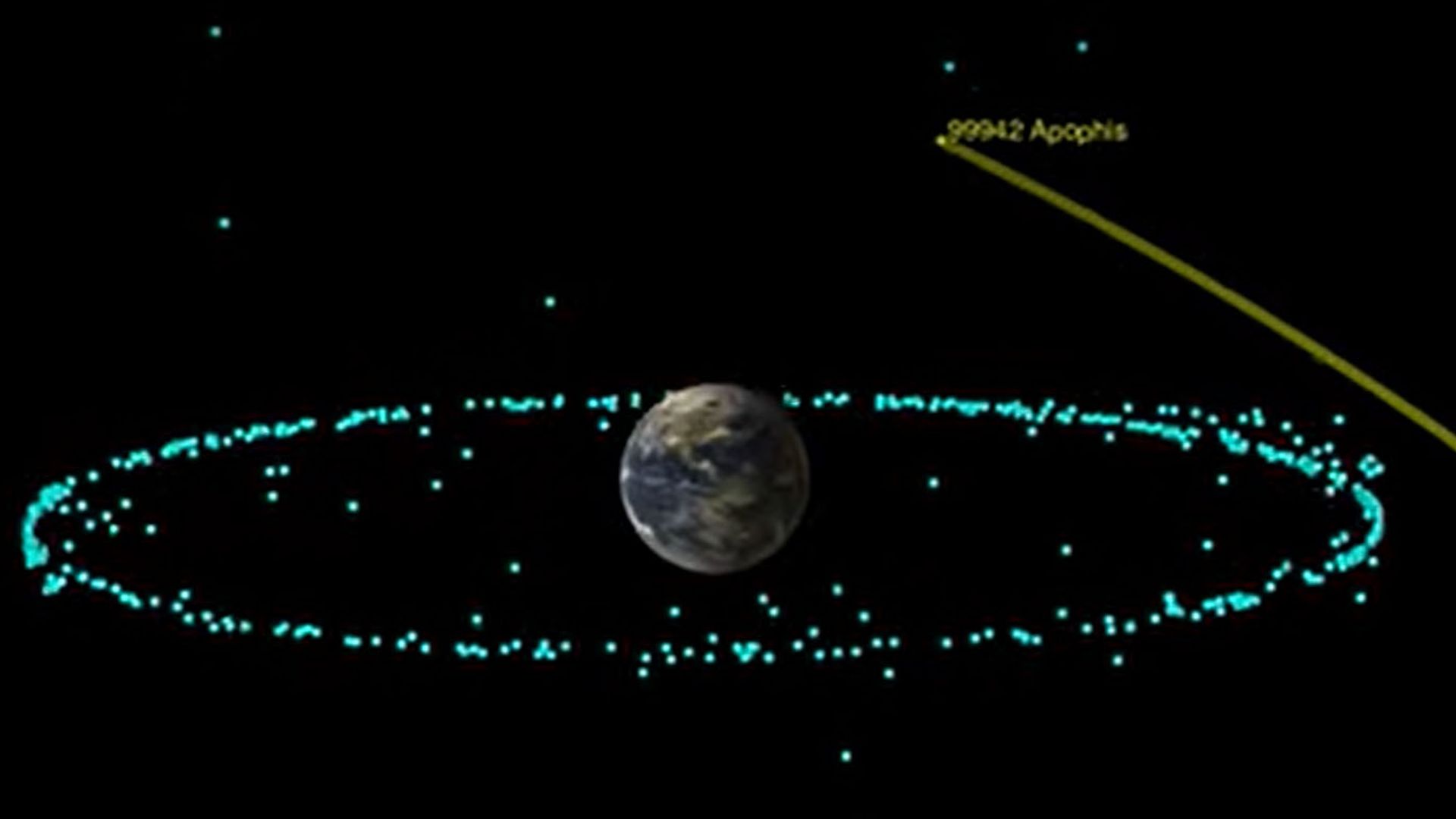
Friday the 13th usually just means bad luck for superstitious people, but in April 2029, it’s the date a 1,100-foot chunk of space rock named Apophis will scream past Earth. We're talking about a distance so close it’ll be under the orbit of our own TV and weather satellites. Most headlines call it the God of Chaos asteroid because they want you to panic. They want the clicks. But if you're looking for a disaster movie script, you’re going to be disappointed. Apophis isn’t going to hit us. It isn’t even going to come close enough to "brush" the atmosphere.
What it will do is provide the most significant scientific opportunity in our lifetime.
I’ve spent years tracking how we talk about Near-Earth Objects (NEOs), and the misinformation surrounding Apophis is staggering. People hear "340 meters wide" and "closer than the moon" and immediately start prepping for an impact. Let’s get the facts straight right now. NASA and the European Space Agency (ESA) have spent decades crunching the numbers. After a radar observation campaign in 2021, scientists officially ruled out any chance of an impact for at least the next 100 years. It’s a spectator event, not an extinction event.
Why the 2029 Flyby is a Scientific Goldmine
Most asteroids we study are tiny specks in a telescope or require billion-dollar missions to visit. Apophis is bringing the lab to us. On April 13, 2029, this rock will be visible to the naked eye for about two billion people across Europe, Africa, and parts of Asia. It’ll look like a moving star, crossing the sky faster than many satellites.
This isn't just about taking pretty pictures. Earth’s gravity is going to physically alter the asteroid. Think about that for a second. We’re going to watch a planet’s gravitational pull tug on a celestial body in real-time. This "tidal torque" could trigger "asteroid-quakes" or even cause landslides on its surface. It might change the way the asteroid rotates. Scientists at the Planetary Science Institute are already preparing to monitor these shifts. It’s basically a free experiment in planetary defense physics.
We rarely get to see how "rubble pile" asteroids—which are basically clumps of space junk held together by gravity—behave under stress. Apophis is likely one of these piles. By watching how it reacts to Earth’s pull, we learn how to potentially deflect one in the future if a real threat ever shows up.
The RAMSES Mission and Why We’re Going Back
You might remember the OSIRIS-REx mission that grabbed samples from the asteroid Bennu. That same spacecraft is currently drifting through space, rebranded as OSIRIS-APEX, on its way to meet Apophis right after the flyby. But the ESA isn’t sitting around waiting for NASA to share the homework.
They recently announced the RAMSES mission (Rapid Apophis Mission for Space Safety). The plan is to get a spacecraft to Apophis before it reaches Earth. They want to see the "before and after" of the gravitational encounter. If RAMSES gets the green light for full funding, it’ll be a masterclass in rapid response.
The goal here isn't just curiosity. It’s about "Space Safety." That sounds like a boring government department, but it’s actually the most important work in the solar system. We need to know the structural integrity of these rocks. If we ever have to use a kinetic impactor—like the DART mission did—to nudge an asteroid off course, we need to know if the rock will move in one piece or shatter into a thousand smaller, equally deadly pieces. Apophis is our best chance to figure that out without actually having to blow anything up.
Navigating the Hype and the Real Danger
Let's talk about the "Chaos" branding. The name Apophis comes from Egyptian mythology—a serpent that tried to eat the sun. It’s a cool name, sure. But it’s led to some pretty wild theories on social media. I’ve seen people claiming that NASA is hiding the "real" coordinates or that a hidden "keyhole" in space will guarantee a hit in 2036 or 2068.
That’s nonsense.
The "keyhole" theory was a legitimate concern back in 2004. The idea was that if Apophis passed through a very specific, tiny patch of space during the 2029 flyby, Earth's gravity would tweak its orbit just enough to cause an impact years later. But science gets better over time. Better radar, better tracking, and more data points mean our "uncertainty ellipse" has shrunk to almost nothing. We know where this thing is going. We don't have to guess anymore.
The real danger isn't Apophis. The real danger is the stuff we haven't found yet. We’ve mapped most of the "planet-killers"—the rocks over a kilometer wide. But there are thousands of smaller rocks, the size of a football stadium, that could level a city. Apophis is a reminder that we live in a shooting gallery. It’s not a threat, but it is a wake-up call to keep funding planetary defense programs.
What You Should Do in 2029
If you're in the right part of the world, don't stay inside. This is a once-in-a-millennium event. Usually, an asteroid this size only comes this close every 1,000 to 5,000 years. You don't need a telescope to see it, though a good pair of binoculars will make the experience way better.
Most people will probably ignore it, thinking it’s just another "space thing." Don't be that person. You’re looking at a relic from the birth of our solar system, 4.6 billion years old, buzzing our planet. It’s a visceral reminder of how small we are and how much work we still have to do to protect our pale blue dot.
Keep an eye on the OSIRIS-APEX mission updates as we get closer. NASA will likely be livestreaming the approach, and the data coming back will be mind-blowing. We’re going to see the surface of a "live" asteroid in high definition as it reacts to our world.
If you want to stay updated without the doom-scrolling, follow the NASA CNEOS (Center for Near-Earth Object Studies) website. They post the raw data. No fluff, no "God of Chaos" clickbait, just the math. The math says we’re safe. The math says this is going to be awesome. Trust the math.
Mark your calendar for April 13, 2029. It’s going to be a hell of a show.