The smell of a village is a fingerprint. In the borderlands of southern Lebanon, that scent is a heavy, sweet mixture of crushed thyme, old stone dust, and the smoke from wood-fired ovens. For generations, these smells were the constant companions of people like "Amine," a hypothetical but representative olive farmer whose family has tilled the same rocky soil since the Ottoman era. To Amine, the ridge above his house wasn't a strategic coordinate on a map. It was the place where the sun lingered longest in the afternoon, the natural windbreak that protected his grove from the harshest winter gusts.
Now, that ridge is a silhouette of jagged debris.
A new pattern has emerged in the rolling hills of the Levant, one that looks less like traditional warfare and more like a systematic architectural scrubbing. It is a process of un-building. To understand what is happening today in southern Lebanon, you have to look back at the scorched earth of the Gaza Strip. The tactics are shifting from the pursuit of combatants to the permanent alteration of the geography itself.
The Architecture of Absence
In a standard conflict, an army moves through a town, holds it, and moves on. The buildings remain, scarred but standing. But the "playbook" currently being deployed involves a more permanent form of displacement. It begins with the controlled demolition of entire residential blocks.
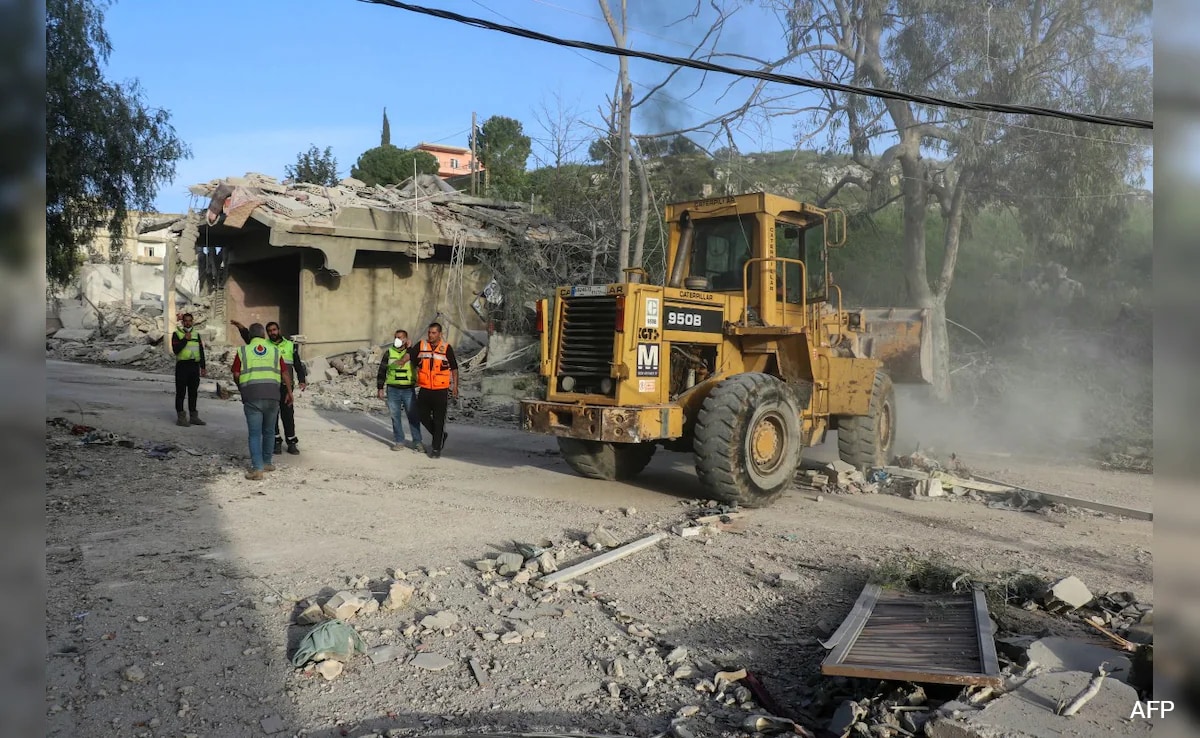
Consider the mechanics of a village like Mhaibib. This was not a site of a singular, frantic exchange of fire. Instead, satellite imagery and ground-level footage reveal a choreographed sequence of destruction. Explosives are set. A countdown is initiated. In a single, thunderous instant, centuries of domestic history—the wedding photos in the drawers, the hand-carved bedframes, the jars of preserved labneh in the pantries—are converted into a uniform grey powder.
The goal isn't just to remove a threat. It is to remove the possibility of return.
When you flatten a village, you aren't just destroying homes. You are destroying the infrastructure of life. You are tearing up the water pipes, the electrical grids, and the narrow goat paths that dictate how a community breathes. By the time the dust settles, the very "place-ness" of the place has evaporated. It becomes a blank slate. On that slate, a new reality is written: the outpost.
The Buffer of Broken Glass
Military strategists call this the creation of a "buffer zone." It sounds clinical. It sounds like a safety feature on a piece of heavy machinery. But for the people living on either side of the Blue Line, a buffer zone is a void.
The logic follows a cold, mathematical progression. If a village is three kilometers from the border and can provide cover for an anti-tank missile team, the logic dictates that the village must cease to exist. If the next village provides a vantage point, it, too, is added to the ledger of necessary erasures.
This is where the Gazan precedent becomes a haunting map for Lebanon. In Gaza, the creation of a "cleared" corridor along the border involved the demolition of thousands of structures to ensure a permanent line of sight for sensors and automated weapon systems. In Lebanon, the terrain is different—limestone cliffs instead of sand dunes—but the intent is a mirror image.
By leveling these frontier towns, the military creates a "kill zone" where any movement is visible, and any shadow is a target. It is a security model built on the total absence of the "other."
But what happens to the ghosts?
The Invisible Stakes of the Soil
The real cost of this strategy isn't measured in the price of the plastic explosives or the fuel for the bulldozers. It is measured in the permanent severance of a people from their land.
Land in this part of the world is not a commodity. It is an identity. When Amine looks at a pile of rubble that used to be his neighbor's house, he isn't just seeing a financial loss. He is seeing the end of a lineage. In the Mediterranean, you don't just own a house; you "belong" to it. You are the son of the man who built the terrace, the grandson of the woman who planted the fig tree.
When the village is replaced by a fortified outpost—a high-tech nest of concrete, cameras, and barbed wire—the landscape ceases to be a home and becomes a frontier. Outposts are lonely things. They are built for watching, not for living. They don't have bakeries. They don't have schools. They have an appetite for distance.
The "Gaza Playbook" suggests that once an outpost is established in a cleared zone, that zone becomes a permanent military landscape. It is a slow-motion annexation of space through the removal of everything that makes space human.
The Logic of the Uninhabitable
There is a specific kind of silence that follows a modern demolition. It isn't the quiet of a peaceful night. It’s the ringing, pressurized silence of a vacuum.
Strategists argue that this is the only way to ensure the safety of northern Israeli communities—to create a physical gap so wide and so barren that no infiltration is possible. They see it as a defensive necessity. From their perspective, the villages were no longer civilian centers but fortified hubs for a non-state actor.
This creates a terrifying paradox. To protect one set of homes, another set must be pulverized. To ensure the return of displaced families on one side, the displacement of families on the other side must be made irreversible.
The strategy treats the landscape as a chessboard, but the board is made of flesh and memory. If the playbook continues to its logical conclusion, the border will no longer be a line on a map. It will be a wide, desolate scar—a belt of rubble stretching from the sea to the mountains, where nothing grows and no one walks.
The Weight of the Dust
We often talk about war in terms of "wins" and "losses," as if it were a ledger that could be balanced. But how do you balance the loss of a village's name?
The technical term for this is "urbicide"—the killing of a city. Or, in this case, "ruricide"—the killing of the countryside. It is a way of winning a war by ensuring the enemy has nothing left to come back to. If there is no roof, there is no shelter. If there is no well, there is no life. If there is no village, there is no "enemy" to hide within it.
It is an effective tactic in the short term. It clears the field of fire. It provides a sense of absolute control. But it ignores the fundamental law of the human heart: a person who has lost everything has nothing left to fear.
As the bulldozers move and the outposts rise, the soil itself is being transformed. It is being packed down, hardened, and stripped of its history. The olive trees are uprooted, replaced by steel masts topped with rotating lenses that blink in the sun.
Somewhere in a crowded apartment in Beirut or a tent in the Bekaa Valley, a child is being told a story about a village that no longer exists. They are being told about the smell of the thyme and the way the light hit the ridge in the late afternoon. They are learning the names of the streets that are now just piles of white stone.
The outposts are made of concrete, but the memories are made of something much harder to demolish. A landscape can be cleared, but it can never be truly emptied. The silence of the new buffer zone isn't a peace; it is a long, held breath.
The dust from the fallen houses doesn't just settle on the ground. It gets into the lungs. It stays in the throat. It becomes the air that the next generation breathes.