The ink on a voter’s index finger in India is designed to do one thing. It refuses to wash off. Made with silver nitrate, that thin purple stripe reacts to ultraviolet light, staining the skin for weeks as physical proof that a citizen stood in a line, stepped behind a cardboard partition, and spoke to the state.
For decades, that stain was the ultimate equalizer. In a country where a billionaire in Mumbai and a landless brick-kiln worker in Bihar share the exact same constitutional weight, the electoral roll was supposed to be a sacred ledger.
Now, people are in the streets because they believe someone is taking an eraser to the book.
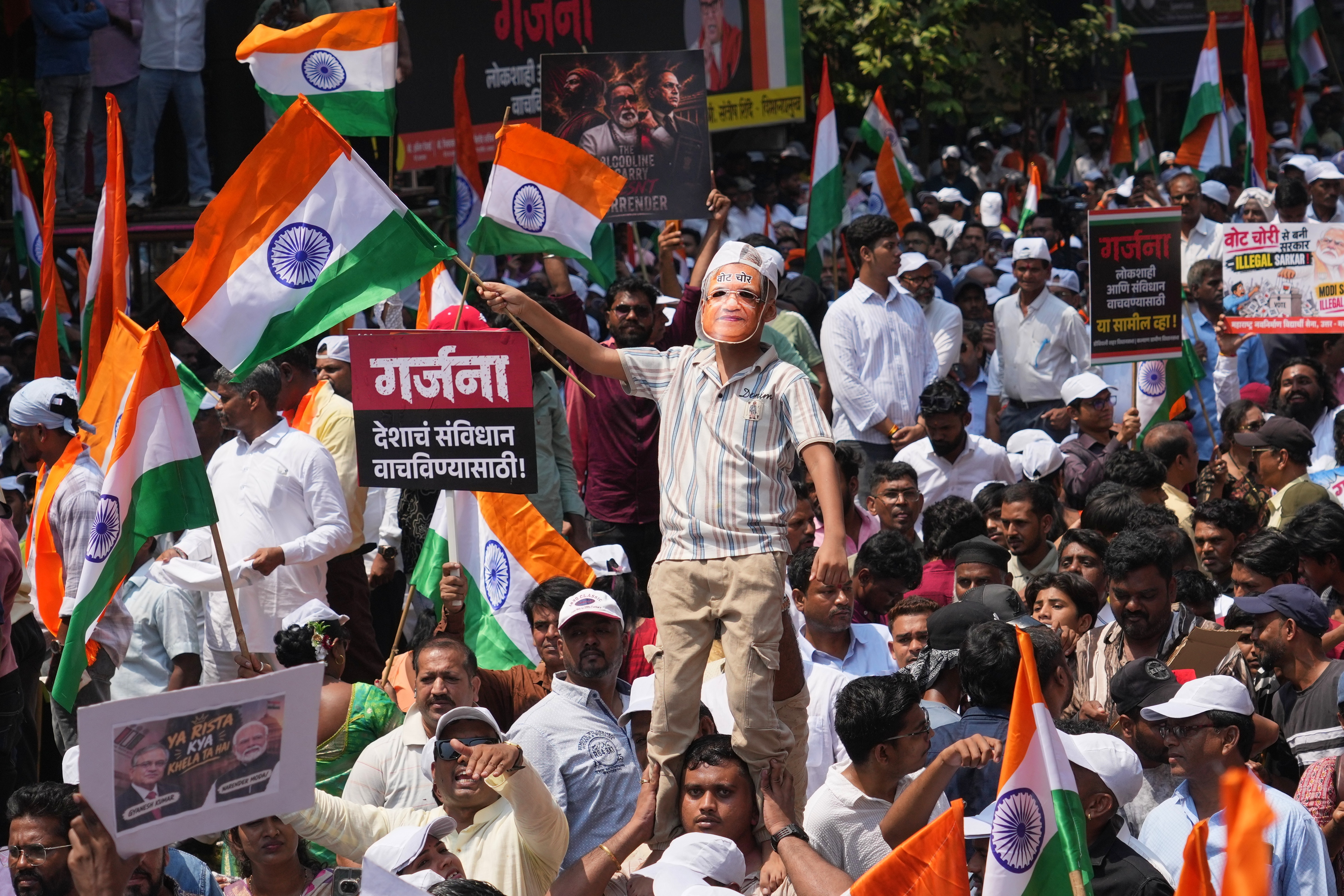
Across India—from the humid, banner-draped avenues of Kolkata to the dusty municipal offices of rural Maharashtra and the tense university gates of New Delhi—protests have erupted over sweeping revisions to the electoral rolls. To an outsider skimming the morning headlines, the dispute looks like a dry bureaucratic quarrel over database hygiene, address verification, and duplicate entries.
It is not.
When you strip away the administrative jargon, the nationwide protests in India over voter list changes are a fight over existence itself. In the world’s largest democracy, to disappear from the voter list is to become a ghost in your own country.
The Morning You Stop Existing
To understand why a spreadsheet update can bring thousands of people onto the asphalt under a blistering sun, step away from the policy papers and consider a hypothetical scenario.
Meet Ramesh. He is forty-two years old, a migrant mason who leaves his village in eastern Uttar Pradesh every October to build high-rises on the outskirts of Gurgaon. He sends money home through his phone, pays taxes every time he buys a packet of biscuits or a liter of diesel, and returns to his village every spring for the harvest and the elections.
One morning during a "Special Summary Revision"—the routine period when the Election Commission of India updates its rolls—a local Booth Level Officer knocks on the door of Ramesh’s ancestral home. Ramesh is six hundred miles away pouring concrete. His elderly mother is at the local clinic. The neighbor, confused or careless, mentions that Ramesh lives in the city now.
A box is ticked. A status is changed from present to shifted.
Months later, Ramesh takes a twenty-hour train ride home to cast his ballot. He brings his laminated voter ID card, the one with the slightly blurry black-and-white photograph he took twenty years ago. He stands in the queue outside the primary school. He reaches the table. The polling official runs a finger down the printed sheet, stops, and shakes his head.
Deleted.
Ramesh has not moved permanently. He has not broken a law. He has not surrendered his citizenship. Yet, with a single stroke of administrative editing, his constitutional voice has vanished. Multiply Ramesh by millions of seasonal laborers, married women who change surnames and villages, impoverished families without formal property deeds, and minority communities living in informal settlements, and you begin to feel the tremor beneath the current unrest.
The Machinery of the Ledger
How does a democracy of nearly a billion eligible voters maintain its list without losing people—or without letting fraud creep in?
Think of the Indian electoral roll not as a static stone tablet, but as a massive, breathing census that must be rebuilt every single year. People turn eighteen. People pass away. Millions move from villages to megacities in search of work. If the Election Commission never cleaned the rolls, dead citizens would linger on the sheets forever, creating an open invitation for impersonation and ballot stuffing.
Historically, this maintenance has been handled through a combination of house-to-house verification by Booth Level Officers—usually local schoolteachers or municipal workers—and digital cross-referencing. In recent years, the state has pushed aggressively to link voter ID cards with Aadhaar, India’s biometric national identity system, alongside new algorithmic deduplication software designed to flag identical names, photos, or addresses.
On paper, the goal sounds entirely reasonable. Clean lists. One person, one vote. Zero ghosts.
But algorithms do not walk down narrow alleyways. Software cannot tell the difference between a fraudulent duplicate entry and two brothers living in the same joint-family compound who share a common regional name. When automated systems purge "suspicious" entries at scale, or when local officials face intense pressure to hit deletion targets before an election cycle, the margin of error stops being a statistic. It becomes a disenfranchised neighborhood.
I remember standing outside a municipal ward office during a previous revision cycle, watching an elderly tailor argue with a clerk through a rusted iron grille. The tailor had voted in every single election since 1977. He held a stack of yellowing utility bills and old voter slips bound with a rubber band. The clerk barely looked up from his monitor, repeating a single phrase like a metronome: The system shows your record was removed during verification. Fill out Form 6 and wait.
The terror in that old man’s eyes was not about losing a partisan contest. It was the sudden, sickening realization that the burden of proof had flipped. The state no longer had to prove he didn't belong; he had to prove he was real.
Why the Streets Have Erupted Now
If voter list updates happen every year, why have the protests boiled over into a nationwide flashpoint right now?
Three volatile currents have collided at the exact same moment.
First is the sheer scale and timing of the deletions. Opposition parties, civil society groups, and independent data journalists analyzing public electoral rolls have pointed to sudden, statistically anomalous spikes in voter deletions across key battleground states. In several constituencies, the number of names struck off the rolls between election cycles rivaled—or even exceeded—the narrow victory margins of the previous races. When a parliamentary seat is won by four thousand votes, and ten thousand names quietly vanish from specific booths within that constituency, suspicion ceases to be paranoia. It becomes arithmetic.
Second is the quiet procedural shift in how citizens are notified. Under standard rules, a voter’s name is not supposed to be deleted without proper field verification and an opportunity to object. Protesters allege that in hundreds of wards, bulk deletion requests—submitted using Form 7, the official application for objecting to an inclusion—were processed without genuine doorstep checks. Imagine waking up to discover a stranger filed paperwork claiming you no longer live in your own house, and the bureaucracy took their word over yours.
Third, and perhaps most explosive, is the entanglement of the voter list with deeper anxieties over citizenship and belonging. Over the past decade, debates surrounding the National Register of Citizens and the linkage of welfare benefits to biometric databases have left marginalized communities hyper-aware of how easily paperwork can be weaponized. For low-income families, minorities, and internal migrants, the voter card is more than a ticket to the polling booth. It is the foundational document that anchors their right to subsidized grain, housing schemes, and legal standing. Threaten the voter list, and you threaten their roof and their rations.
The Anatomy of a Bureaucratic Blind Spot
To understand the fury of the demonstrators, you have to understand the asymmetry of Indian paperwork.
If you live in an affluent gated community in Bengaluru or South Delhi, correcting an error on the electoral roll takes ten minutes on a smartphone app. You upload a scanned copy of your passport or utility bill, track your application status online, and receive an SMS confirmation.
Now imagine you live in a flood-prone riverbank settlement in Assam, a sprawling slum cluster in Mumbai, or a temporary construction camp outside Hyderabad. Your home has no formal street number. Your landlord refuses to give you a written lease to avoid property taxes. You work twelve hours a day, six days a week, and losing a single day’s wage to stand in line at a sub-divisional magistrate’s office means your family skips meals.
When the electoral system demands digital literacy, formal proof of residence, and repeated in-person hearings to reinstate a deleted name, it creates an invisible wall. Nobody needs to lock the doors of the polling station to keep the poor out. You simply make the paperwork heavy enough that they cannot carry it.
During the recent demonstrations, protesters have carried oversized cardboard replicas of Form 6—the application required to add a name back to the roll—alongside torn-up voter IDs. Their chants are pointedly simple: We exist. Count us.
Inside the Echo Chamber of Blame
Of course, the institutions at the center of the storm tell a vastly different story, and dismissing their perspective entirely misses half the tragedy.
Election officials argue, with genuine frustration, that they are trapped in an impossible bind. If they leave outdated names on the rolls, political parties accuse them of enabling bogus voting and rigging outcomes. If they aggressively scrub the rolls to remove deceased voters and duplicate entries, those exact same political parties accuse them of mass disenfranchisement.
There is truth in this. India’s rapid urbanization has scrambled its demographic map faster than any manual filing system can track. Tens of millions of people genuinely do live in two places at once—registered in their ancestral village while residing in a rented room in a metropolis. Removing an authentic duplicate entry is not an attack on democracy; it is basic maintenance.
Yet, institutional defensiveness has often made the crisis worse. Rather than releasing granular, booth-level audit trails showing why specific names were deleted—and holding officials accountable when bulk deletions bypass field verification—authorities have frequently met public outrage with blanket denials and opaque technical explanations.
In a democracy, trust is not built by demanding faith in the machine. Trust is built by opening the hood and letting the public inspect the gears.
What Happens When the Ink Fades
History offers a blunt warning about what happens when citizens begin to doubt the integrity of the electoral ledger.
Democracy does not usually collapse in a single dramatic night of tanks and curfews. More often, it erodes through a slow, grinding loss of legitimacy. When millions of people believe the rules of entry are tilted—when a mother in a working-class neighborhood watches her neighbors get scrubbed from the rolls while affluent colonies remain untouched—the social contract frays.
People stop seeing elections as a peaceful arena for resolving conflict and start seeing them as a rigged performance.
The protesters filling the streets today are, ironically, demonstrating a fierce, stubborn faith in the very system they are criticizing. You do not risk arrest, tear gas, and lost wages to fight for a place on a voter list unless you still believe your vote carries power. Their anger is a form of civic devotion. They are demanding the right to participate in the argument that decides their future.
The Path Back to the Ledger
Resolving this crisis does not require inventing a brand-new electoral architecture. The safeguards already exist in Indian law; they simply need to be enforced with radical transparency rather than bureaucratic convenience.
First, every deletion must be auditable and reversible at the doorstep. If an algorithm flags a duplicate or a Booth Level Officer marks a resident as shifted, the burden of verification belongs to the state, not the citizen. Physical notices—written in the local language, not dense legalese—must be delivered and publicly posted at the neighborhood polling station months before final publication, giving communities time to verify their own neighbors.
Second, India must solve the migrant paradox. A nation powered by internal migration cannot continue punishing workers for moving to find jobs. Expanding remote voting mechanisms or allowing seamless, verified constituency transfers without stripping families of their rural protections would eliminate millions of disputed entries overnight.
Finally, independent third-party audits of pre-election roll revisions must become standard practice. When civil society watchdogs, journalists, and all political parties can examine the exact criteria behind large-scale deletions in real time, rumors die in the sunlight.
Until that happens, the tension humming beneath India’s streets will not dissipate.
Think back to that tiny bottle of purple ink waiting inside every polling booth across the subcontinent. For over seventy-five years, through wars, famines, emergencies, and seismic political shifts, that stain on a finger has been a quiet miracle—a covenant between a sprawling, chaotic nation and its ordinary people. It says: You are here. You matter. You cannot be erased.
A pencil mark on a ledger can be rubbed out in seconds. The people marching outside the election offices are making sure the state remembers that citizens are not written in graphite.